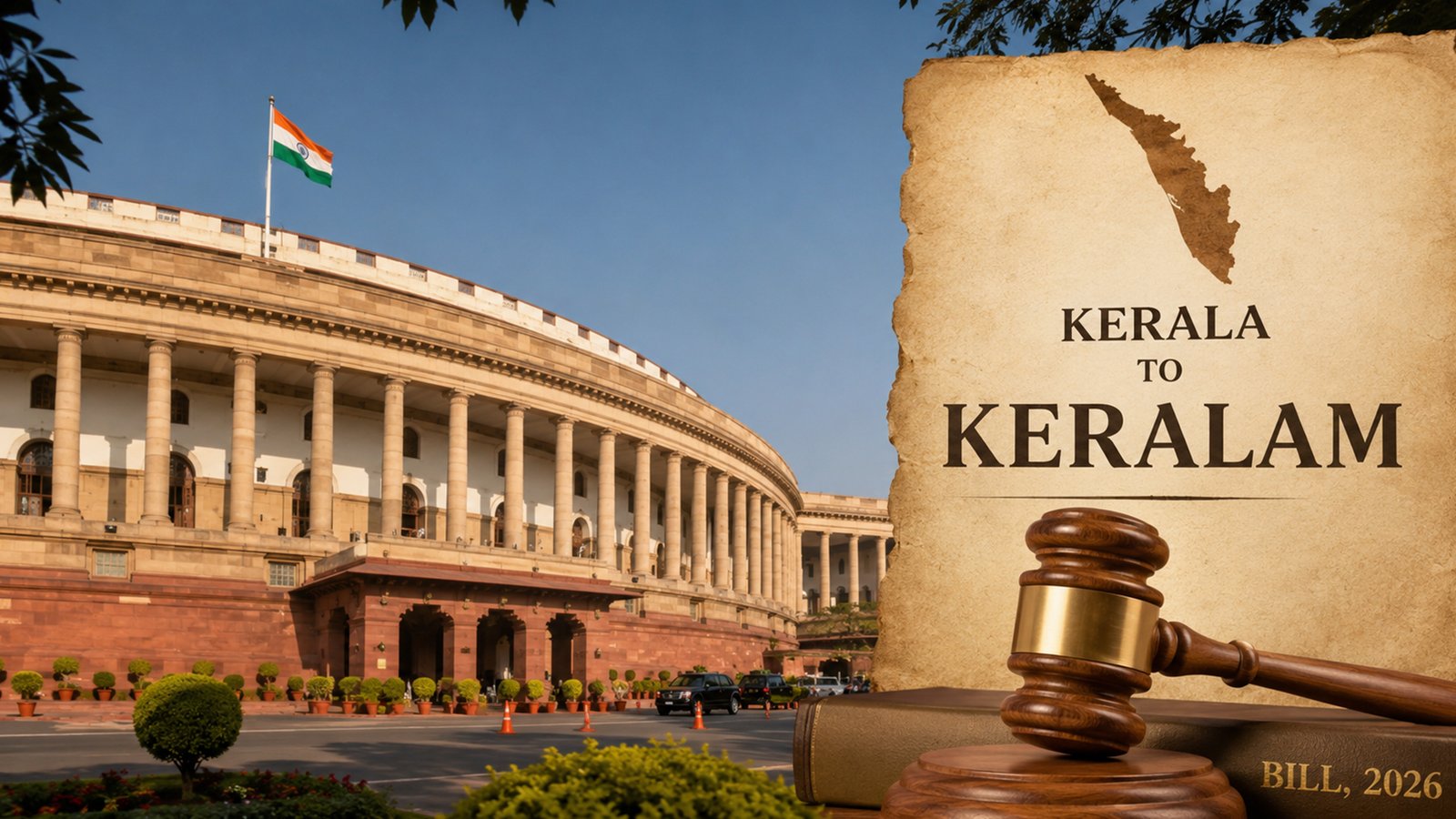
Kerala moved closer to officially becoming “Keralam” on Monday as the Union government brought the proposed name-change legislation before the Lok Sabha, taking the long-pending demand into the parliamentary process.
Union Home Minister Amit Shah is scheduled to introduce the Kerala (Alteration of Names) Bill, 2026, which seeks to change the official name of the state from Kerala to Keralam. The move follows a series of steps that began with resolutions passed by the Kerala Legislative Assembly and the Union Cabinet’s approval earlier this year.
The proposed name, Keralam, is the Malayalam name commonly used for the state. The Kerala Assembly had unanimously sought the change, arguing that the name “Keralam” reflects the state’s linguistic and cultural identity more accurately.
The Assembly passed a resolution on June 24, 2024, requesting the Centre to amend the First Schedule of the Constitution and replace “Kerala” with “Keralam”. The resolution followed an earlier attempt in 2023 and was subsequently examined by the Union government.
The Union Cabinet approved the proposal in February 2026, clearing the way for the next stage of the constitutional process. The President was then required to refer the proposed legislation to the Kerala Assembly for its views before the Bill could proceed to Parliament.
The proposed legislation is significant because changing the official name of a state requires parliamentary action under Article 3 of the Constitution. Parliament has the power under the provision to alter the name of an existing state.
The name-change process, therefore, is not simply an administrative exercise. Once the Bill completes the parliamentary process and receives presidential assent, the change will have to be reflected in the First Schedule of the Constitution.
The proposed change has also gained political attention in Kerala. BJP state president Rajeev Chandrasekhar described the introduction of the Bill as a historic moment for the state and said it represented an important step towards recognising Kerala’s linguistic and cultural identity.
For supporters of the proposal, “Keralam” is more than a change in spelling. They argue that it is the name used by Malayalam speakers and therefore better represents the state’s identity. Kerala was formed as a Malayalam-speaking state on November 1, 1956, following the reorganisation of states on linguistic lines.
The name-change Bill is being taken up alongside another important piece of legislation concerning the cooperative sector.
Amit Shah is also scheduled to introduce a Bill aimed at expanding the financing powers and scope of the National Cooperative Development Corporation (NCDC). The NCDC is a statutory corporation under the Ministry of Cooperation and provides financial assistance for cooperative-sector development.
The proposed expansion comes as the Centre continues to strengthen the cooperative sector and improve access to institutional finance. NCDC supports cooperatives involved in areas including agriculture, dairy, fisheries, handloom, poultry and other income-generating activities.
The corporation currently provides loans and grants to state governments for financing primary and secondary-level cooperative societies. It can also provide direct assistance to national-level cooperatives and other societies whose operations extend beyond one state.
The Centre has already taken steps to increase the flow of bank credit through NCDC. In January 2026, the Reserve Bank of India allowed loans sanctioned by eligible banks to NCDC for onward lending to cooperative societies to qualify under the Priority Sector Lending (PSL) framework, subject to applicable conditions.
The move is expected to create an additional channel of funding for cooperative institutions, particularly those working in agriculture and related sectors.
The two Bills therefore cover very different areas. The Kerala name change Bill deals with the constitutional identity of a state, while the NCDC legislation focuses on expanding financial support for cooperatives.
For Kerala, however, the name-change legislation carries a distinct cultural and political significance. The demand has been discussed for years, with successive resolutions from the state Assembly seeking recognition of “Keralam” as the official name.
The proposed change will not take effect merely because the Bill has been introduced in the Lok Sabha. It must still go through the parliamentary process and receive presidential assent before the official name can be changed.
The development nevertheless marks an important step in a process that began with a state-level resolution and eventually received Union Cabinet approval.
If Parliament approves the legislation, government departments and official institutions will subsequently have to implement the new name in their records and documents according to the applicable legal and administrative process.
The Lok Sabha’s consideration of the Bill has therefore brought the decades-old linguistic and cultural question into a decisive legislative phase. For supporters, the proposed transition from Kerala to Keralam represents a formal recognition of the name the state has long been known by in Malayalam.
The coming parliamentary proceedings will determine whether that proposed identity becomes the state’s official constitutional name.