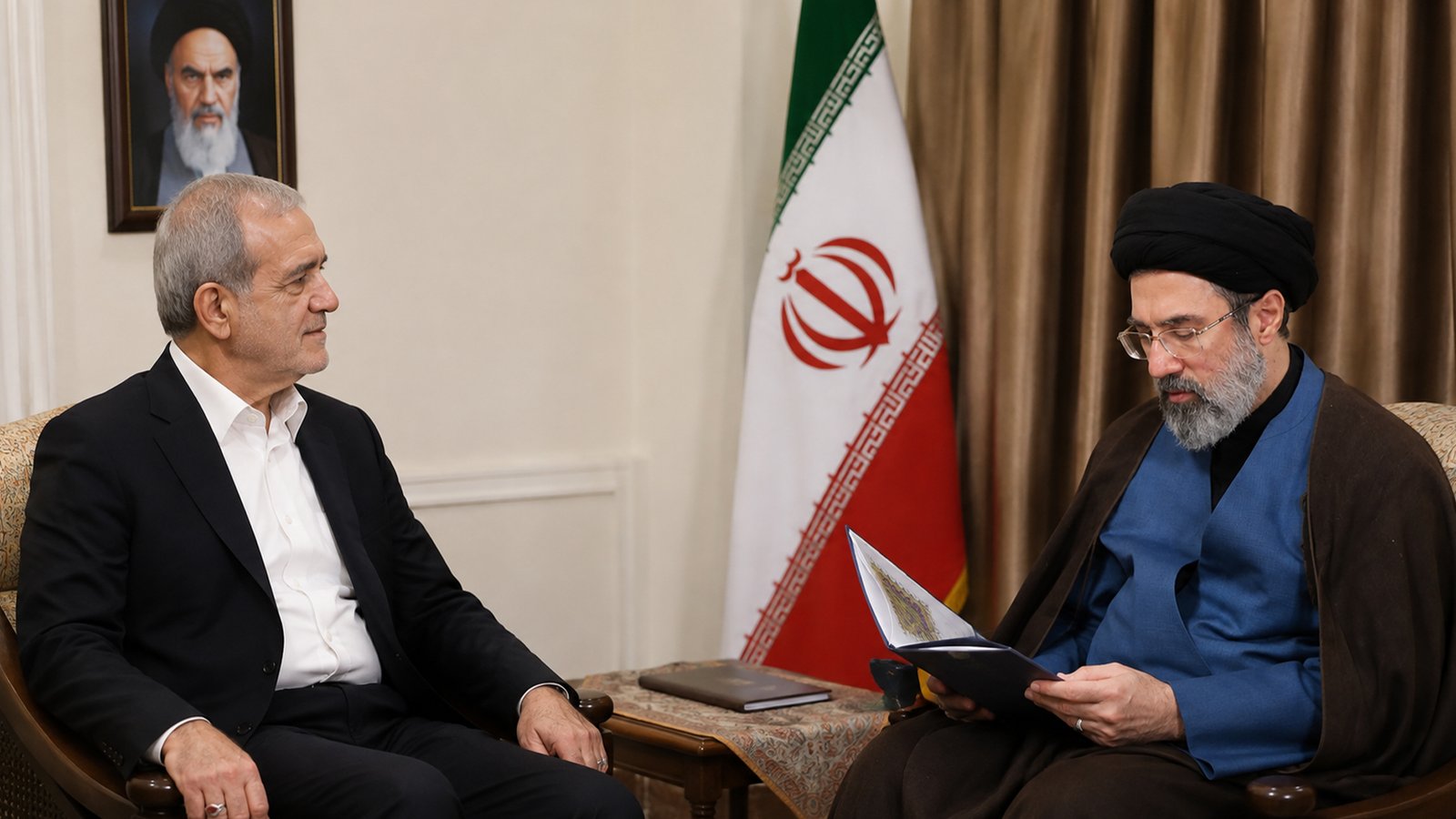
Iranian President Masoud Pezeshkian has met Supreme Leader Mojtaba Khamenei, according to Iranian state media, as renewed questions continue over the health and prolonged public absence of the country’s top leader.
The meeting reportedly took place in late July but was only highlighted publicly amid growing speculation about Khamenei’s condition. The timing has attracted attention because the Supreme Leader has made very few public appearances since taking office in March following the death of his father, Ayatollah Ali Khamenei.
The Iranian leadership has repeatedly rejected reports that Mojtaba Khamenei is seriously ill. Officials have maintained that he remains in control of the country and continues to conduct official duties, although details about his activities have been limited.
The latest meeting with Pezeshkian is therefore being seen as an effort to demonstrate that the Supreme Leader remains active in Iran’s political and state affairs. However, no detailed account of the meeting or its location has been publicly provided.
The announcement came as speculation over Khamenei’s health intensified following months in which he has largely remained out of public view. Iranian authorities have faced growing pressure to provide evidence of his activities and physical condition.
Iranian officials have said that security concerns are one reason for limiting images and public appearances involving the Supreme Leader. His office has also rejected claims circulating online about his health.
Pezeshkian has previously spoken about communicating with Khamenei, but the circumstances surrounding those interactions have remained unclear. In recent months, the president has indicated that maintaining contact with the Supreme Leader has at times been difficult.
The latest reported meeting is significant because the Iranian Supreme Leader holds the country’s highest political and religious authority. The position has influence over the armed forces, foreign policy and several key state institutions, making the leader’s health and ability to govern an issue of major importance.
Khamenei became Supreme Leader in March after his father was killed in strikes on Iran. His succession marked a major change in Iran’s leadership at a time of intense regional tensions and military confrontation.
Since taking office, however, the younger Khamenei has largely avoided public appearances. His limited visibility has fuelled speculation about his health, with reports ranging from claims of serious illness to allegations that he suffered injuries during the strikes that killed his father.
Iranian authorities have consistently disputed the more serious claims.
The latest development comes alongside an apparent effort by Iranian officials to show that Khamenei remains involved in decision-making. Iranian media recently released a short, undated video that appeared to show him speaking with a group of people. The footage did not establish when or where it was recorded.
Iranian officials have also indicated that additional footage could be released showing the Supreme Leader in public and during meetings with military commanders. The move appears aimed at countering speculation surrounding his absence from public life.
The government’s handling of the issue has nevertheless raised questions about transparency. With Khamenei occupying the most powerful political position in Iran, uncertainty over his health has broader implications for the country’s political stability and decision-making process.
The meeting with Pezeshkian also comes against the backdrop of major domestic and foreign-policy challenges. Iran continues to deal with economic pressures, international tensions and security concerns linked to the wider Middle East conflict.
The president and Supreme Leader occupy different positions within Iran’s political system. While Pezeshkian heads the elected government, the Supreme Leader has ultimate authority over several crucial areas, including the armed forces and strategic national policy.
That division makes communication between the two leaders particularly important. Any prolonged disruption in contact could potentially affect how major decisions are coordinated across the Iranian state.
Iranian officials have sought to project unity within the leadership despite the speculation surrounding Khamenei. The latest announcement appears consistent with that approach, presenting the Supreme Leader as actively engaged with the president.
At the same time, the lack of recent live public appearances means questions about Khamenei’s health are unlikely to disappear immediately. The release of undated footage may offer some reassurance to supporters, but it does not independently establish his current physical condition.
For now, there is no confirmed public evidence establishing that Khamenei is suffering from a critical illness. Reports about his health remain contested, while Iranian authorities continue to insist that he is carrying out his responsibilities.
The meeting with Pezeshkian is consequently important less for what is known about its contents than for what it signals about Iran’s leadership. It suggests an effort to demonstrate continuity at the highest level of government while speculation continues over the Supreme Leader’s health and public absence.
As Iran navigates political, economic and security challenges, the visibility and functioning of its Supreme Leader will remain closely watched both inside the country and abroad.