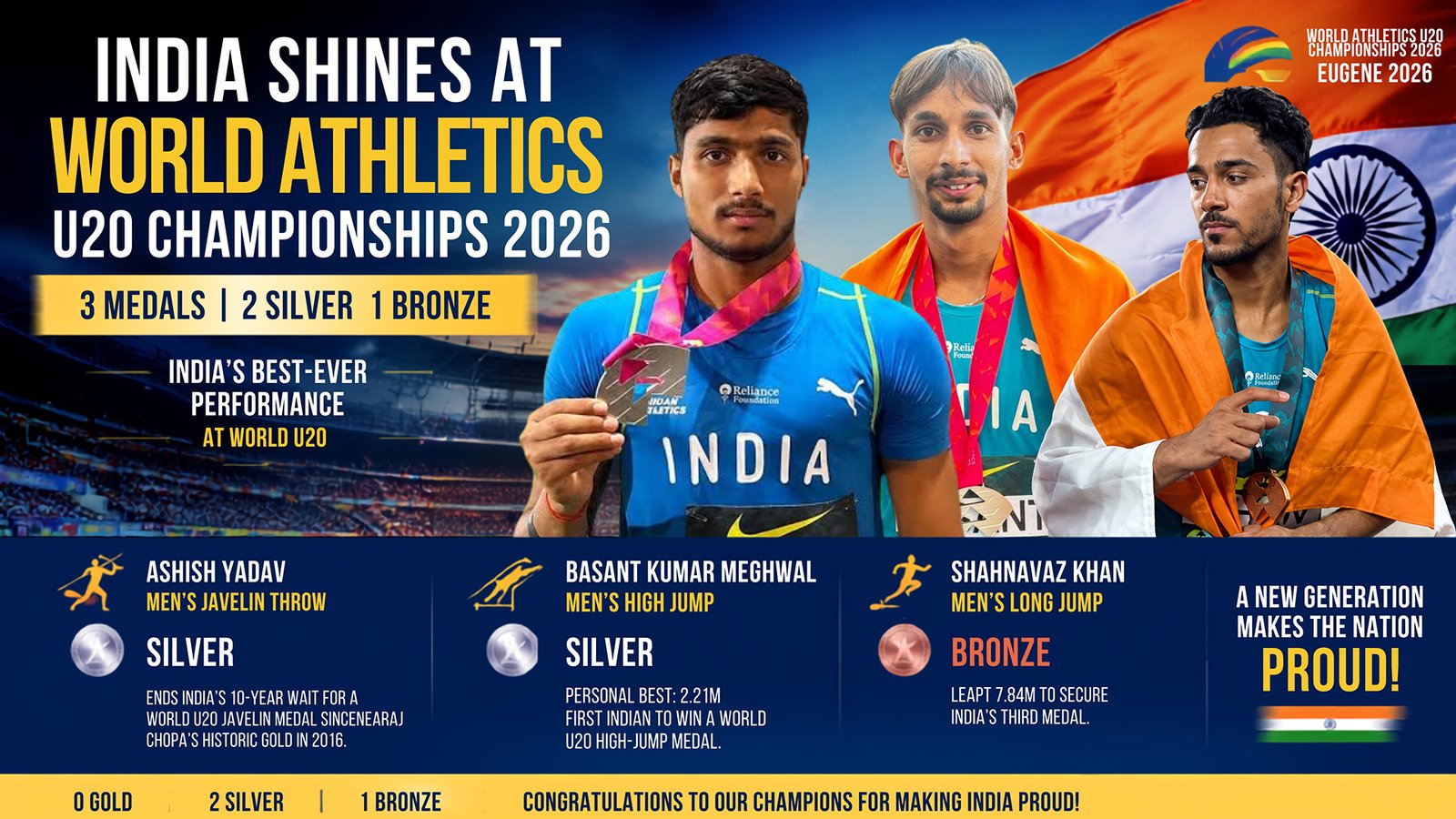
India signed off from the World Athletics U20 Championships 2026 in Eugene, Oregon, with three medals, completing one of its strongest campaigns at the global junior athletics event.
The Indian team returned with two silver medals and one bronze, matching the country’s best-ever medal tally at the World U20 Championships. The haul was built around memorable performances in the men’s javelin throw, high jump and long jump.
The breakthrough performances came from Ashish Yadav, Basant Kumar Meghwal and Shahnavaz Khan, who each secured a place on the podium in field events.
Ashish opened India’s medal account with silver in the men’s javelin throw. His performance was particularly significant because it made him only the second Indian athlete to win a javelin medal at the World U20 Championships after Neeraj Chopra.
Chopra had won gold in the event a decade ago, setting the foundation for India’s growing reputation in javelin. Ashish’s silver has now added another chapter to that history and highlighted the emergence of a new generation of Indian throwers.
Ashish’s journey has also drawn attention because of his modest beginnings. The youngster from Mawaiya in Uttar Pradesh reportedly trained in difficult conditions, including practising with a wooden javelin near dry ponds. His progress from those surroundings to a global junior podium reflects the depth of talent emerging from India’s smaller towns and villages.
Basant Kumar Meghwal then produced another historic performance in the men’s high jump.
The 19-year-old from Rajasthan cleared 2.21 metres, matching his personal best, to win the silver medal. More importantly, he became the first Indian athlete to win a high jump medal at the World Athletics U20 Championships.
Basant’s result was especially notable because he cleared the same height as eventual champion Younes Ayachi of Algeria. The Algerian athlete took gold after clearing 2.21m with fewer attempts, while Basant secured silver.
His performance also underlined the progress being made in Indian high jump. India has traditionally been stronger in events such as javelin, long jump and sprinting, making Basant’s achievement an important development for the discipline.
Shahnavaz Khan completed India’s medal-winning trio with bronze in the men’s long jump.
The Indian jumper produced a best effort of 7.84 metres, becoming the first Indian man to win a long jump medal at the World U20 Championships. His achievement came several years after Shaili Singh won silver in the women’s long jump at the 2021 edition.
The three medals also showed the breadth of India’s field-event talent. Rather than depending on one discipline, the country found success across javelin, high jump and long jump.
The results are particularly encouraging because the World Athletics U20 Championships serve as an important platform for athletes who are expected to move into senior international competition. Performances at this level can provide both confidence and experience before athletes begin competing regularly against senior opposition.
India’s campaign was not without disappointment. High jumper Pooja Singh, who had arrived with strong expectations, finished seventh in the women’s final and narrowly missed a podium place. Her result nevertheless came after a strong qualifying campaign and added to India’s presence in the field events.
The Indian contingent’s overall showing also reflected the country’s growing emphasis on developing young athletes. Training centres, national competitions and junior international exposure have increasingly provided athletes from different parts of India with opportunities to compete at higher levels, strengthening the pipeline of talent across Indian sports.
The performance in Eugene also carries significance beyond the medal table. India has often relied heavily on a small group of established stars at major athletics competitions. The emergence of young medal winners provides evidence that the talent pool is gradually becoming broader.
Neeraj Chopra, India’s Olympic and world champion javelin thrower, welcomed the performances of the young athletes and urged the athletics community to build on the momentum. His success has played a major role in inspiring a new generation of Indian javelin throwers, and Ashish’s silver is another indication of that influence.
For Basant and Shahnavaz, meanwhile, their achievements have opened new possibilities in events where India has historically had fewer global podium finishes.
The medal tally also places India’s 2026 campaign among its strongest performances at the World Athletics U20 Championships. The three-medal haul of two silver and one bronze matches the country’s best return at the competition, reinforcing the steady progress of Indian junior athletics.
India leaves the World Athletics U20 Championships with three medals and three young athletes who have already made history. Their performances have added fresh momentum to Indian athletics and offered a glimpse of the talent that could shape the country’s next generation on the global track and field stage.