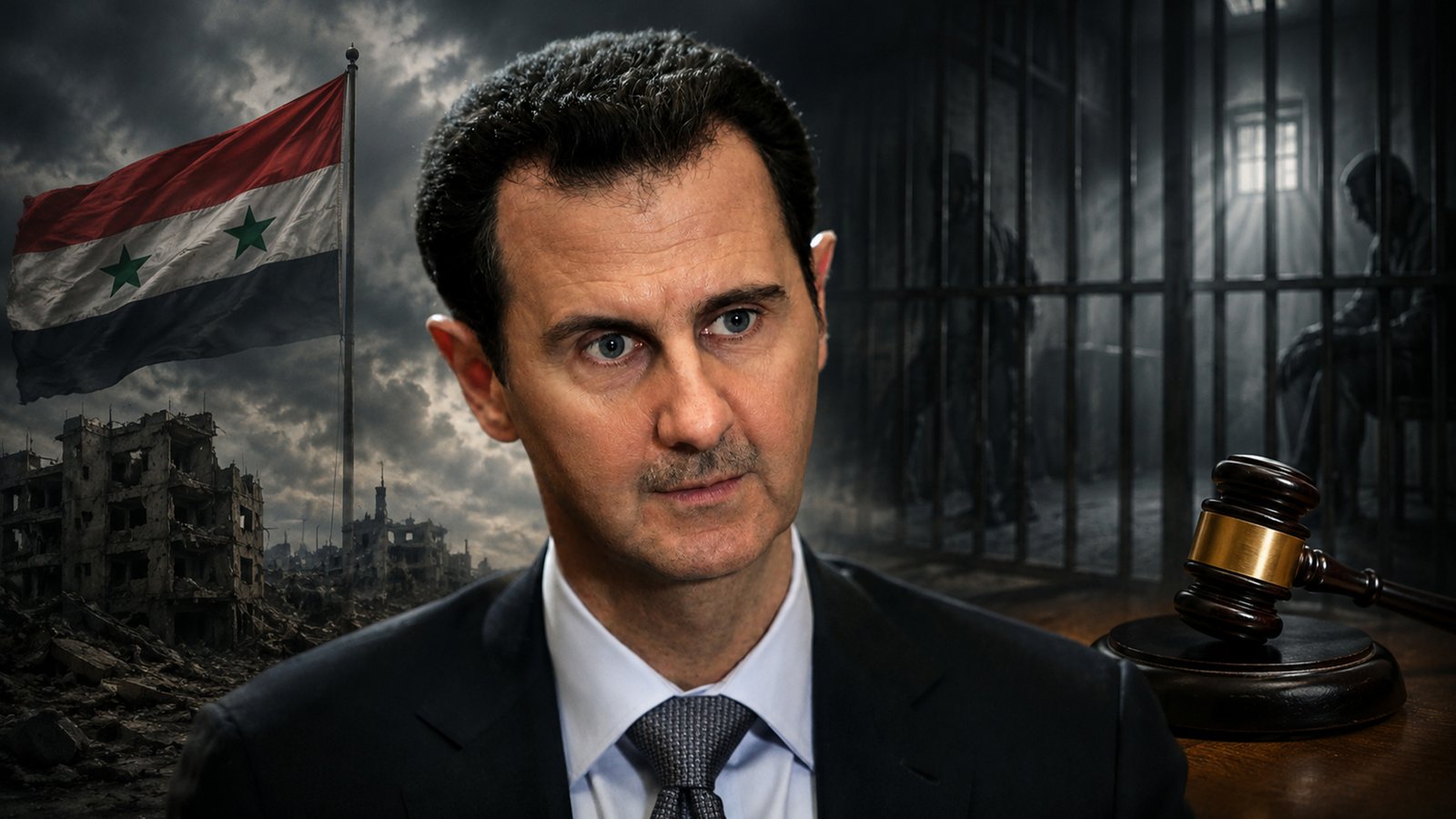
A Syrian court has sentenced former president Bashar al-Assad and his younger brother Maher al-Assad to death in absentia over war crimes and crimes against humanity committed during Syria’s devastating civil war. The ruling marks a major moment in the country’s efforts to hold senior figures of the former regime accountable for violence that killed about 500,000 people over nearly 14 years.
The death sentences were issued by a Syrian court on Tuesday. Bashar al-Assad, who ruled Syria from 2000 until his government was overthrown in December 2024, was convicted of charges including premeditated murder, torture, arbitrary detention and crimes against humanity. His brother Maher, who commanded Syria’s elite Fourth Division and was regarded as one of the regime’s most powerful security figures, was sentenced alongside him.
Neither of the Assad brothers was present in court. They fled to Moscow after a lightning rebel offensive toppled the Assad government in December 2024. Russia, which had been a major military and political supporter of the Assad regime during the civil war, has so far resisted requests to extradite the brothers. The Syrian authorities have said they will continue pursuing international legal avenues to bring them before the country’s justice system.
The court also sentenced Atef Najib, Bashar al-Assad’s cousin and former head of political security in Daraa, to death. Unlike the Assad brothers, Najib was present during the proceedings after being arrested in Syria.
Najib’s case is closely connected to the beginning of the Syrian uprising in 2011. He was accused of being responsible for the torture of 15 schoolboys who had written anti-Assad slogans on a wall in Daraa. Their detention and alleged abuse became one of the incidents that helped ignite protests in the southern province before demonstrations spread across Syria.
The trial has been presented by Syria’s new authorities as an important step towards transitional justice. The government has been trying to establish accountability for abuses committed under the former regime while also dealing with continuing political, sectarian and security tensions across the country.
For many Syrians, the verdict carries a significance beyond the punishment itself. Families of people who were killed, detained or tortured during the Assad era have spent years seeking recognition and accountability. The court proceedings have provided an opportunity for some of those allegations to be formally examined within Syria.
However, the practical impact of the death sentence against Bashar al-Assad remains uncertain because he is outside Syria. Moscow’s refusal to hand him over means that the verdict is unlikely to result in his immediate arrest or execution. The same issue applies to Maher al-Assad.
The ruling therefore has both a legal and symbolic dimension. It establishes that Syria’s new authorities are prepared to prosecute the country’s former leadership, but enforcing the sentence will depend heavily on international cooperation and Russia’s future position.
The Assad family’s rule was marked by an extensive security apparatus that was used against political opponents and civilians. When peaceful protests began in 2011, the government’s response quickly became violent. Arrests, torture, bombardment and other forms of repression helped turn the uprising into a full-scale conflict involving government forces, rebel groups, jihadist organisations and foreign powers.
The conflict eventually drew military intervention from Russia and Iran in support of Assad, while the United States, Turkey and other countries backed different opposition groups or conducted operations against extremist organisations. The war fragmented Syria and displaced millions of people both inside the country and abroad.
Assad remained in power for years despite international pressure, but his government collapsed rapidly in December 2024 when rebel forces advanced on Damascus. The former president and his brother subsequently escaped to Russia.
The fall of the Assad regime opened a new chapter for Syria but did not immediately end violence. The country has continued to experience clashes and sectarian tensions. According to the Guardian, around 1,500 mostly Alawite civilians were killed during retaliatory violence in March 2025 following attacks by Assad loyalists on security forces. More than 1,700 people were also killed in violence in the Druze-majority province of Suweida in July 2025.
These episodes have complicated efforts by Syria’s new leadership to build a functioning political system and prevent revenge attacks. Transitional justice has consequently become an important part of the government’s attempt to address the legacy of the Assad era while avoiding further communal conflict.
The death sentences also raise questions about the use of capital punishment in cases involving war crimes and crimes against humanity. International justice mechanisms have historically relied heavily on imprisonment rather than execution, and some experts have argued that capital punishment can complicate efforts to secure international cooperation or extradition.