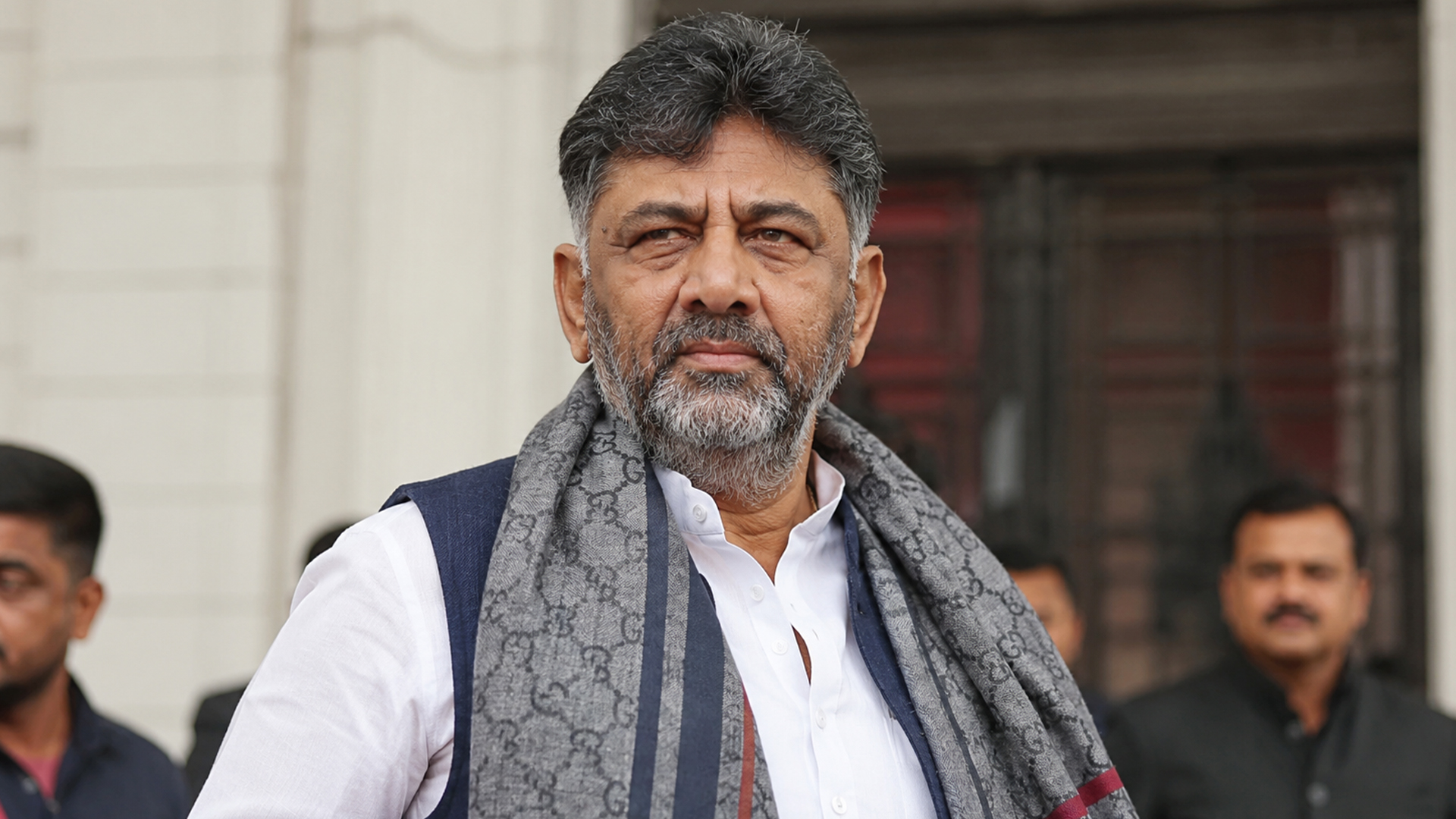
Karnataka Chief Minister D.K. Shivakumar has allocated portfolios to 23 ministers, ending weeks of uncertainty within the Congress government just before the state legislature’s monsoon session. The portfolio distribution, announced on Wednesday, also brings several changes for senior ministers and assigns important departments to 19 recently inducted ministers.
Shivakumar has retained some of the government’s most influential portfolios, including Finance, Cabinet Affairs, Personnel and Administrative Reforms, Intelligence, Information, Law and Justice, and Parliamentary Affairs and Legislation. He will also continue to oversee Agriculture Marketing, Town and Country Planning, and urban local bodies under the Bengaluru Development Authority and Bengaluru Metropolitan Region Development Authority.
The Finance portfolio is particularly important as the government manages its spending commitments, development programmes and welfare schemes. Shivakumar will also hold portfolios that have not been allocated to other ministers.
Among the major changes, senior Congress leader R. Ramalinga Reddy has been moved from Major and Medium Irrigation to Forest, Ecology and Environment. Reddy had earlier sought a change in his portfolio after being assigned irrigation responsibilities in June.
N. Chaluvarayaswamy, who had served as Agriculture Minister under the previous Siddaramaiah government, will now take charge of Major and Medium Irrigation. Agriculture has gone to Narendra Swamy, one of the newly inducted ministers.
U.T. Khader, who already held Health and Family Welfare, has been given additional responsibility for Minority Welfare, Haj and Wakf. B.Z. Zameer Ahmed Khan will continue to handle Housing.
K.H. Muniyappa has been assigned Social Welfare, a department he had reportedly been seeking. He was previously handling Food and Civil Supplies. That department has now gone to Rizwan Arshad, who will also look after Consumer Affairs.
The allocation gives several first-time ministers important responsibilities. Rizwan Arshad has been given Food, Civil Supplies and Consumer Affairs, while Narendra Swamy gets Agriculture. H.C. Balakrishna will handle Municipal Administration and K.M. Shivalingegowda has been given Excise.
Dr Ajay Singh has been assigned Minor Irrigation along with Science and Technology. T. Raghumurthy will handle Scheduled Tribes Welfare, while K.S. Basavanthappa gets Muzrai, Fisheries, Ports and Inland Water Transport.
Vijayanand Kashappanavar has been given Small Scale Industries and Public Enterprises, while Rudrappa Lamani will oversee Sugar and Textiles.
Several ministers have retained their existing portfolios, providing continuity in key areas. Santosh Lad will continue with Labour and Employment, S.S. Mallikarjun with Mines and Geology and Horticulture, Madhu Bangarappa with Primary and Secondary Education, and Shivaraj Tangadagi with Backward Classes Welfare and Kannada and Culture.
Basavaraj Raya Reddy returns to Higher Education, a department he handled during the Siddaramaiah government between 2013 and 2018. Former deputy chief minister Laxman Savadi has been assigned Cooperation, excluding Agriculture Marketing.
C.S. Puttaranga Shetty will handle Animal Husbandry and Sericulture, while B. Nagendra has been given Planning and Statistics.
The portfolio allocation follows weeks of internal discussions within the Karnataka Congress. The ministry took nearly two months to expand after Shivakumar and the first group of 13 ministers were sworn in on June 3. Nineteen ministers were later inducted, increasing pressure on the party leadership to distribute departments while managing competing demands from legislators.
The delay had also created frustration among Congress MLAs who were left out of the expanded Cabinet. Shivakumar had held discussions with the Congress high command in Delhi as the party attempted to manage dissatisfaction and avoid further divisions.
The Chief Minister eventually decided against an immediate reshuffle. Instead, the government proceeded with the portfolio allocation while leaving the possibility of further changes open after the monsoon session.
The question of greater representation for women also remains unresolved. Congress leaders Laxmi Hebbalkar, Annapoorna E. Thukaram and Kaneez Fathima were among those considered for induction. However, the issue has been deferred for now, with a possible reshuffle to be considered later.
The timing of the decision gives the ministers clearer responsibilities as the Karnataka Assembly begins its monsoon session. Ministers will now be expected to answer questions on their departments, defend government policies and respond to opposition criticism on issues ranging from infrastructure and irrigation to education, welfare and public finances.
For Shivakumar, keeping Finance and several other key departments gives him direct control over important areas of administration. At the same time, the distribution of major portfolios among senior leaders and newly inducted ministers gives the expanded Cabinet a clearer division of responsibilities.
The latest Karnataka Cabinet portfolio allocation is therefore more than an administrative exercise. It reflects the Congress leadership’s attempt to balance experience, political demands and administrative priorities while keeping the government focused on its legislative agenda.
With the monsoon session now underway, attention will shift from the internal negotiations over portfolios to the performance of individual ministers and the government’s ability to deliver on its commitments. The possibility of another reshuffle, particularly to address demands for wider representation, remains open after the session.