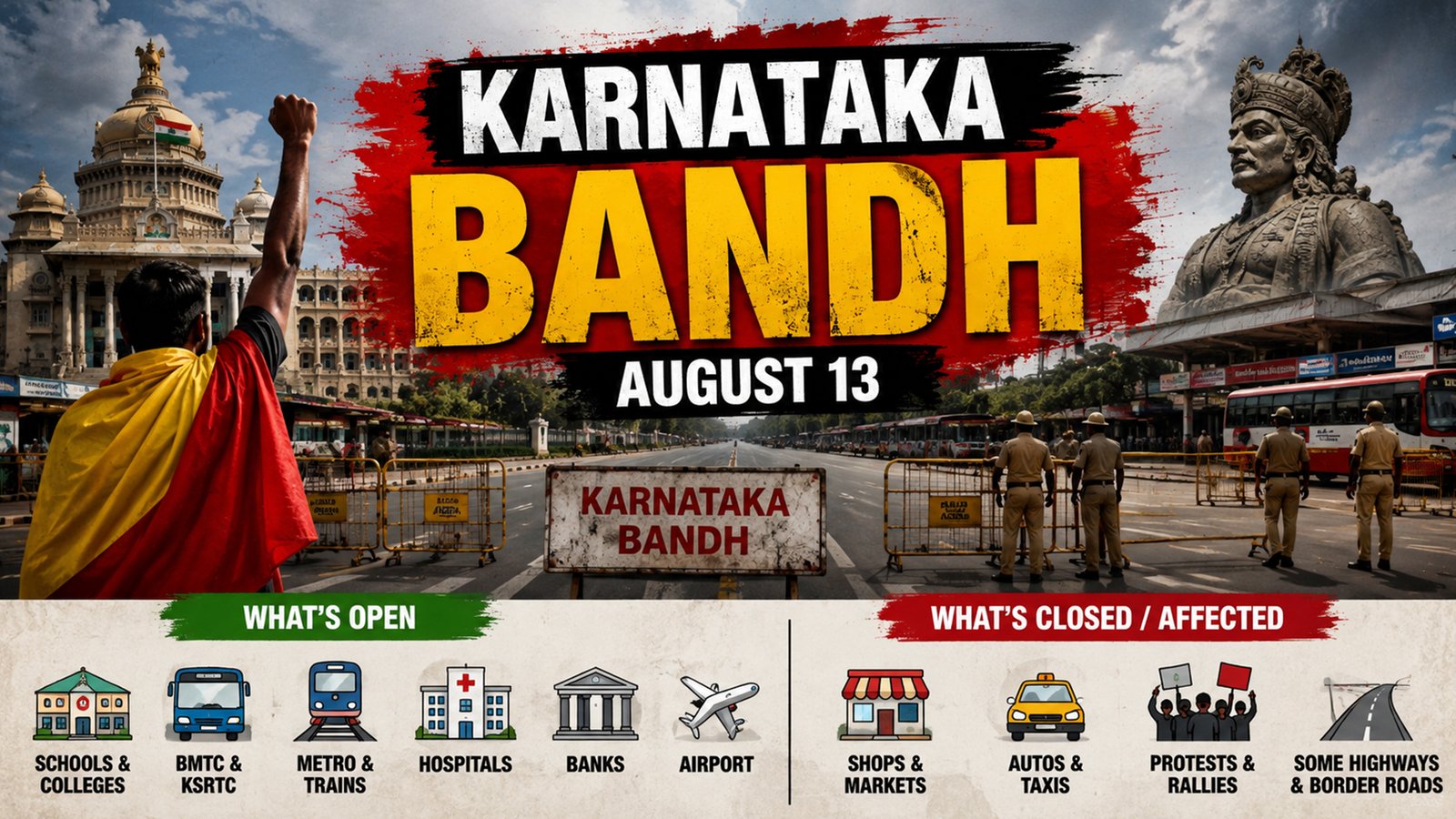
Karnataka is observing a statewide bandh on Thursday, August 13, over the Cauvery water-sharing dispute with Tamil Nadu, but the shutdown has so far produced a mixed response. While protests have intensified in parts of the Cauvery basin, particularly Mandya, Bengaluru and several other major cities have largely continued with normal daily activity. Public transport, schools, offices, hotels and markets are operating in many areas, although commuters have been advised to remain alert for protests, road blockades and local traffic restrictions.
The Karnataka bandh was called by the Federation of Kannada Organisations led by Vatal Nagaraj. The shutdown is scheduled from 6 am to 6 pm and is primarily directed against orders requiring Karnataka to release 12,000 cusecs of Cauvery water a day to Tamil Nadu for 15 days. The demand has triggered renewed political and public opposition in Karnataka, with protesters arguing that the state needs to conserve water for drinking, agriculture and other essential requirements.
The latest water-sharing dispute escalated after the Cauvery Water Regulation Committee directed Karnataka on August 11 to release 12,000 cusecs daily from August 12. The latest direction represents a sharp increase from the earlier requirement of maintaining a flow of 3,500 cusecs at Biligundlu for 15 days. The Cauvery Water Management Authority subsequently backed the latest direction. Karnataka has maintained that reservoir inflows remain below average and that releasing the additional water could put pressure on its own drinking-water and agricultural needs.
The bandh has also expanded beyond the immediate Cauvery water issue. Supporters have raised demands relating to the Mekedatu reservoir project, Kalasa-Banduri Nala project and Upper Krishna project, along with other regional concerns. The Supreme Court is scheduled to hear Tamil Nadu’s plea relating to the dispute on August 17, adding another layer of uncertainty to the ongoing conflict.
For people in Bengaluru, however, Thursday has not turned into the complete shutdown many had feared. Several major Kannada organisations, transport groups, school associations and hotel bodies have either withdrawn their support for a full bandh or chosen to extend only moral support. The Bengaluru City Police has also appealed to people to continue their normal activities and said nobody should be forced to shut shops, stop work or participate in protests.
Public transport remains largely operational. BMTC buses are running in Bengaluru, while KSRTC services have also continued. Namma Metro services are operating as well. Autos, taxis, app-based cabs and private transport have been available in most areas. The situation could nevertheless change on individual routes if protesters block roads or demonstrations gather at major junctions.
Rail and air travel have also not been significantly affected. Operations at Kempegowda International Airport near Devanahalli are continuing normally, with airport taxis and other services operating. Passengers have nevertheless been advised to leave early because demonstrations or traffic restrictions could cause delays on roads leading to the airport.
Schools and colleges in Bengaluru have remained open. Some educational institutions have continued classes and even conducted scheduled internal examinations. The decision came after school management groups withdrew their support for a shutdown. Mysuru has similarly reported normal school operations.
Government offices, banks, IT and biotechnology companies and other private establishments are also functioning. Shopping malls, markets, APMC yards, hotels, bakeries, restaurants, darshinis, shops, street vendors and garment establishments have largely remained open. Hospitals, pharmacies and other essential medical services continue to operate as normal.
The contrast is sharper in Mandya, the centre of the Cauvery agitation. Farmers and pro-Kannada groups staged demonstrations at Sanjay Circle and other locations, with protesters blocking the old Bengaluru-Mysuru highway. Some carried empty pots and horse gram to highlight concerns over water availability and the possible impact on farming. Police detained activists who attempted to disrupt bus services and maintained a strong presence to prevent further escalation.
The immediate picture, therefore, is of a partial Karnataka bandh rather than a complete statewide shutdown. The strongest impact is being felt in areas closely linked to the Cauvery dispute, while major urban centres continue to function. For residents and travellers, the practical concern is less about blanket closures and more about possible delays caused by demonstrations and temporary road blockades.
Mysuru, Hassan and several other urban centres have largely escaped major disruption. In Mysuru, buses to Bengaluru, Mangaluru and other destinations continued to operate, while shops, hotels, autos and taxis remained open. Bengaluru also recorded little disruption during the morning, with BMTC and KSRTC buses operating from Kempegowda Bus Station under heightened police security.