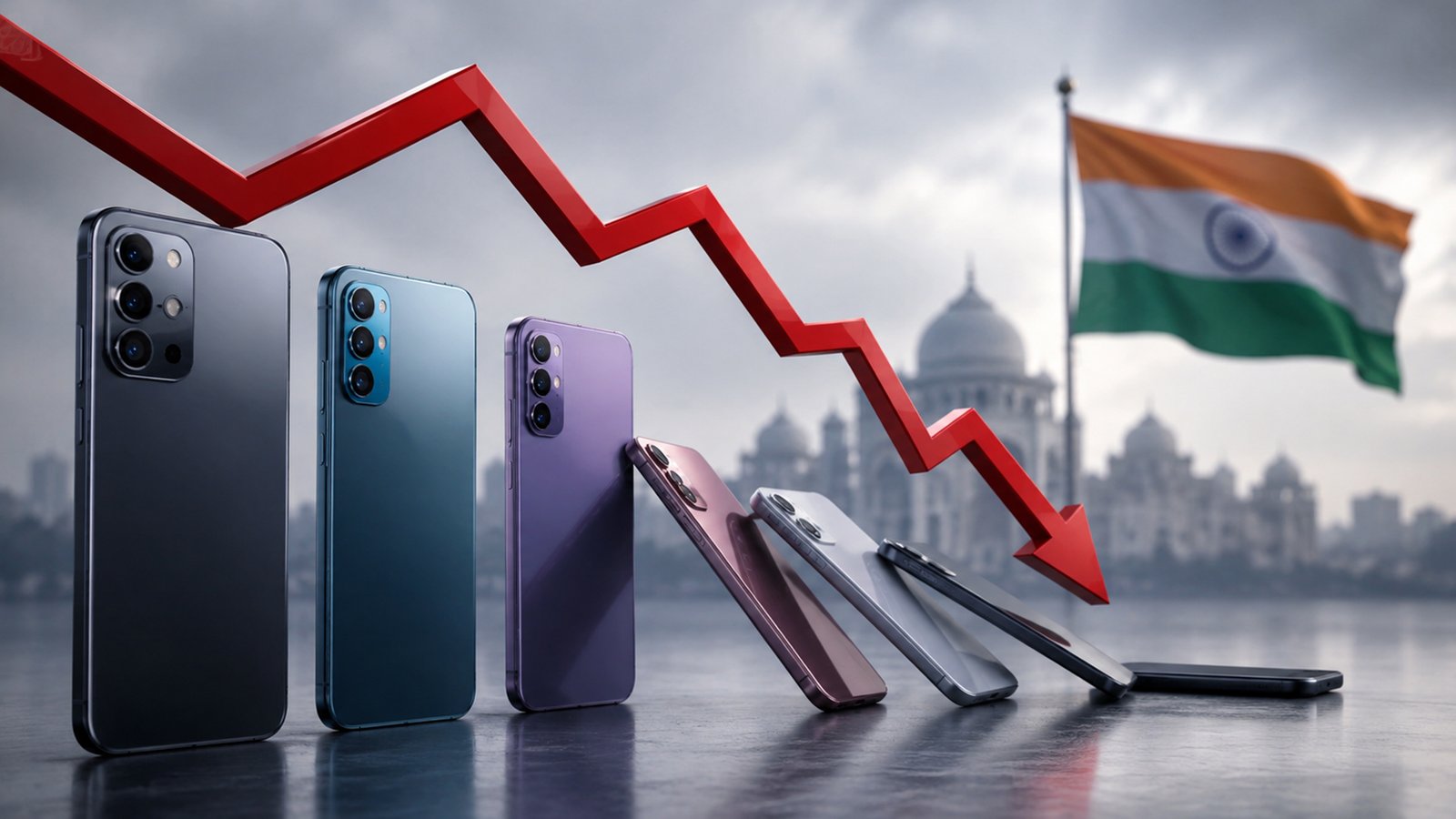
India’s smartphone market weakened sharply in the second quarter of 2026, with shipments falling 11.1% year-on-year to 33.2 million units as a global shortage of memory chips pushed up device prices and squeezed demand. The decline was particularly severe among Chinese smartphone makers, while Samsung and Apple managed to strengthen their positions in the market.
According to International Data Corporation (IDC) data, India’s smartphone shipments declined for the fourth consecutive quarter. The fall highlights the pressure facing manufacturers as rising component costs make it increasingly difficult to offer affordable devices. The impact has been strongest in the lower-priced segments, where consumers are more sensitive to even small increases in handset prices.
The average selling price of a smartphone in India rose 14.4% year-on-year to a record $315 in the June quarter. The sharp increase reflects higher costs for memory chips and other components. For manufacturers that traditionally compete on aggressive pricing, the increase has made it harder to maintain margins while keeping devices affordable.
Chinese brands have been among the biggest casualties. Vivo, Oppo, Xiaomi and Realme all recorded declines in shipments during the quarter. These companies have traditionally relied on the budget and mid-range segments, where competitive pricing and frequent model launches helped them build a large customer base in India.
Vivo remained the country’s largest smartphone brand, but its shipments fell about 14% from a year earlier. Its market share declined to 18.4% from 19% in the same period last year.
Oppo, the third-largest smartphone brand, recorded an 8.5% decline in shipments. Xiaomi’s shipments dropped 10%, while Realme saw a 14.2% fall. The figures underline the growing difficulty Chinese manufacturers are facing in India’s mass-market smartphone segment.
Some Chinese-linked brands experienced even sharper declines. Vivo’s iQOO recorded a 61% drop in shipments, while Xiaomi’s Poco declined 12.3%. OnePlus reported a relatively smaller fall of 2.5%.
The pressure is closely linked to the changing economics of low-cost smartphones. The market for devices priced below $100 collapsed 74.3% year-on-year in the second quarter. Its share of India’s overall smartphone market fell from 15.6% to just 4.5%.
This segment has traditionally been important for Chinese manufacturers because of their ability to combine competitive prices with features such as larger displays, better cameras and higher storage. However, rising memory costs have reduced the scope for manufacturers to maintain those price advantages.
Samsung has emerged as one of the biggest beneficiaries of the shift. Its shipments grew marginally by 0.4%, but its market share increased from 14.5% to 16.4%. The company’s wide product range and strong presence across price categories have helped it remain relatively resilient despite the overall market contraction.
Apple also gained market share as demand for premium smartphones remained stronger than demand for entry-level devices. Apple’s shipments rose around 0.7%, taking its market share to 8.5% from 7.5% a year earlier.
The premiumisation of India’s smartphone market has become increasingly visible, reflecting broader shifts across consumer technology. Shipments in the $400-$600 segment jumped 60.3% year-on-year during the quarter. Its share of the market almost doubled to 8.6% from 4.8%.
The trend suggests that while Indian consumers are becoming more cautious about spending, those who do upgrade are increasingly choosing higher-priced smartphones. This has helped Apple and Samsung offset some of the weakness seen in the mass-market segment.
The iPhone 17 was the highest-shipped smartphone model in India during the first half of 2026, according to IDC. However, Apple has also faced supply constraints affecting several iPhone models because of the global component shortage.
Another notable development was the return of demand for 4G smartphones. As entry-level 5G devices became more expensive, some consumers opted for cheaper 4G models. The share of 4G smartphones increased to 11.1% during the quarter.
IDC expects this trend to be temporary. As manufacturers work through existing inventories, consumers are likely to face fewer low-cost 4G options and increasingly move towards more expensive 5G smartphones.
The shift was also visible in India’s smartphone sales channels. Online shipments fell 19.8% year-on-year, reducing the online channel’s share from 46.4% to 41.9%. Online sales have traditionally benefited from discounts and promotional campaigns, but weaker discounts have made these platforms less attractive to price-sensitive consumers.
Offline sales proved more resilient, declining 3.6%. Smartphone companies have increasingly relied on physical retailers to reach customers as online promotions have become less aggressive.
The weakness in the Indian smartphone market is not limited to the April-June quarter. Shipments during the first half of 2026 fell 7.9% to 64.2 million units, the lowest first-half volume in five years.
Despite the fall in volumes, the market’s overall value increased 3.6%. The rise was driven by higher average selling prices and stronger demand for premium smartphones.
The second half of the year could bring additional pressure. IDC expects smartphone shipments to decline by more than 15% in the second half as manufacturers exhaust existing lower-cost inventories and higher memory prices are reflected more fully in retail prices.