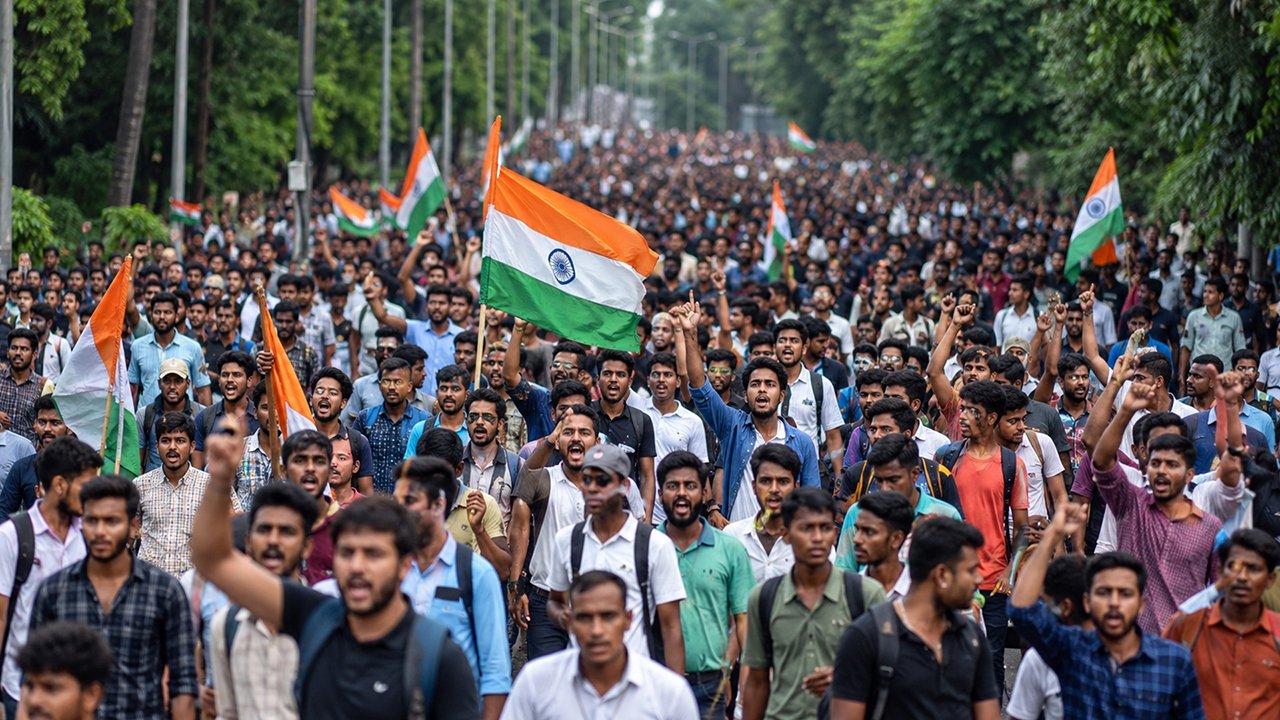
The Jharkhand government on Wednesday cancelled the 14th Jharkhand Public Service Commission (JPSC) Civil Services Examination and two other JPSC examinations as the student agitation over alleged recruitment irregularities entered its 19th day in Ranchi. Chief Minister Hemant Soren announced the decision in the state Assembly, while also ordering an investigation into examinations conducted by TDPL, a company linked to several of the complaints raised by protesting aspirants.
The government’s decision addresses one of the key demands of the students, but it has not ended the agitation. Protesters from the JPSC-JSSC Reforms Manch are continuing their sit-in at Jaipal Singh Munda Stadium in Ranchi and have said they will decide their next course of action through their core committee. Their wider demands include cancellation of several examinations, an independent probe, changes to the recruitment system and greater transparency in the functioning of the JPSC and Jharkhand Staff Selection Commission (JSSC).
The latest development follows a tense few days in Ranchi. On Monday, August 10, students and job aspirants marched towards the Jharkhand Assembly as part of a Vidhan Sabha gherao programme. Police stopped the protesters using barricades, water cannons, tear gas and lathi-charge after the situation escalated. Police said stones were thrown during the confrontation and several personnel were injured. Reports put the number of injured police personnel at 14.
The march was led by student groups protesting alleged irregularities in JPSC and JSSC recruitment examinations. The protesters have argued that repeated controversies surrounding competitive examinations have damaged candidates’ confidence in the recruitment process. Many aspirants spend years preparing for government examinations, and cancellations, delays or allegations of malpractice can leave candidates facing further uncertainty.
Student leader Devendra Nath Mahto has emerged as one of the prominent faces of the agitation. He had been on a hunger strike at the Jaipal Singh Munda Stadium and joined the Assembly march in an ambulance after his health deteriorated. His hunger strike had continued for nine days by the time of the August 10 march. He was later hospitalised as his condition worsened.
Mahto and other protesters have maintained that the agitation should remain peaceful. However, the confrontation outside the Assembly changed the character of the dispute, with the police action becoming an issue in itself. Opposition parties criticised the use of force against the students, while the administration maintained that police acted after the situation turned confrontational.
The political response intensified on August 11. The BJP called a Jharkhand bandh to protest the police action against the students. The shutdown affected normal life in parts of the state, with reports of road blockades and burning tyres in Ranchi. Schools and other institutions were also affected in several areas.
The Akhil Bharatiya Vidyarthi Parishad (ABVP) separately organised a march towards the Assembly on August 11. Around 110 ABVP workers were detained during the protest after clashes with police. The organisation said it was protesting against the treatment of students and the alleged irregularities in the recruitment examination system.
At the centre of the dispute is the question of how many examinations should be cancelled and investigated. Protesters have previously said that the government had cancelled only a small number of examinations despite their demand covering a wider set of tests. The government, on the other hand, has maintained that it has addressed most of the concerns raised during discussions with student organisations.
Several rounds of talks between government representatives and student groups have already taken place, but they failed to produce a settlement. Protesters later rejected a government-appointed panel for further discussions and sought direct dialogue with Chief Minister Hemant Soren. The government has continued to argue that the issue can be resolved through talks.
The student groups are not completely uniform in their demands. Different organisations have raised concerns about different JPSC and JSSC examinations, the recruitment process, examination agencies and the handling of complaints. Some have called for a Central Bureau of Investigation (CBI) probe, while others have sought a state-level investigation and structural reforms.
The government’s cancellation of the 14th JPSC Civil Services Examination is significant because the examination had become one of the major points of contention. Soren also announced the cancellation of two other JPSC examinations, widening the government response to the protests. The proposed investigation into examinations conducted by TDPL is another important step, particularly because protesters have repeatedly questioned the role of external agencies in the examination process.
The protests, however, are not only about cancelling examinations. At the heart of the agitation is a demand for confidence in the state’s recruitment system. Students want assurances that examinations will be conducted fairly, question papers and evaluation will remain secure, complaints will be investigated independently and successful candidates will not face prolonged uncertainty over appointments.
The continuing protest also puts pressure on the Hemant Soren government, which faces the challenge of balancing the students’ demands with the need to maintain the credibility and continuity of its recruitment system. For the aspirants, the issue has become a question of jobs, time and fairness after years of preparation.
As the agitation enters its 19th day, the immediate focus is on whether the cancellation of three JPSC examinations and the proposed investigation will be enough to bring protesters back to the negotiating table. Student representatives are expected to discuss the government’s latest decisions and determine the next phase of their movement.