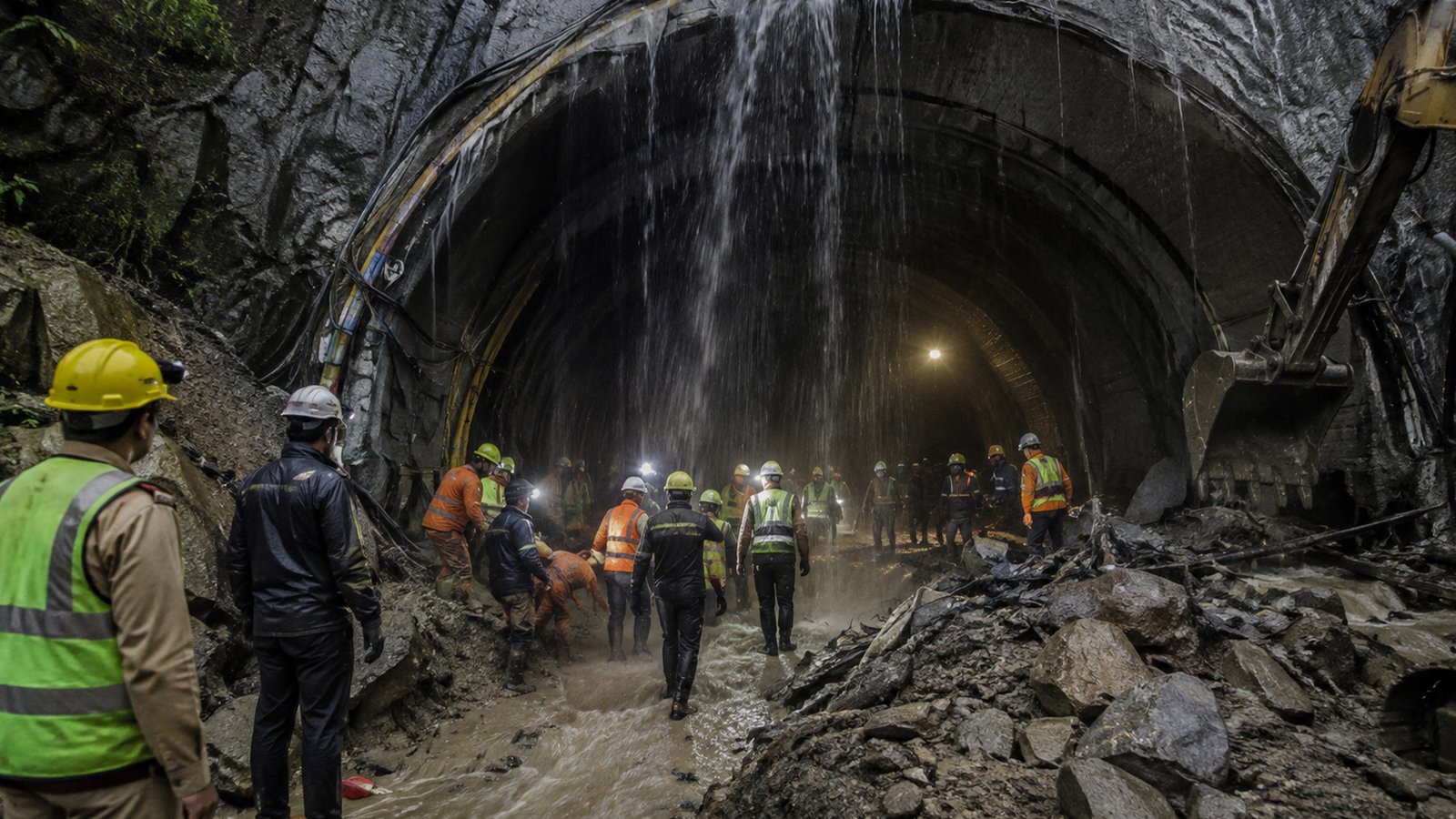
Seven workers were killed and 14 injured after a sudden rush of water and debris entered an under-construction tunnel at a hydropower project in Chamoli district of Uttarakhand, trapping workers inside and triggering a major multi-agency rescue operation. The incident occurred at the Vishnugad-Pipalkoti Hydroelectric Project in the Pipalkoti area on Thursday evening. Authorities are still working to account for everyone who was inside the tunnel when the accident took place.
The tunnel is being developed by the Tehri Hydro Development Corporation (THDC), with construction work being carried out by Hindustan Construction Company (HCC). Officials said the accident occurred at around 6.45 pm when a large quantity of water and debris suddenly entered the tunnel. The sudden inflow left workers with little time to escape and blocked parts of the passage.
Officials initially reported that 22 workers were trapped following the incident. As rescue operations progressed, the number of workers accounted for changed several times because teams had difficulty reaching sections affected by water and debris. The latest reports confirmed seven deaths, while injured workers were taken to the District Hospital in Gopeshwar for treatment. One or more workers were still being searched for as rescue teams continued operations.
The rescue operation has brought together several agencies, including the National Disaster Response Force (NDRF), State Disaster Response Force (SDRF), Indo-Tibetan Border Police (ITBP), Army, Central Industrial Security Force (CISF), police and local emergency teams. Heavy equipment has also been deployed to clear debris and create access to the affected portion of the tunnel.
Rescuers have faced difficult conditions inside the tunnel because of water accumulation and unstable debris. Teams have been working carefully to remove the material while avoiding further risks to both trapped workers and rescue personnel. Reports said improvised equipment, including drum boats, was being used in flooded portions of the tunnel to reach inaccessible areas.
The accident has raised immediate questions about tunnel safety, construction-site safety and disaster preparedness at large infrastructure projects in Uttarakhand. The state has some of India’s most challenging terrain, with steep mountains, unstable geological formations and frequent landslides. Construction of tunnels and hydropower infrastructure in such conditions requires continuous geological monitoring and strong emergency-response arrangements. The disaster also adds to wider national developments in India around infrastructure safety, disaster preparedness and the protection of workers at major construction projects.
The exact reason for the sudden entry of water and debris has not yet been established. Officials have referred to a landslide and heavy water seepage, but a detailed investigation will be required to determine what triggered the incident and whether the water came from a natural underground source, rainfall-related seepage or another geological event.
The Vishnugad-Pipalkoti project is a major hydropower project in Uttarakhand and forms part of the state’s extensive effort to develop its hydroelectric potential. The accident has once again brought attention to the risks faced by workers constructing large tunnels in the fragile Himalayan region.
Uttarakhand Chief Minister Pushkar Singh Dhami reached the accident site and reviewed the rescue operation. He directed officials to intensify efforts and ensure that every available resource was used to locate and rescue workers who could still be inside the tunnel. District officials have also been supervising the operation and coordinating the different agencies involved.
The injured workers were shifted to hospital as rescue teams continued working at the project site. Medical teams have been treating those rescued from the tunnel, while authorities are also working to identify the deceased and communicate with their families. The incident has caused considerable distress among relatives waiting for information about workers who remained unaccounted for.
The disaster comes against the backdrop of repeated concerns over infrastructure construction in Uttarakhand’s ecologically and geologically sensitive Himalayan terrain. The state has witnessed several major incidents involving tunnels, roads and hydropower projects. The 2023 Silkyara tunnel collapse, in which 41 workers were trapped for 17 days before being rescued, had already triggered a nationwide discussion about tunnel construction standards, worker safety and emergency evacuation plans.
The Chamoli incident is different in nature because the immediate danger came from the sudden entry of water and debris rather than a complete blockage caused by a roof collapse. This has made controlling water levels and clearing the affected section central to the ongoing rescue effort.
Authorities are expected to conduct a detailed assessment once the immediate rescue phase is completed. Investigators will likely examine the tunnel’s construction conditions, geological surveys, drainage and water-management systems, safety procedures and the circumstances surrounding the sudden debris flow.
The priority for rescue teams is to reach anyone who may still be trapped. The operation is being conducted cautiously because further debris movement or water ingress could endanger both workers and rescuers.
As the rescue operation continues, officials are expected to provide updated figures on the workers rescued, injured, killed and still missing. The final toll will depend on the outcome of the search inside the affected tunnel.