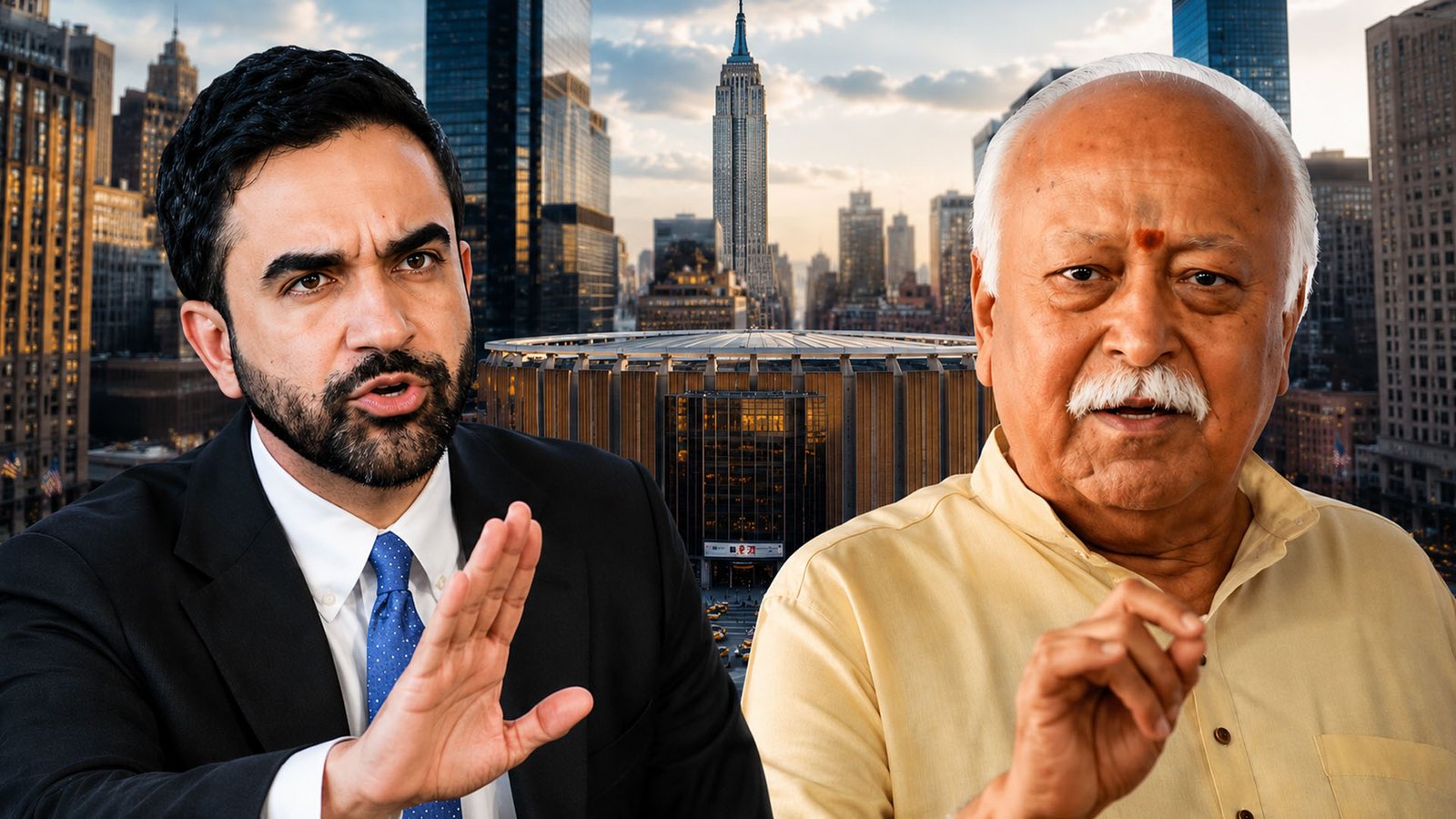
New York City Mayor Zohran Mamdani has publicly opposed a planned event featuring Rashtriya Swayamsevak Sangh (RSS) chief Mohan Bhagwat at Madison Square Garden, but said the city may not have the legal authority to stop the private gathering.
Bhagwat is scheduled to address around 5,000 members of the Indian diaspora at the iconic New York venue on August 29. The event, titled the Universal Oneness Celebration, is being organised by the American Hindus for Engagement and Dialogue (AHEAD) Forum as part of the RSS’s centenary-year global outreach programme.
Speaking at a news conference on Tuesday, Mamdani was asked about calls to cancel the event and protests planned against Bhagwat’s appearance. The mayor said plainly, “I don’t support the rally,” while adding that he was unsure whether New York City had jurisdiction to cancel a private event.
Mamdani also explained that his opposition was connected to his understanding of India and the values he was raised with. As New York’s first Indian-American mayor, he said his mother’s family remains in India and that he grew up with an image of the country as a pluralistic society and a secular republic where every citizen belonged.
He said it was troubling to see the rise of a movement based on what he described as an “exclusionary vision” of a country. Mamdani added that his opposition came not only from his identity as an Indian-American but also from his position as mayor of a city that, he said, believes in the belonging of people regardless of colour, religion, faith or origin.
The comments have brought fresh attention to the longstanding debate surrounding the RSS, its ideology and its relationship with Indian politics. The RSS is widely described as the ideological parent organisation of the ruling Bharatiya Janata Party (BJP). The organisation, however, describes itself as a cultural movement focused on uniting Hindus and rejects accusations that it promotes intolerance towards minorities.
The Madison Square Garden event has already attracted opposition from several interfaith and civil rights organisations in New York. Hindus for Human Rights, the Indian American Muslim Council and the Interfaith Centre of New York were among groups that held a press conference outside New York City Hall and urged the venue to cancel Bhagwat’s appearance.
The controversy comes as Bhagwat begins an international tour marking the RSS’s 100th year. He arrived in the United States on Tuesday and is scheduled to travel to the US, Canada and the United Kingdom as part of the organisation’s centenary-year outreach. The tour is intended to engage Indian-origin and Hindu communities abroad and present the RSS’s perspective on India, Hindu society and its cultural outlook.
Organisers have presented the New York programme in very different terms from the criticism surrounding it. AHEAD Forum describes the Universal Oneness Celebration as an event centred on the idea of Vasudhaiva Kutumbakam, or “the world is one family”. According to the organisers, the gathering seeks to encourage people to move beyond divisions, recognise shared human bonds and promote mutual respect, harmony and unity.
The contrasting descriptions have placed the Madison Square Garden programme at the centre of a wider debate within the Indian-American community. Supporters view Bhagwat’s visit as an opportunity to discuss Indian culture, Hindu thought and the RSS’s global outreach. Opponents argue that giving the RSS chief a prominent platform in New York risks normalising an organisation they associate with majoritarian politics and concerns over minority rights.
The controversy has also raised an important question about the limits of political authority. Mamdani’s remarks make clear that opposing a private gathering is different from having the power to cancel it. While the mayor has expressed his personal and political opposition, he has not indicated that the New York City administration intends to intervene to stop the programme.
The issue has therefore moved beyond the scheduled appearance of one Indian political figure. It touches on questions of free expression, religious identity, diaspora politics and competing ideas about India’s national character.
The event has become an opportunity to reiterate his commitment to pluralism and inclusion. For Bhagwat and the organisers, the programme represents an important part of the RSS’s centenary-year international outreach. With protests expected around the Madison Square Garden gathering, the August 29 event is likely to remain a closely watched moment for New York’s Indian-American community and for the wider debate over the RSS’s presence abroad.