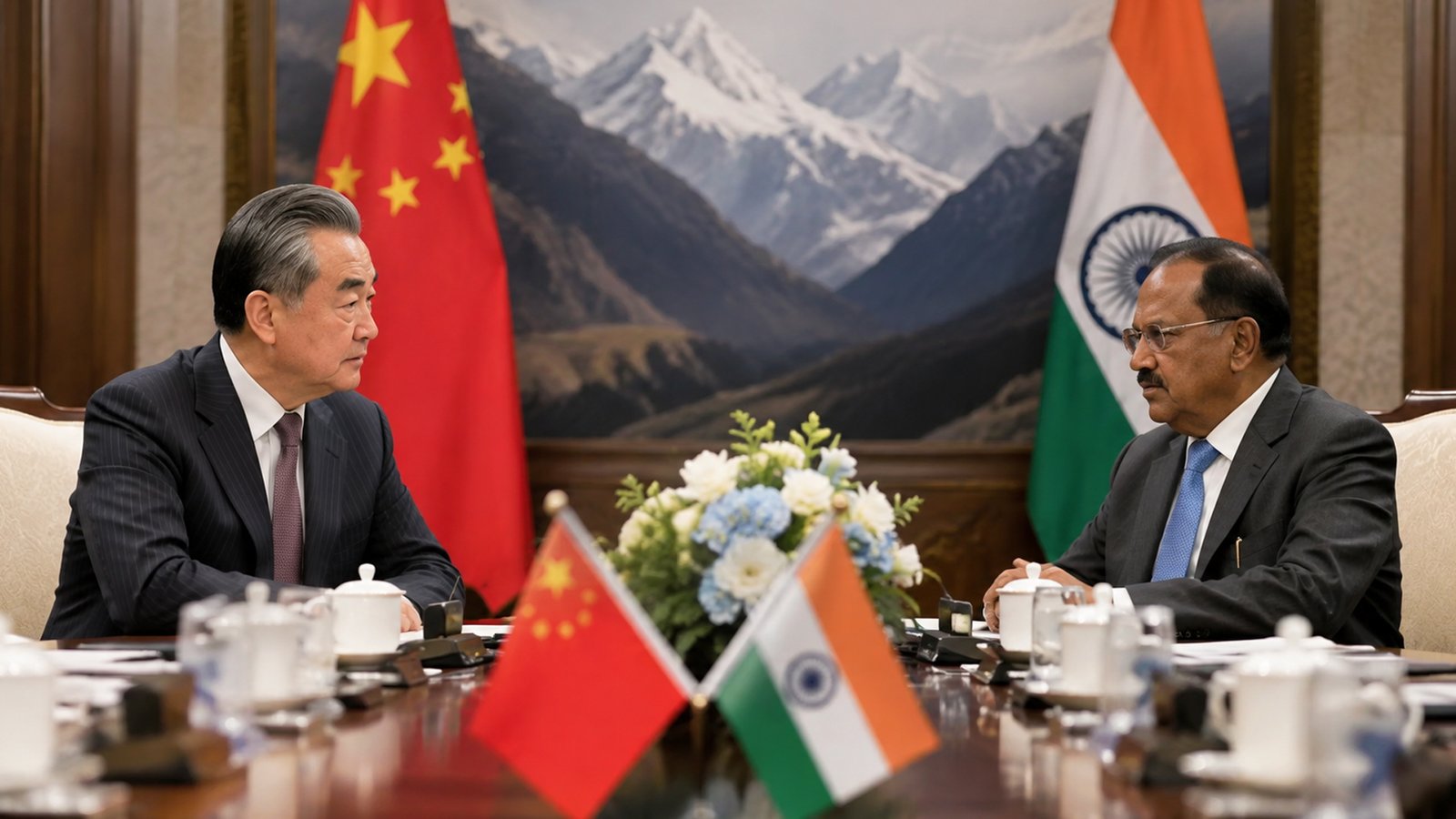
National Security Advisor Ajit Doval arrived in Beijing for the 25th round of India-China Special Representatives’ talks on the boundary question, with both sides looking to maintain peace along the Line of Actual Control (LAC) and improve strained bilateral relations.
Doval, who is India’s Special Representative for the boundary issue, is scheduled to hold talks with Chinese Foreign Minister Wang Yi on Tuesday. The meeting comes at an important stage in India-China relations, with both countries trying to build on recent efforts to reduce tensions along their disputed Himalayan border.
Before the talks with Wang Yi, Doval met Chinese Vice President Han Zheng in Beijing on Tuesday. The two sides discussed ways to strengthen “peace and tranquillity” in the border areas and improve bilateral relations. Their discussions also covered broader economic, political and multilateral engagement between India and China.
The Special Representatives’ meeting is significant because the boundary dispute has remained one of the biggest sources of tension between the two Asian neighbours. Relations deteriorated sharply after the deadly Galwan Valley clash in June 2020, followed by a prolonged military stand-off in eastern Ladakh.
Since then, India and China have held several rounds of military and diplomatic discussions aimed at reducing tensions. An agreement on patrolling arrangements in October 2024 helped both sides move towards disengagement at some friction points. The latest talks are expected to build on those efforts and explore ways to prevent fresh incidents along the LAC.
The boundary talks are not expected to produce an immediate settlement of the larger India-China border dispute. Instead, the focus is likely to remain on maintaining stability, managing differences and creating conditions for a more predictable relationship.
Chinese Foreign Ministry spokesperson Lin Jian said Doval and Wang would hold an in-depth discussion on the boundary question as well as bilateral, regional and international issues. This indicates that the talks could extend beyond the border dispute and touch on the wider relationship between New Delhi and Beijing.
The timing of Doval’s visit is also important because Chinese President Xi Jinping is expected to travel to India for the BRICS summit in New Delhi on September 12 and 13. His visit, if confirmed, would be his first trip to India in seven years and could provide an opportunity for Prime Minister Narendra Modi and Xi to hold high-level discussions.
The proposed Xi visit has added importance to the Doval-Wang talks. Both countries would want to avoid renewed border tensions ahead of a major diplomatic engagement. A stable border could also provide space for India and China to address other areas of their relationship, including trade, investment and people-to-people contacts.
However, differences remain. Arunachal Pradesh continues to be a sensitive issue, with China making territorial claims over the Indian state and India firmly rejecting them. The two sides also continue to differ over their interpretation of the boundary and the LAC.
Peace and tranquillity along the border remains central to improving relations with Beijing as far as New Delhi is concerned. India has repeatedly maintained that normalisation of the broader bilateral relationship depends on maintaining peace along the frontier.
China has also signalled interest in improving relations with India, particularly as both countries face a rapidly changing regional and global environment. Recent diplomatic engagement has included discussions on restoring connectivity, economic exchanges and high-level visits.
The Special Representatives mechanism was established to find a political framework for resolving the boundary question. Doval has represented India in the mechanism since 2014, while Wang Yi represents China. The mechanism operates separately from military-level talks and is intended to address the boundary issue at a political and strategic level.
The latest round therefore comes after years of military tension, diplomatic negotiations and gradual disengagement. While a final boundary settlement remains difficult, regular dialogue provides both sides with a channel to manage disagreements.
The immediate priority for India is to ensure that the border remains peaceful and that existing agreements are implemented properly. For China, maintaining stability with India could help create a more favourable environment for broader bilateral engagement.
The Doval-Han Zheng meeting on Tuesday offered an early indication of the emphasis both sides are placing on stability. The subsequent Doval-Wang talks are expected to provide a clearer picture of whether India and China can make further progress on managing their boundary differences.
With the BRICS summit approaching and a possible Xi Jinping visit to New Delhi on the horizon, the talks carry significance beyond the immediate border issue. Any progress in maintaining peace along the LAC could help create momentum for a cautious improvement in India-China relations.