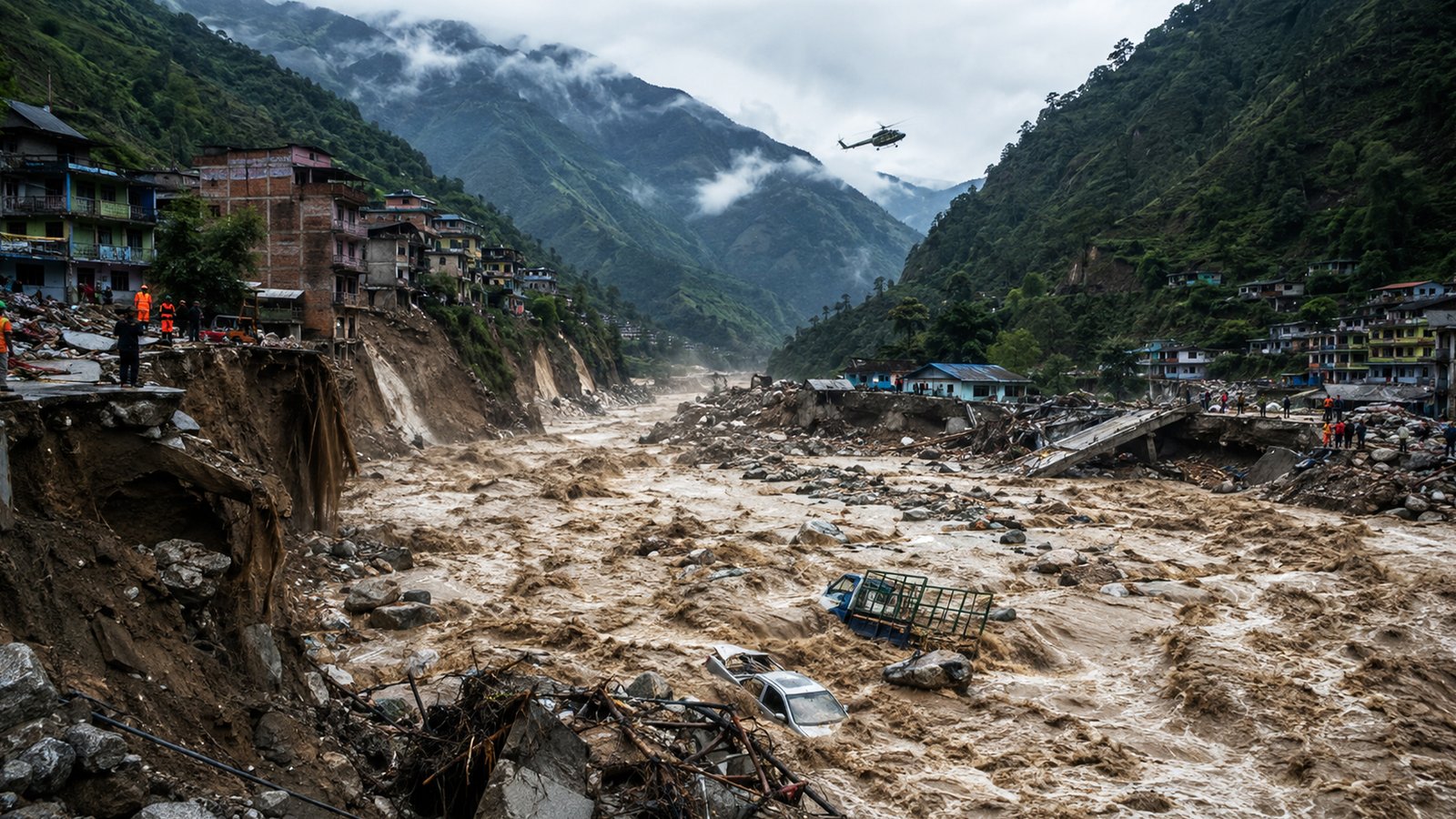
Nepal is battling a devastating flood disaster after sudden flash floods swept through areas near the Nepal-China border, killing at least 175 people and leaving nearly 1,500 people missing across Nepal and Tibet. Rescue teams are working through damaged roads, collapsed bridges and thick layers of mud as they search for survivors and recover bodies.
The disaster struck on Wednesday in Nepal’s Rasuwa district after a huge surge of water and debris entered the Bhotekoshi River system. The flood hit areas around the Rasuwagadhi border crossing, a key route between Nepal and Tibet, and swept through settlements including Timure.
The flooding was initially linked to an earthquake, but geological assessments later pointed to a glacial collapse. A large mass of ice and rock reportedly broke away in the Himalayan region, sending water, ice, rocks and mud rushing into the Lhende Khola River. The resulting flash flood gained enormous force as it moved through the narrow mountain valleys.
The flood destroyed homes, roads, bridges and other infrastructure within minutes. Several hydropower facilities were also damaged, while electricity and communication services were disrupted in parts of the affected region. The difficult Himalayan terrain has made it hard for rescue workers to reach some of the worst-hit locations.
The number of people missing has continued to rise as authorities gather information from remote areas. Latest reports indicate that about 826 people are missing in Nepal, while another 558 are unaccounted for on the Tibet side of the border. The figures remain subject to change as authorities verify reports from families, local administrations and tourism agencies.
Foreign tourists and pilgrims account for a large share of those missing. The affected region is an important route for travellers heading towards Mount Kailash and the Kailash Mansarovar pilgrimage. Indians are among the largest groups of foreign nationals reported missing.
Nepal’s Foreign Minister Shishir Khanal has said nearly 300 Indians were among those reported missing, although officials are still verifying the numbers. Earlier lists had put the number of missing Indian nationals at 133, highlighting how quickly the situation has changed as more information has emerged from the remote border region.
India has moved quickly to support Nepal’s rescue and relief efforts. Prime Minister Narendra Modi spoke with Nepal Prime Minister Balendra Shah and conveyed condolences over the loss of lives. Modi assured Shah that India was ready to provide all possible humanitarian assistance and said Indian teams were coordinating with Nepal on rescue and relief operations.
Within hours of the conversation, India sent its first consignment of emergency relief supplies to Nepal. An Indian Air Force C-130J aircraft carried around 10 tonnes of material, including temporary shelters, blankets, hygiene kits, solar lamps and medicines. The supplies are intended to help people who have lost homes or remain stranded in flood-hit areas.
India is also keeping additional resources ready. A C-17 transport aircraft, along with National Disaster Response Force teams and technical experts, has been kept on standby for further assistance if required. Indian authorities are coordinating with Nepalese officials to determine what additional support may be needed as rescue operations continue.
The Indian Embassy in Kathmandu is separately working with the Nepal government to locate and assist Indian nationals affected by the floods. The focus is on establishing the whereabouts of missing travellers, helping stranded citizens and coordinating their safe evacuation wherever possible.
The rescue effort in Nepal remains challenging. Helicopters are being used to reach isolated communities and evacuate survivors because several roads and bridges have been washed away. Nepal’s Army, Police and Armed Police Force have deployed thousands of personnel for search, rescue and relief operations. More than 100 people, including foreign nationals, have already been rescued from some of the worst-affected areas.
The disaster has also created concerns downstream. The force of the flood damaged critical infrastructure and left large amounts of sediment and debris in river channels. Authorities are monitoring rivers closely for further flooding, landslides and other secondary risks.
India has also been watching developments along its northern borders, particularly in Bihar, where rivers originating in Nepal could rise following heavy rainfall and flooding upstream. Authorities in vulnerable areas have been asked to remain alert as the situation develops.
The scale of destruction has raised wider concerns about the growing threat of extreme weather events in the Himalayas. Scientists have warned that warming temperatures are accelerating glacier melt and can weaken ice and rock formations at high altitudes. When these formations collapse, they can trigger sudden floods carrying huge quantities of water, mud and debris into densely populated valleys.
With hundreds of people still unaccounted for and access to several areas severely restricted, Nepal’s flash flood disaster remains an unfolding emergency. India’s early relief assistance and continued coordination with Nepal are expected to play an important role as the country moves from immediate rescue operations towards relief and recovery.