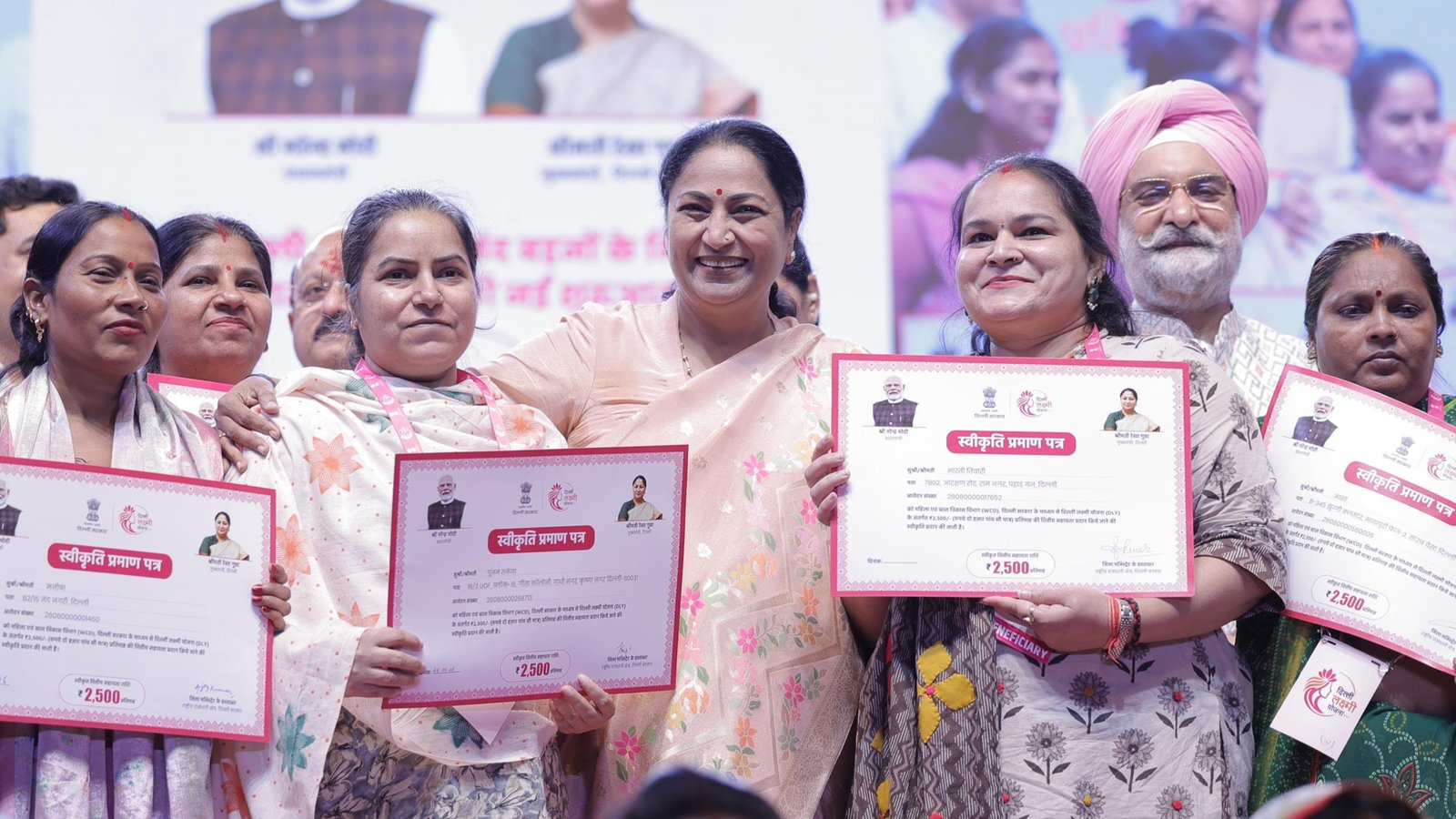
The Delhi government has begun rolling out the Delhi Lakshmi Yojana, a financial assistance scheme aimed at giving women from low-income households greater financial security and control over household spending.
Chief Minister Rekha Gupta handed over approval letters to verified beneficiaries at an event at Talkatora Stadium on August 26. While the government had initially planned to distribute letters to around 4,000 women, the latest update said sanction letters had been issued to 4,190 beneficiaries, with 2,500 women receiving them at the main event. The first payment under the scheme is scheduled to reach beneficiaries from September 1.
The scheme provides eligible women with financial assistance of ₹2,500 every month. The Delhi government has set aside ₹5,110 crore for the programme in its 2026-27 Budget. The government expects the initiative to eventually cover a much larger number of women as applications are verified and approved.
The scale of interest in the scheme became clear soon after its online registration opened on August 1. More than 9.2 lakh women had registered by August 26, while 6.52 lakh applications had been formally submitted, according to government figures. However, registration alone does not guarantee assistance. Every application has to go through an eligibility check before the government issues a sanction.
The scheme is designed for women between 21 and 60 years of age. The applicant must be the eldest eligible woman in her family and must be a registered voter in Delhi. The family’s annual income must not exceed ₹2.5 lakh. In addition, the applicant, her husband or either of her parents must have been a Delhi resident for at least 10 years.
The government has also laid down several conditions to ensure that the benefit reaches households that need it. Women already receiving government pensions or similar financial assistance are excluded. Income-tax payees, GST filers, government employees and public office-holders are also not eligible.
Other restrictions cover families with more than three living children, households whose annual electricity consumption exceeds 2,400 units and families that own a four-wheeler. Applicants with criminal records are also excluded under the notified guidelines.
One of the distinctive features of the Delhi Lakshmi Yojana is that the ₹2,500 is not necessarily given as unrestricted cash. The government has created two payment options.
Under the first option, ₹1,000 is transferred every month through a Central Bank Digital Currency, or CBDC, wallet linked to the beneficiary’s bank account. The remaining ₹1,500 goes into a recurring deposit or fixed deposit. The deposit component has a lock-in period until July 31, 2029.
The second option allows the beneficiary to place the entire ₹2,500 into a recurring or fixed deposit. This arrangement gives beneficiaries an opportunity to build savings rather than using the entire monthly assistance immediately.
The CBDC component also comes with spending restrictions. According to the scheme guidelines, the digital funds cannot be used for items such as alcohol, tobacco, narcotic drugs, lottery tickets, gambling and betting services. The government can add other restricted goods or services to the list if required.
The scheme is therefore being presented as more than a monthly assistance programme. The Delhi government has described it as a measure aimed at improving women’s financial independence and giving them a greater role in household decisions. At the launch, Gupta said the initiative was intended to strengthen women’s financial security rather than simply provide monetary support.
The application process will continue beyond the first batch of beneficiaries. Applications submitted through the official portal are sent to the relevant district offices of the Department of Women and Child Development. Officials examine the applications and verify the information before eligible cases are sent for approval.
The Delhi Lakshmi Yojana is expected to remain an important part of the Delhi government’s welfare programme, with its success depending not only on timely payments but also on transparent verification, effective grievance redressal and ensuring that assistance reaches the women for whom it is intended.
The government has also planned a system for correcting mistakes or completing missing information in applications. This could be important given the large number of applications received during the first few weeks of registration.
The scheme’s implementation will now be closely watched as the government moves from registration to regular payments. With lakhs of applications already submitted, the verification process will determine how quickly additional women are brought into the programme.
For the first group of beneficiaries, however, the rollout has moved from an announcement to a tangible benefit. Their sanction letters are in hand, and the first ₹2,500 instalment is due on September 1.