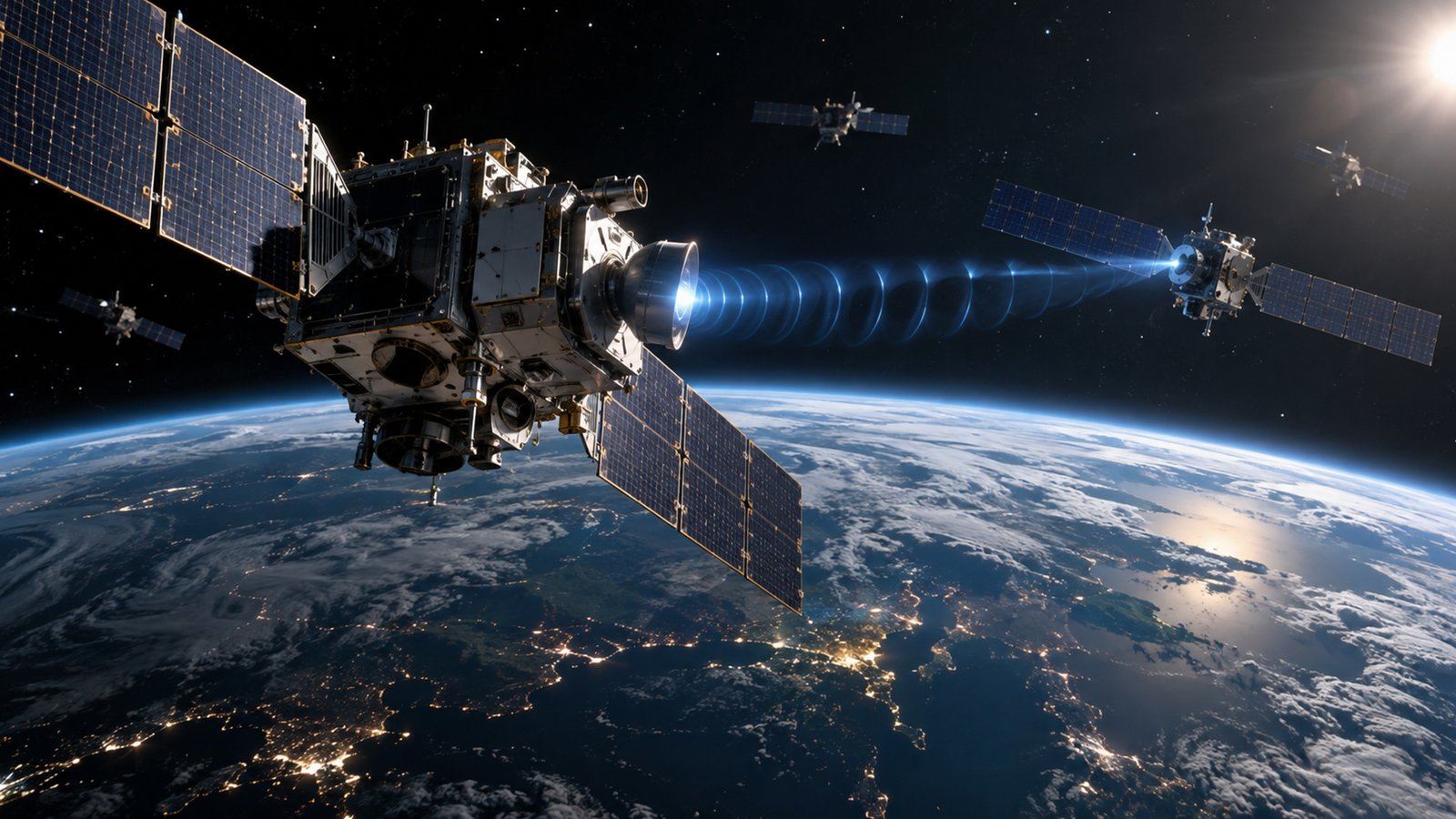
The United States has confirmed that it has deployed weapons in orbit, marking a major development in the growing military competition between Washington, China and Russia beyond Earth.
US Air Force Secretary Troy Meink made the disclosure at an Air, Space and Cyber Conference in Maryland. He said the US Space Force now has on-orbit space control weapons that can be used to protect American military forces from attacks in space.
The announcement is significant because Washington has previously discussed developing and testing systems to protect satellites and counter threats in orbit. This is the first clear public confirmation that such weapons have actually been placed in space.
The US has not revealed how many weapons are currently in orbit. It has also kept details about their design, launch dates and exact locations secret.
Officials have not said whether the weapons are capable of physically destroying another satellite. They could instead use electronic warfare, jamming or other methods to interfere with an enemy spacecraft.
The Pentagon uses the term space control to describe a broad range of military capabilities designed to protect US satellites and prevent adversaries from using space systems against American forces.
The development comes as the US increasingly sees space as a potential battlefield. Modern military operations depend heavily on satellites for communications, navigation, intelligence, surveillance and missile warning.
China and Russia have been rapidly expanding their own military space programmes, prompting growing concern in Washington.
US officials have repeatedly warned that both countries are developing technologies capable of disrupting or attacking satellites. China has expanded its military satellite network and is investing heavily in systems that could track and interfere with American space assets.
Russia has also demonstrated anti-satellite capabilities. In 2021, Moscow destroyed one of its own satellites with a missile during a test. The incident created thousands of pieces of debris and raised concerns about the dangers of military activity in crowded orbits.
Russia has also operated satellites capable of approaching other spacecraft, a capability that has drawn close attention from US military officials.
Washington’s latest move reflects a shift in strategy. Rather than relying only on ground-based systems to defend satellites, the US military wants the ability to respond to threats directly in orbit.
The US Space Force has already been conducting exercises and missions aimed at preparing for such situations.
One recent effort, known as Victus Haze, tested how quickly the US could launch a spacecraft and respond to a potential threat in orbit. The exercise included manoeuvres designed to simulate an encounter with another spacecraft.
The US military says such capabilities are necessary because its satellites could become targets during a major conflict.
Satellites are now considered critical military infrastructure. They help armed forces communicate across long distances, identify targets, monitor missile launches and navigate weapons and aircraft.
A disruption to these systems could therefore have serious consequences during a conflict.
The latest disclosure is also likely to increase concerns about a space arms race.
China and Russia have strongly criticised the expansion of US military capabilities in space. Beijing has previously accused Washington of turning outer space into a potential battlefield and has called for international measures to prevent an arms race.
The US, meanwhile, argues that its space capabilities are primarily aimed at protecting its forces and maintaining a military advantage.
International rules governing weapons in space add another layer to the debate.
The 1967 Outer Space Treaty prohibits countries from placing nuclear weapons and other weapons of mass destruction in orbit. It does not, however, ban all conventional weapons or military equipment in space.
That gap has become increasingly important as countries develop technologies that can disable or disrupt satellites without necessarily destroying them.
The growing dependence on satellites also means the consequences of a space conflict could extend well beyond military targets.
Weather forecasting, navigation, communications, banking systems and several other civilian services depend on space-based infrastructure. A major attack on satellites could therefore disrupt everyday life on Earth.
The US government has not disclosed the precise capabilities of its newly confirmed orbital weapons. That secrecy makes it difficult to determine whether they represent a completely new class of weapons or the operational deployment of technologies that have already been tested.
The announcement itself, however, sends a strong message to potential rivals.
The US wants China and Russia to know that it has the ability to operate and defend itself in orbit, rather than leaving its satellites vulnerable to attack.
The development also highlights how quickly space is changing from a largely peaceful domain into an increasingly contested military environment.
With the US, China and Russia investing heavily in space weapons, anti-satellite systems and military satellites, competition is moving steadily beyond Earth.
What happens next could determine whether these new capabilities remain primarily defensive tools or become part of a wider arms race in space.