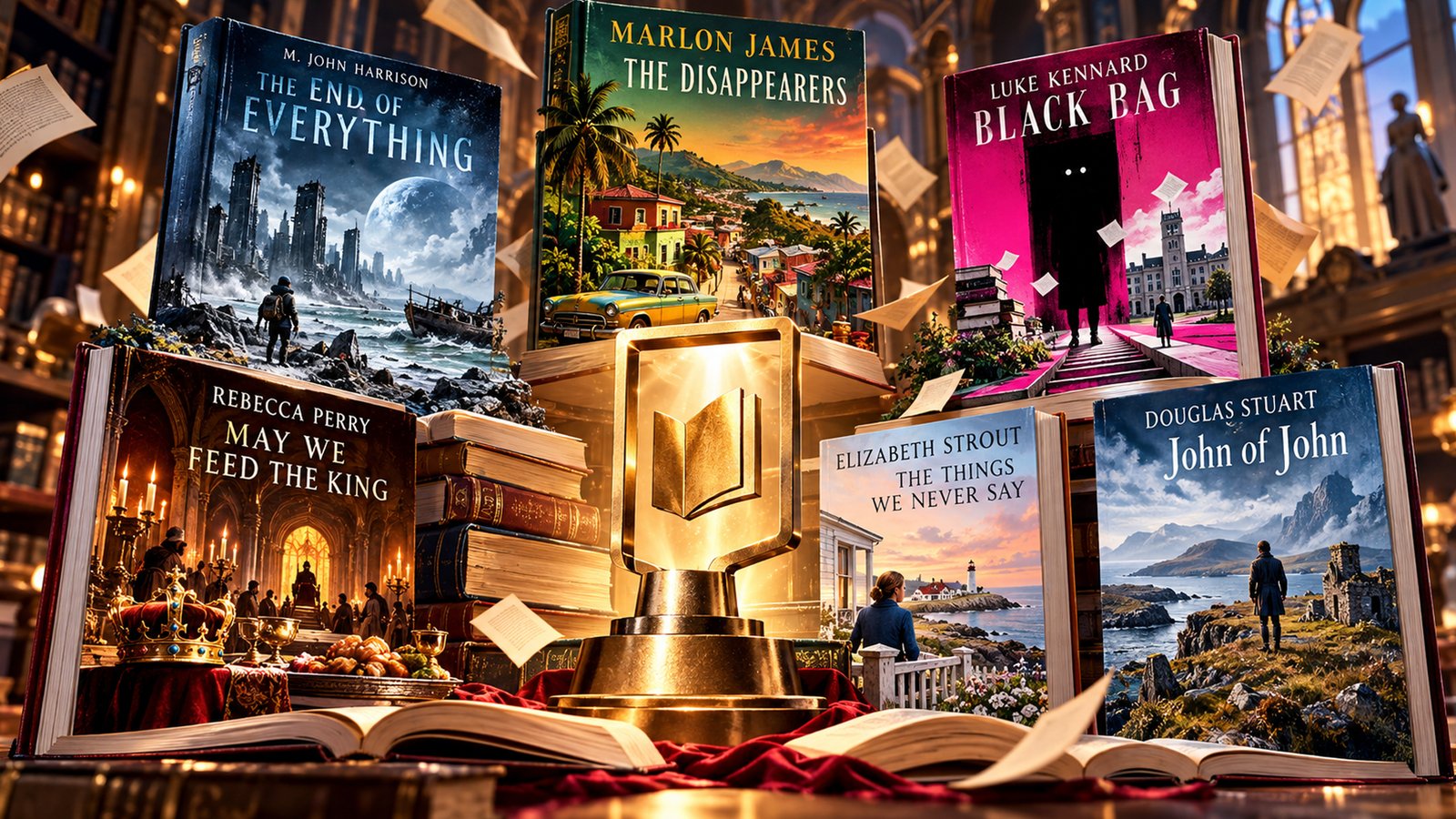
Six very different novels are now competing for the 2026 Booker Prize, bringing together established literary voices, previous winners and a debut novelist in one of the year’s most closely watched literary contests.
The shortlist was selected from 13 longlisted books, which themselves were chosen from 163 submissions. The final six take readers across different countries, time periods and imagined worlds, moving from a post-apocalyptic Britain and late-1980s Jamaica to a medieval court, a university experiment and a small Scottish island.
The shortlisted books are The End of Everything by M. John Harrison, The Disappearers by Marlon James, Black Bag by Luke Kennard, May We Feed the King by Rebecca Perry, The Things We Never Say by Elizabeth Strout, and John of John by Douglas Stuart.
The winner will be announced on November 9 at a ceremony in London. The winning author will receive £50,000, while each shortlisted writer receives £2,500.
Six books, six very different worlds
M. John Harrison’s The End of Everything takes readers into a bleak, post-apocalyptic landscape on the Kent coast. The story follows Phillip Tennant, a scavenger trying to survive with his aunt while dealing with a mysterious alien presence. The novel blends science fiction, dystopia, satire, mystery and road fiction, giving a familiar end-of-the-world story an unusual and often darkly comic edge.
Marlon James returns to the Booker shortlist with The Disappearers, set in Kingston, Jamaica, during the late 1980s. The novel explores the aftermath of a violent attack on a group of gay men, bringing questions of identity, survival, memory and social prejudice into a story shaped by Jamaica’s cultural and literary history. James previously won the Booker Prize in 2015 for A Brief History of Seven Killings.
Black Bag by Luke Kennard takes a stranger route. Inspired by a real psychology experiment, it follows an actor who agrees to spend a university term inside a large black leather bag as part of an experiment. What begins as an absurd premise develops into a campus satire that examines identity, masculinity, relationships and human vulnerability.
Rebecca Perry’s May We Feed the King is the only debut novel on the shortlist. The story moves between a modern-day museum curator and an unnamed medieval court, using history and storytelling to question how societies remember the past and decide who deserves to be remembered. Perry has previously published poetry, but this is her first novel.
Elizabeth Strout’s The Things We Never Say centres on Artie Dam, a history teacher living on the Massachusetts coast. His seemingly settled life begins to unravel as private secrets and the political tensions surrounding the 2024 US election enter his world. Strout, a Pulitzer Prize winner, has previously been shortlisted for the Booker Prize and returns to the contest with another closely observed story about ordinary lives and hidden emotions.
The final title, John of John by Douglas Stuart, takes readers to the remote Isle of Harris in Scotland. It follows John-Calum MacLeod, a young art graduate who reluctantly returns home and is forced to confront family expectations, buried secrets and the life he left behind. Stuart won the Booker in 2020 for Shuggie Bain.
A shortlist built around identity and belonging
Although the six novels differ sharply in style and setting, questions of identity, family, community and belonging connect many of them.
The books explore the pressure of expectations, the secrets people carry and the ways communities can shape individual lives. Some deal directly with social prejudice and political divisions, while others approach similar questions through fantasy, historical fiction, satire or speculative storytelling.
The shortlist also brings together authors at very different stages of their careers. James and Stuart are former Booker winners, while Strout is returning after previous recognition by the prize. Harrison, Kennard and Perry are appearing on the shortlist for the first time.
The age and experience of the writers also span an unusually wide range. Harrison, aged 81, could become the oldest Booker Prize winner if he takes the award. The current record belongs to Margaret Atwood, who was 79 when she jointly won in 2019.
Booker Prize heads towards its final night
The 2026 shortlist reflects the changing shape of contemporary fiction, bringing together established literary reputations and new voices without being tied to a single genre.
The six novels move between realism and speculative fiction, historical settings and contemporary political life, comedy and tragedy. Their common thread is an interest in people trying to understand themselves and their place in an often uncertain world.
The final decision now rests with the five-member judging panel chaired by classicist Mary Beard, alongside Raymond Antrobus, Jarvis Cocker, Rebecca Liu and Patricia Lockwood. The winner will be revealed in London on November 9, bringing this year’s Booker Prize journey to its final chapter.