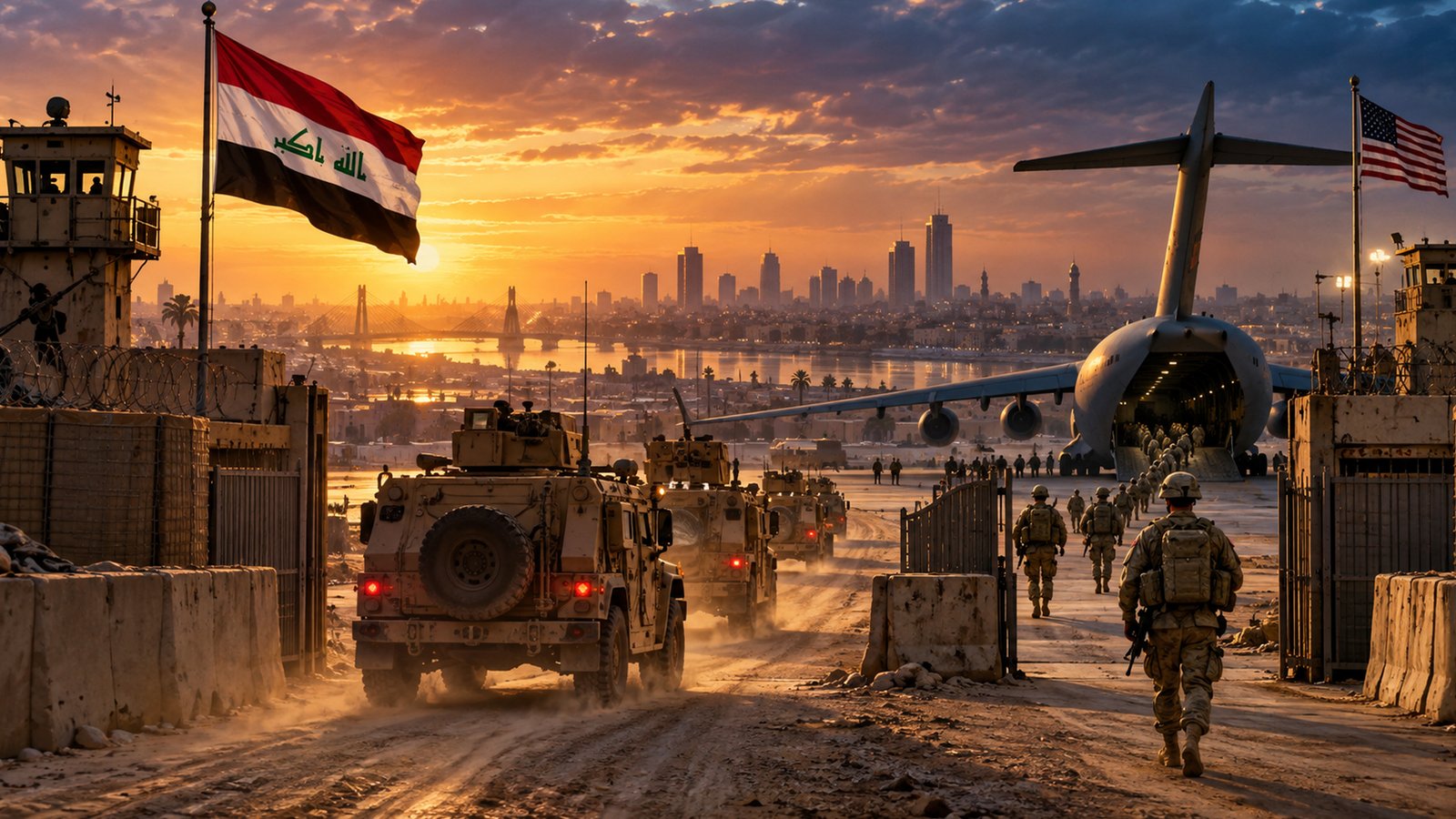
The United States has completed the withdrawal of its remaining military forces from Iraq, ending more than two decades of direct US military involvement in the country and beginning a new phase in Baghdad’s security relationship with Washington.
The final US troops and equipment left Erbil Air Base in Iraq’s Kurdistan region on September 30, marking the end of the US-led coalition’s military mission in Iraq. The coalition headquarters has shifted to Jordan, while American forces continue counterterrorism operations against Islamic State (ISIS) in neighbouring Syria.
The withdrawal follows an agreement reached between Washington and Baghdad in 2024 to end the coalition’s military mission in Iraq. Most US troops had already left Iraqi bases, with a smaller contingent remaining in the Kurdistan region for the final stage.
The US military first entered Iraq in 2003 after the invasion that removed Saddam Hussein from power. American forces withdrew in 2011 but returned three years later after ISIS captured large areas of Iraq and Syria.
The latest withdrawal closes a major chapter in that military history. Iraq will now take greater responsibility for counterterrorism operations and national security, while Washington plans to maintain defence cooperation with Baghdad through a bilateral relationship.
The transition comes as Iraq continues to balance its relationships with the United States and neighbouring Iran. Several powerful Iraqi armed groups have close ties with Tehran and have opposed the continued presence of American troops.
Iran has long called for US forces to leave Iraq, and Iran-aligned factions have welcomed the withdrawal. The departure removes a major US military presence that had served as a counterweight to Iranian influence in parts of Iraq.
The role of armed groups remains one of the most sensitive issues facing the Iraqi government. Baghdad has sought greater state control over weapons and security operations, but some powerful militias have resisted calls to disarm.
The government has set a new timeline to address the issue, with efforts to bring weapons held by non-state groups under state control expected to continue into 2027. The process could prove politically difficult because some of the groups have significant influence within Iraq’s political system.
Security concerns also remain despite the end of ISIS territorial control. Iraqi forces and the US-led coalition defeated ISIS as a territorial organisation in Iraq in 2017, but the group continues to operate through sleeper cells and underground networks.
The US military has provided intelligence, surveillance, training and logistical support to Iraqi forces during the campaign against ISIS. With the combat mission ending, Iraqi security forces will have to carry more of the responsibility for identifying and targeting the group’s remaining networks.
The US has said the end of the coalition mission does not mean the end of its security relationship with Iraq. Washington intends to continue working with Iraqi forces through a bilateral defence partnership, including areas such as training and security cooperation.
The coalition’s relocation to Jordan also allows regional counter-ISIS coordination to continue without maintaining the same military footprint inside Iraq.
The withdrawal carries particular significance for Iraq’s Kurdistan region, where US forces had maintained a presence and supported operations against ISIS. Kurdish officials have raised concerns about potential security gaps, particularly amid continuing regional tensions and attacks involving armed groups.
Iraq now faces the challenge of maintaining security while managing competing regional interests. The country has repeatedly been caught between Washington and Tehran, with tensions between the two powers sometimes spilling onto Iraqi territory.
The US exit could give Baghdad greater room to pursue an independent security policy, but it also places greater responsibility on Iraqi institutions. The government will need to strengthen its security forces, prevent ISIS from rebuilding and manage the influence of armed groups.
The withdrawal also reflects the changing nature of the US presence in the Middle East. Washington has increasingly shifted from large-scale military deployments towards targeted counterterrorism operations, security partnerships and regional cooperation.
Iraq has regained greater control over its national security framework, but it must now manage threats and regional pressures with a smaller foreign military presence.
The coming years will show how effectively Iraq can maintain counterterrorism capabilities, strengthen state control over armed groups and balance relations with the United States and Iran. The US military mission may have ended, but Iraq’s wider security challenges remain.