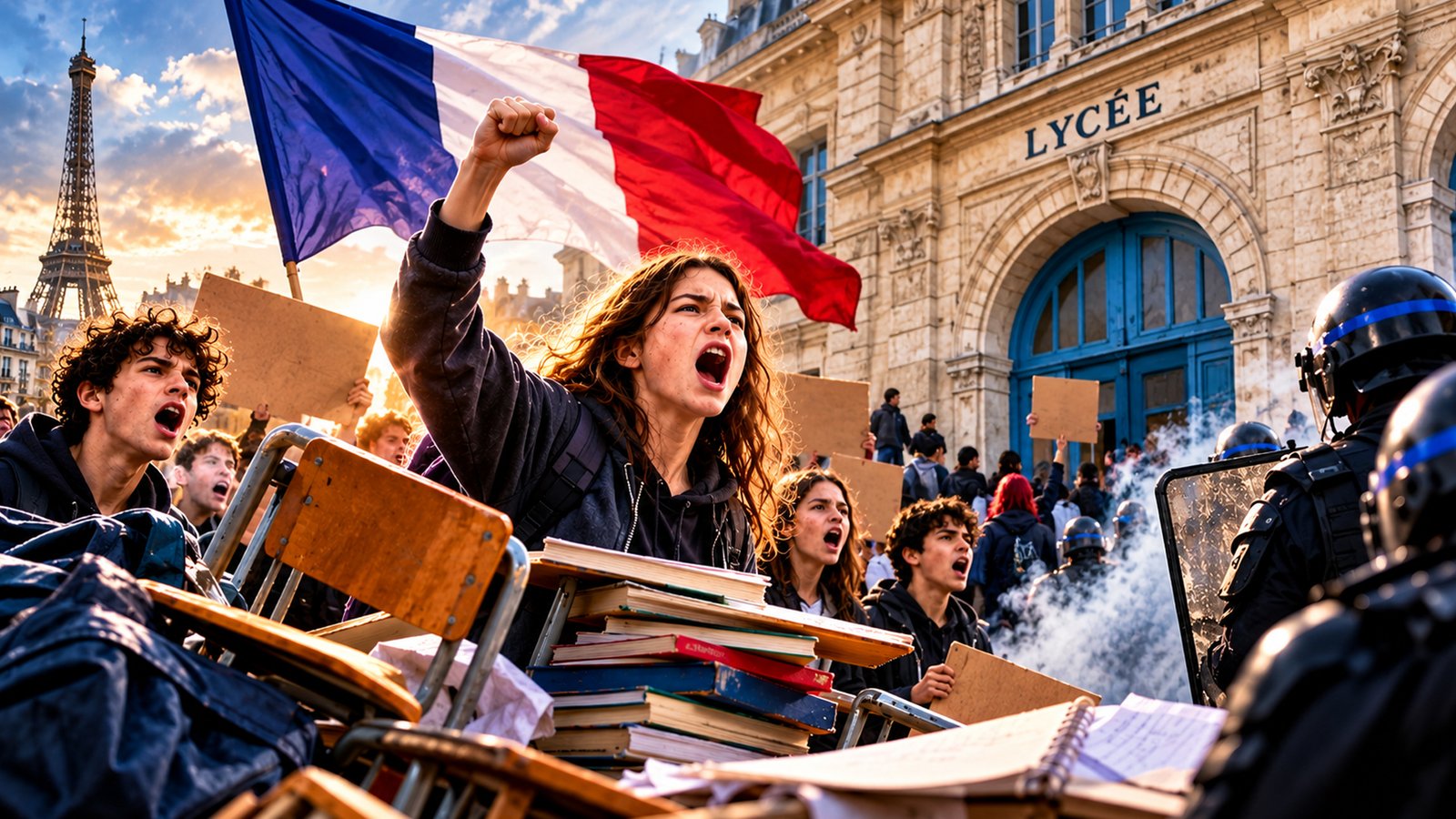
France’s young people are making themselves heard. What began as students blocking school entrances has grown into a wider protest movement, with teenagers taking to the streets to demand better schools, more teachers and a future they believe is slipping further out of reach.
The demonstrations began in September in the Paris suburbs and have since spread to cities across France. Students have blocked schools, joined marches and gathered outside government buildings, drawing support from teachers, parents and trade unions.
The immediate complaints are easy to understand. Students say their schools are short of teachers and support staff, classrooms are overcrowded and some buildings are in poor condition. Lessons are frequently cancelled when teachers are absent and no replacements are available.
For students in France’s poorer suburbs, the problems can feel even more personal. The banlieues, home to many working-class and immigrant communities, have long faced concerns about unequal access to public services. Students involved in the protests say they are tired of being told to wait for improvements while watching other parts of the country receive better facilities and opportunities.
The movement has deliberately tried to keep young voices at its centre. There is no single student leader directing the protests. Instead, teenagers have organised blockades and demonstrations through local groups and social networks, giving the movement a loose and sometimes unpredictable character.
Their message, however, is remarkably consistent: listen to them.
Students want functioning classrooms, adequate teaching staff and better support for those preparing for university or employment. They are also questioning the pressure placed on teenagers by France’s education and university admissions systems.
Behind those demands is a deeper anxiety about what comes after school.
Many young people worry about finding secure jobs, paying for housing and building independent lives. They are growing up in a period shaped by inflation, climate concerns, rapid advances in artificial intelligence and uncertainty over the future of work.
Some protesters have also brought wider political issues into the demonstrations, including the war in Gaza. That has made the movement broader than a campaign focused solely on education.
The government is now facing the difficult task of responding to the students without promising money it may not have.
Prime Minister Sébastien Lecornu has acknowledged that some of the complaints are legitimate and has promised proposals aimed at improving school buildings and teacher availability. The government has also stressed that any new spending must be properly funded.
That is a significant challenge for France, which is under pressure to reduce its budget deficit and manage a heavy public debt burden.
Education spending has consequently become part of a much larger argument about what the French state can afford to provide. Government officials point out that France already spends heavily on education compared with many other developed countries. Students and teachers counter that the problem is not simply the amount being spent, but where the money goes and whether it reaches the schools that need it most.
The protests have also taken an uncomfortable turn over policing.
Several demonstrations have seen clashes between police and protesters. The authorities have reported thousands of arrests since the movement began, many involving minors. While many school blockades have remained peaceful, incidents of violence have increased pressure on the government.
The issue became particularly serious after teenagers suffered severe injuries during confrontations involving police equipment. A 15-year-old boy reportedly lost a hand after an incident involving a stun grenade in Lens, while another teenager in Paris suffered serious facial injuries.
The government subsequently suspended the use of stun grenades during student demonstrations and ordered investigations into the incidents.
Rhe situation is increasingly difficult to navigate for parents. They support demands for better education but are also worried about their children being caught up in violence or missing classes.
Teachers find themselves caught in a similar position. Many have joined the protests because they share concerns about staff shortages, overcrowded classrooms and deteriorating school infrastructure. At the same time, prolonged disruption is making it harder for students to keep up with their studies.
The scale of the disruption is becoming harder for the government to ignore. Hundreds of schools have been affected, with some damaged buildings expected to remain closed for weeks. The cost of repairs could run into tens of millions of euros.
Yet the students insist that damaged property is not the heart of their movement.
They want politicians to visit their schools, talk to students and see the conditions for themselves. Some protesters have specifically called on political leaders to go to the banlieues rather than judging the movement from Paris.
That demand captures the wider frustration behind the protests.
Young people feel that decisions affecting their lives are too often made without them. They are being asked to prepare for an uncertain economy, adapt to new technology and confront social and environmental challenges while dealing with schools they believe are not giving them the support they need.
The timing is politically sensitive too. France is already dealing with divisions over public spending, immigration, policing and the cost of living. The student protests have given opposition parties another issue on which to challenge the government.
The left has largely backed the students, while the far right has focused on disorder, violence and the cost of repairing damaged schools.
But beyond the political arguments, the protesters are asking a basic question: what kind of future is France preparing for its young people?
A movement that began with blocked school gates has now become a national conversation about education, inequality, policing and opportunity.
The government can clear the streets, reopen schools and repair damaged buildings. The harder task will be addressing the frustration that brought students there in the first place.
For many of the young people protesting, this is not simply about better classrooms. It is about wanting to believe that their country still has a place for them in its future.