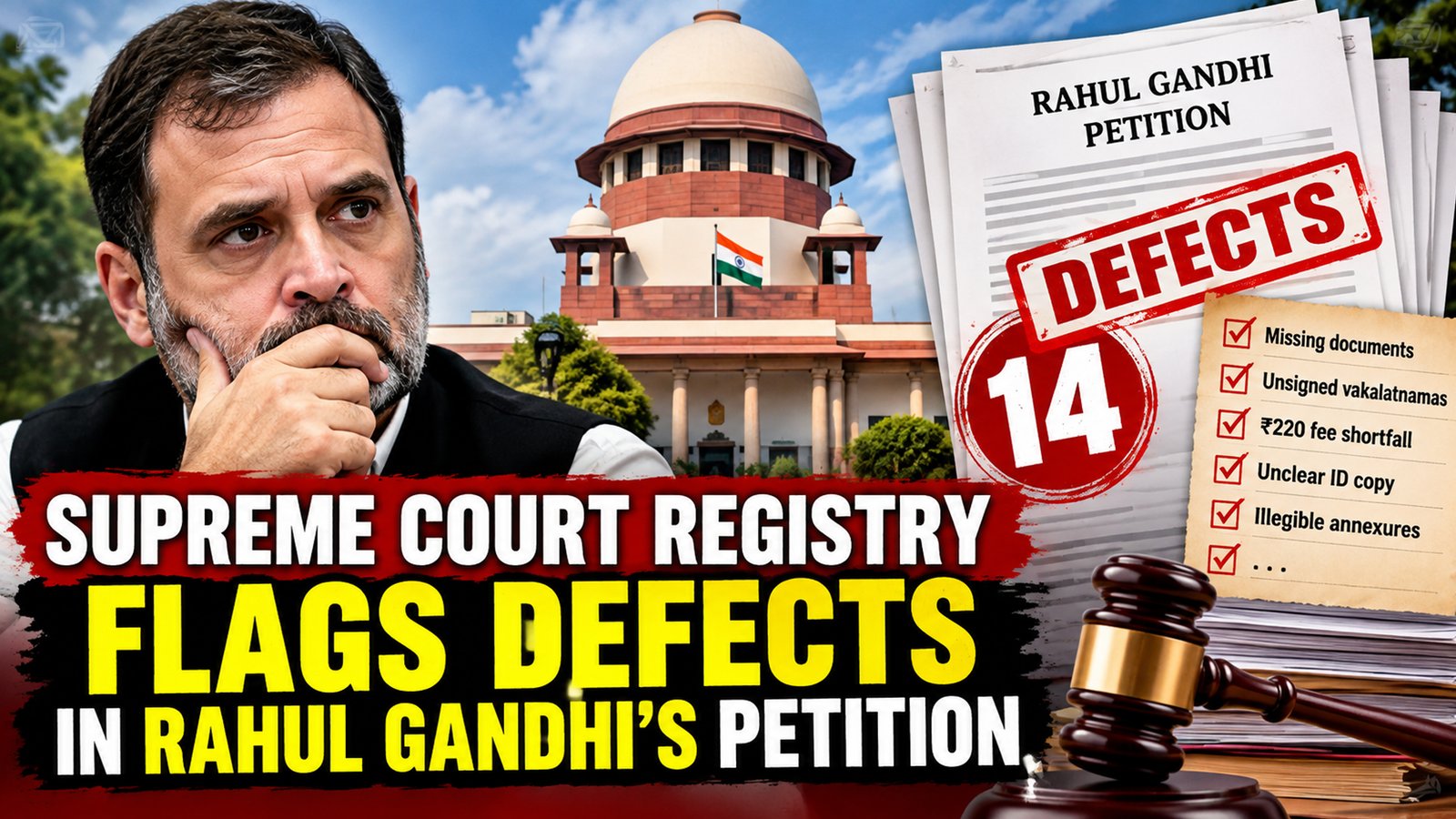
The Supreme Court registry has flagged 14 defects in a petition filed by Congress leader Rahul Gandhi and 10 other INDIA bloc leaders challenging the Election Commission of India’s (ECI) Special Intensive Revision (SIR) of electoral rolls. The objections include missing signatures, incomplete documents, an unclear identity card and a court fee shortfall of ₹220. The defects must be corrected before the petition can proceed towards a hearing.
The petition was filed on October 12 amid growing opposition to Chief Election Commissioner (CEC) Gyanesh Kumar over alleged irregularities in the voter list revision process. Opposition parties have raised concerns that eligible voters could lose their names on electoral rolls and demanded greater transparency in the exercise.
Among the objections raised by the registry was the absence of signed authorisation documents, known as vakalatnamas, for nine of the 11 petitioners. These documents formally authorise lawyers to represent clients in court. The registry also identified issues with affidavits and supporting papers submitted with the petition.
Another objection concerned the identity card submitted for Congress president Mallikarjun Kharge. The photocopy was reportedly unclear, prompting the registry to seek a legible version. Missing pages and other documentation problems were also flagged during the scrutiny of the filing.
The registry further pointed out that the court fee paid with the petition was short by ₹220. Court fees and supporting documents are part of the formal requirements for filing a case. Such procedural defects must be addressed before the matter can move through the court’s filing process.
The registry also raised questions about naming individual Election Commissioners as respondents alongside the Election Commission as an institution. The petition’s legal team will need to respond to the objections and complete the required corrections.
The objections do not amount to a judicial ruling on the allegations made by the opposition. They concern the petition’s filing requirements and documentation. The registry’s scrutiny is a procedural step and does not determine whether the claims about the SIR process have merit.
The INDIA bloc’s petition seeks an investigation into alleged irregularities in the revision of electoral rolls. Opposition leaders have called for greater accountability in the functioning of the Election Commission and safeguards to ensure that eligible voters are not wrongly excluded from voter lists.
The petition seeks an independent audit of changes made to electoral rolls during the SIR exercise. The opposition has also sought access to records relating to the Election Commission’s decisions, including documents that could help explain why names were removed or altered.
Among the demands is the formation of an independent committee led by a retired Supreme Court judge and supported by technical experts to examine deletions and modifications made during the revision process. The petition also seeks measures to protect eligible voters and ensure that changes to electoral rolls are carried out transparently.
The legal action followed a protest by INDIA bloc leaders in New Delhi on Monday. Rahul Gandhi and other opposition leaders marched towards the Supreme Court, raising concerns about the voter list revision exercise and demanding action against alleged electoral irregularities.
Police stopped the march before the leaders could reach the court premises. However, the opposition’s legal team submitted the petition as the political campaign against CEC Gyanesh Kumar gathered momentum.
The dispute centres on the SIR exercise, which aims to verify and update electoral rolls. The Election Commission undertakes such revisions to improve the accuracy of voter lists. Opposition parties, however, have questioned how the exercise has been conducted and demanded explanations about voter deletions.
The controversy has raised wider questions about transparency in election administration and the protection of voting rights. The opposition wants the court to examine whether decisions taken during the revision process followed proper procedures and whether voters affected by deletions have adequate safeguards.