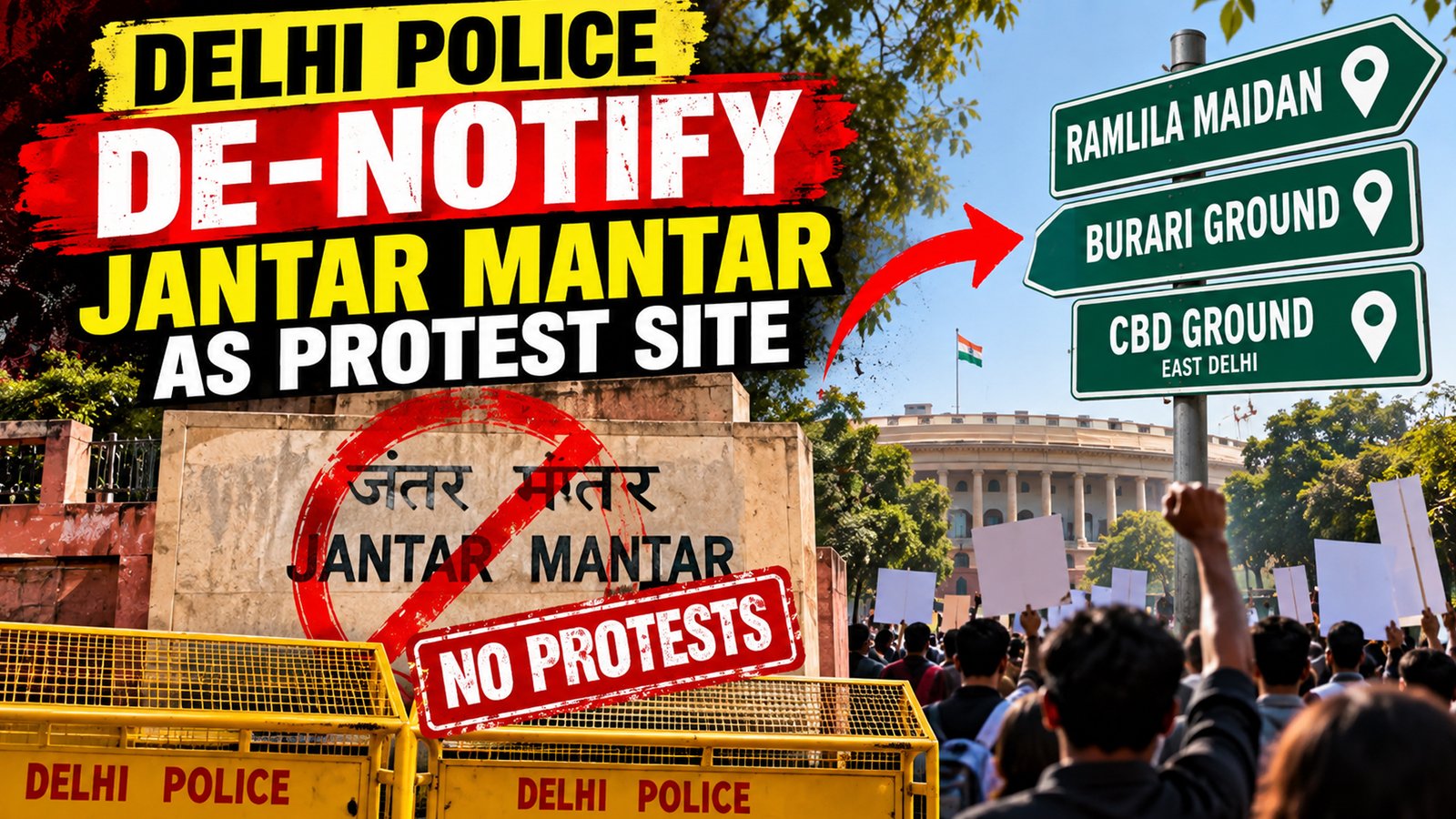
Delhi Police has removed Jantar Mantar from the list of designated venues for protests and demonstrations, marking a major change in how public dissent can be organised in the national capital. An order issued by Police Commissioner Anurag Kumar on October 11 and announced on October 12 named three alternative locations: Ramlila Ground, Burari Ground and CBD Ground in East Delhi.
The decision follows recommendations from a committee constituted by the Union Ministry of Home Affairs to examine alternative venues where citizens could organise protests and demonstrations. Delhi Police said the change modifies an earlier standing order issued in April 2022. Detailed and revised standard operating procedures governing demonstrations at the three new sites will be issued separately.
The move comes amid heightened political activity in Delhi, including protests by opposition parties, student organisations and the Cockroach Janta Party (CJP). Demonstrations at Jantar Mantar in recent months have raised demands over examination irregularities, voter-list revisions and the functioning of public institutions.
Jantar Mantar has long served as one of India’s most recognisable spaces for public protest. Located in central Delhi, the venue has hosted demonstrations by political parties, students, workers, activists and civil society groups seeking government action on a wide range of issues. Its proximity to Parliament, government offices and major political centres has made it a prominent location for campaigns seeking public and media attention.
Under the new arrangement, Ramlila Ground in central Delhi, Burari Ground in the north and CBD Ground in East Delhi will serve as the designated venues for demonstrations. The locations are spread across different parts of the city, meaning protest organisers may have to reconsider travel arrangements, mobilisation plans and access for participants.
The change has also renewed debate over the balance between public order and the right to protest. Authorities have to manage demonstrations while ensuring that public gatherings do not create serious disruption to traffic, emergency services or daily life. At the same time, protesters often rely on visible, accessible locations to communicate their demands and attract attention from policymakers.
The Ministry of Home Affairs committee was tasked with examining suitable alternatives to the existing designated site. The police order states that the decision followed the committee’s recommendations. However, the full details of the committee’s assessment and the criteria used to select the three venues have not been publicly outlined in the initial announcement.
The change is particularly significant because of the ongoing confrontation between police and groups seeking permission to demonstrate at Jantar Mantar. The CJP has been among the organisations demanding the resignation of Chief Election Commissioner Gyanesh Kumar over the controversy surrounding voter-list revisions. Opposition parties have also raised concerns about the revision process, while the Election Commission has defended its procedures.
On October 12, opposition leaders and supporters marched towards the Supreme Court over the voter-list issue. The developments came after police restrictions and detentions during earlier protests in the capital. On October 13, CJP leaders were again detained after attempting to enter the Jantar Mantar site, according to reports, underscoring the continuing dispute over access to the venue.
The controversy over voter-list revisions has become a wider political issue. Opposition parties have questioned the removal of names from electoral rolls and called for safeguards against the exclusion of eligible voters. Authorities and the Election Commission have maintained that electoral-roll revisions are part of the process of maintaining accurate voter lists. The dispute has added to the pressure on police to manage demonstrations and security arrangements in central Delhi.
The relocation of designated protest venues also raises practical questions for organisers. The distance from major political centres, public transport connections, space available for gatherings and access for participants can influence how easily a demonstration can be organised. Ramlila Ground may remain a prominent option because of its central location, while Burari and CBD Ground could require more planning for groups travelling from other parts of the city.
The right to peaceful assembly is protected under the Constitution, although it is subject to reasonable restrictions on specified grounds, including public order. Courts have recognised that authorities can regulate demonstrations, but restrictions must be assessed against constitutional protections. The designation of alternative venues therefore does not remove the broader question of how citizens can exercise their right to peaceful protest.
Delhi Police has said revised guidelines for the three locations will follow. Those rules are expected to clarify the process for seeking permission, the conditions governing gatherings and the arrangements required to maintain public safety. Until the detailed procedures are issued, protest organisers will need to follow the applicable permissions and restrictions announced by the authorities.
The decision changes a longstanding feature of Delhi’s protest landscape. Whether the new venues provide comparable access and visibility will become clearer as political groups, student bodies and civil society organisations begin using them. The central challenge remains ensuring that public order is maintained without making peaceful demonstrations unnecessarily difficult to organise.