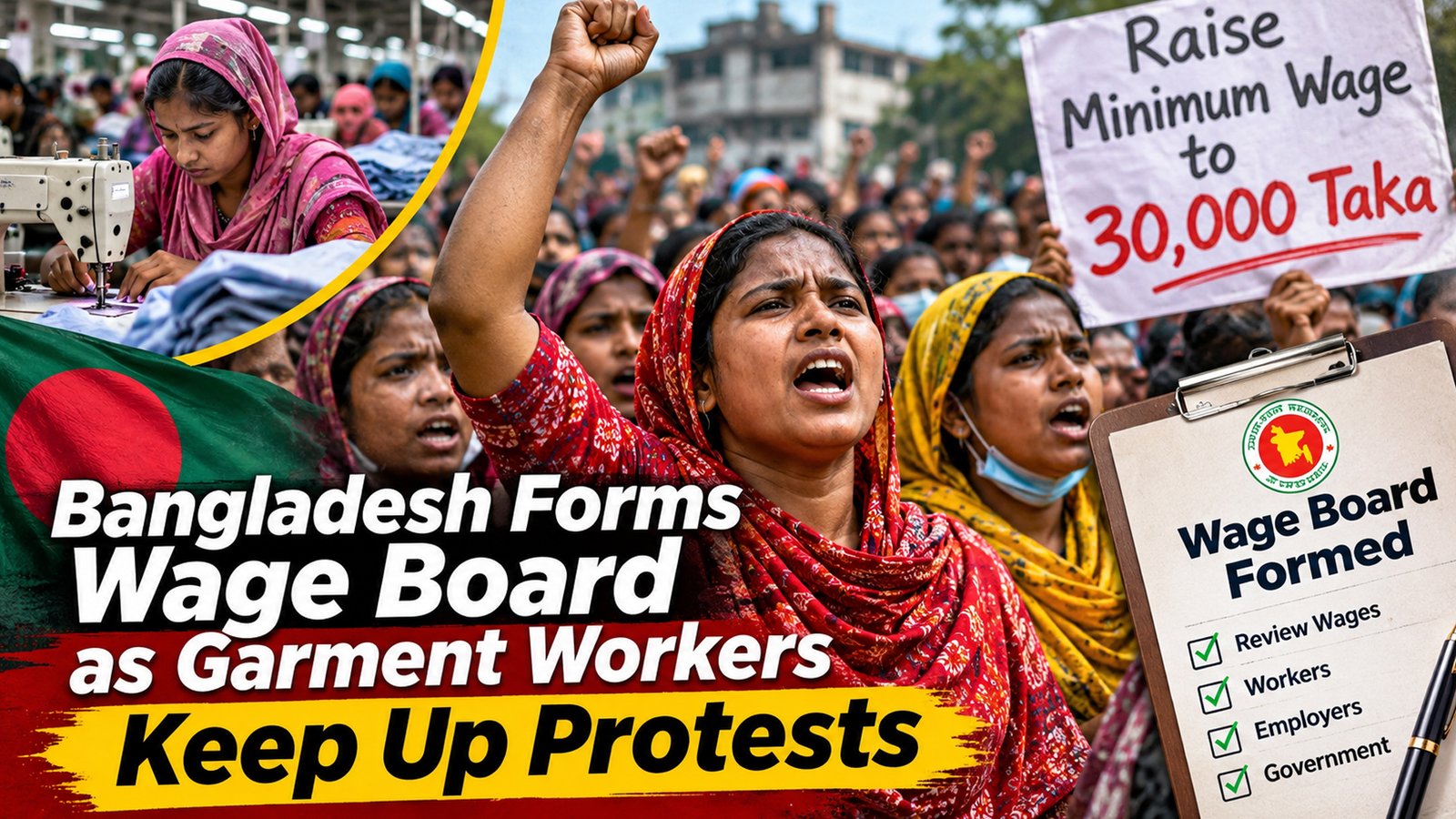
Bangladesh’s garment factories reopened on Monday, November 2, after widespread closures disrupted production across key industrial areas. But the return to work has not brought calm to the country’s largest export industry. Fresh clashes between workers and police were reported in Dhaka and nearby manufacturing hubs as employees continued demanding a sharp increase in the minimum monthly wage.
The government formed a six-member wage board on Sunday, but the move has so far failed to end the protests. Workers are seeking a minimum monthly wage of 30,000 taka, more than double the existing 12,500 taka. They say rising costs of food, house rent, transport and healthcare have made it increasingly difficult to support their families on current salaries.
On Monday, workers attempted to block roads in Dhaka, Ashulia and Gazipur. Police used tear gas to disperse demonstrators in the capital after some protesters threw bricks and stones. Water cannon were used in Ashulia, while Border Guard Bangladesh personnel were deployed in parts of Gazipur to prevent further disruption.
The unrest followed widespread demonstrations and factory shutdowns on Sunday. The Bangladesh Garment Manufacturers and Exporters Association said protests in several cities disrupted operations at 529 factories and affected nearly one million workers. Many employees were sent home after factories declared holidays, while road blockades and clashes disrupted movement in industrial areas.
The wage dispute has put pressure on an industry central to Bangladesh’s economy. The ready-made garment sector employs around four million people, contributes about 10 per cent of the country’s economic output and generates more than 80 per cent of its export earnings. Bangladesh is the world’s second-largest apparel exporter after China and supplies major international retailers and fashion brands.
For workers, the demand for a 30,000-taka minimum wage reflects the widening gap between earnings and the cost of daily life. The current minimum wage of 12,500 taka took effect in December 2023, when it was raised from 8,000 taka. Labour representatives say inflation has eroded the increase, leaving many struggling to pay for basic necessities.
The protests have also highlighted workplace grievances. Labour representatives cite unfair dismissals and blacklisting, which can make it difficult for workers to find jobs elsewhere. They want dismissed employees reinstated and such practices stopped.
The wage board will review the salary structure and recommend a revised minimum wage. It includes worker and employer representatives, a government representative and an independent member. It is chaired by senior judge Sheikh Ashfaqur Rahman. No deadline has been announced.
Labour Minister Ariful Haque Chowdhury has urged workers to return to their jobs and allow the board to carry out its review. The government has called for dialogue between employees and factory owners, warning that prolonged disruption could affect production, export shipments and payments from overseas buyers.
Home Affairs Minister Salahuddin Ahmed met garment industry representatives on Monday to discuss restoring normalcy. He warned that violence would be dealt with firmly. Police also reported arrests over allegations that political activists had instigated demonstrations, but the central dispute over pay and conditions remains unresolved.
Factory owners say a steep wage increase would be difficult to absorb amid rising production costs, energy uncertainty, gas and electricity shortages, and weaker demand in key export markets. They fear higher labour costs could squeeze margins and weaken Bangladesh’s competitiveness.
Bangladesh Garment Manufacturers and Exporters Association president Mahmud Hasan Khan urged workers to let the board complete its review. He warned employers may invoke the “no work, no pay” provision if protests force further closures.
Workers’ representatives argue the industry cannot rely on low wages. Babul Akhter, a workers’ representative on the board, said factory owners should negotiate better prices with international buyers instead of placing the burden of low-cost production on employees.
Economists say the dispute exposes a difficult balance. A substantial wage rise could increase costs and weaken competitiveness, but low pay amid inflation risks deeper hardship and further unrest. A phased adjustment, higher productivity and fairer prices from international buyers could help.
The immediate challenge is to prevent further violence, keep factories operating and give workers’ demands a serious hearing. Reopening offers temporary relief, but does not settle the wage dispute. The board’s recommendation must be acceptable to workers and manageable for employers.
Millions of livelihoods depend on the garment trade. The dispute is testing the government’s ability to manage labour relations while protecting a major source of export revenue. Without a credible path to better pay and conditions, fresh demonstrations and production interruptions remain a risk over the coming weeks ahead.