Delhi’s new winter pollution-control measures have brought long traffic queues to the capital’s borders, leaving commuters frustrated as authorities step up checks on vehicles entering the city. The restrictions, which came into force on November 1, have led to major congestion at the Delhi-Gurugram, Delhi-Noida and Delhi-Ghaziabad borders, even as air quality continues to deteriorate.
The situation remained difficult on Monday, November 2, with intensified vehicle checks causing traffic snarls on roads connecting Delhi with Haryana and Uttar Pradesh. Several entry points, including the Delhi-Sonipat and Delhi-Najafgarh borders, also reported heavy congestion. The Delhi-Gurugram border was among the worst affected, with vehicles backed up for several kilometres on National Highway 48 near the Sirhaul toll plaza. Traffic was also slow on the main carriageway and service roads.
The checks are part of the Delhi government’s Winter Action Plan, aimed at reducing vehicular emissions during the months when pollution levels typically rise. Under the new rules, petrol and diesel vehicles registered outside Delhi that do not meet Bharat Stage VI (BS-VI) emission standards are barred from entering the national capital. This includes older BS-III and BS-IV vehicles.
However, BS-VI-compliant vehicles, along with electric and CNG vehicles, are exempt from the entry restrictions. The ban is scheduled to remain in force until January 31, 2027. Officials are checking vehicle registration details and emission standards at key entry points, while violators are being turned back or issued challans.
The first day of enforcement on Sunday saw authorities check 14,930 vehicles and turn back 1,539 for failing to meet the prescribed requirements. Officials also issued 566 challans for violations of Pollution Under Control Certificate (PUCC) rules. The action resulted in penalties and environmental compensation totalling ₹68.4 lakh, according to official figures available until 5 pm.
Of the total amount, ₹56.6 lakh was collected through fines for PUCC violations, while ₹2 lakh came from penalties for vehicle-entry violations. Another ₹9.8 lakh in environmental compensation was imposed after inspections found dust-control violations at construction sites. Authorities inspected 300 sites, of which 32 were found to be violating the prescribed norms.
The enforcement drive has involved teams from the Delhi Traffic Police and Transport Department, with around 250 personnel deployed at important entry points. Officials have also been using automatic number plate recognition cameras to identify vehicles that do not comply with the restrictions. Major checking locations include Rajokri, DND Flyway, Ghazipur, Singhu, Tikri and Badarpur.
The impact on commuters was particularly visible along the Gurugram border, where traffic queues stretched across several kilometres. At the Sarhaul toll plaza, vehicles heading towards Delhi moved slowly as police personnel checked documents and emission compliance. Some commuters reported spending more than two hours in traffic.
The congestion was not limited to the Haryana border. Long queues were also reported at the Delhi-Noida border and near Municipal Corporation of Delhi toll booths. On Monday, checks continued at several crossings, with enforcement teams sending vehicles that did not meet BS-VI standards back towards neighbouring states. However, the level of checking varied between locations, with some motorists reporting that vehicles were being stopped while others passed through without detailed inspection.
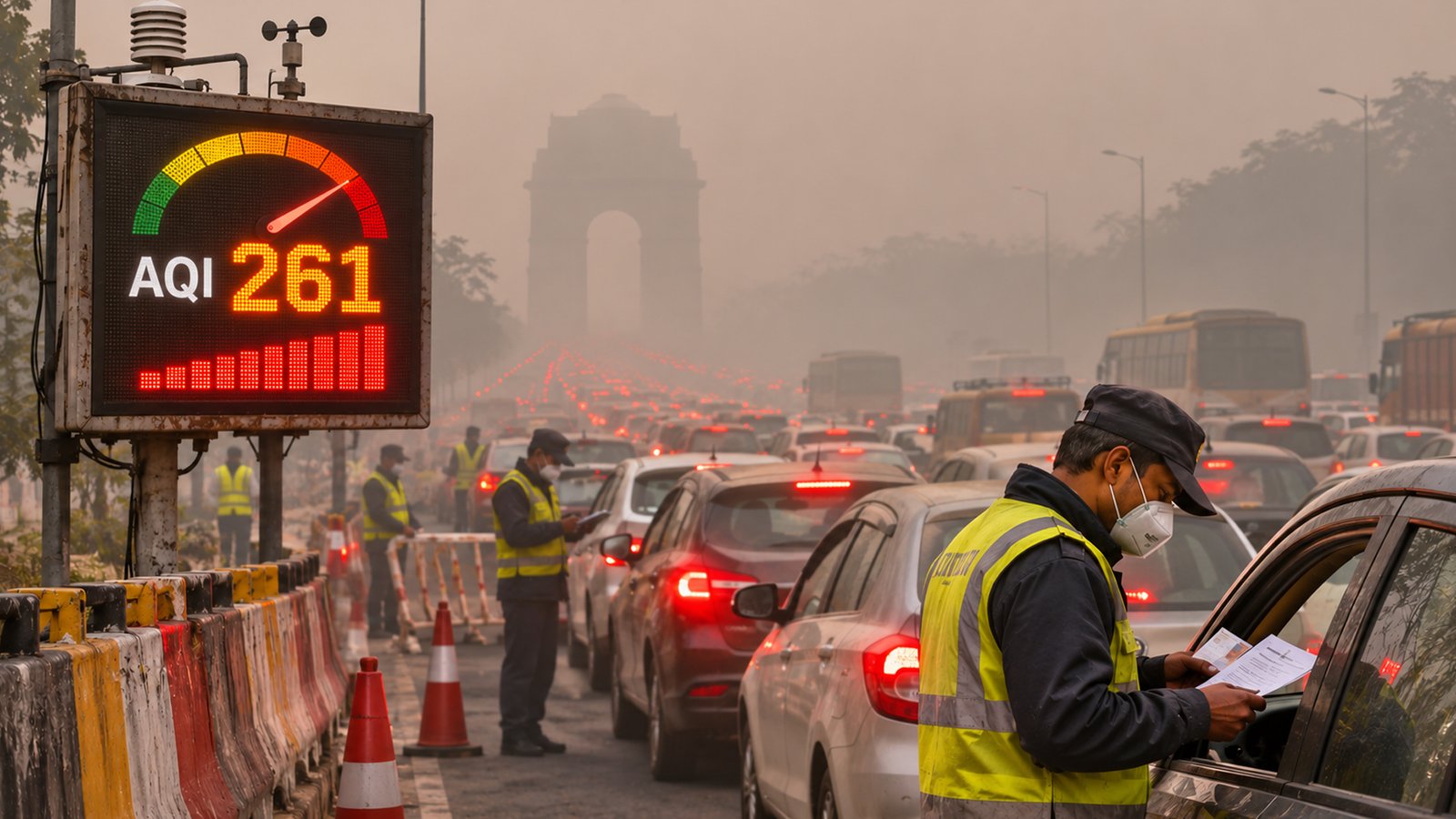
The traffic disruption has coincided with a sharp decline in Delhi’s air quality. On Sunday, the city’s Air Quality Index (AQI) stood at 261, placing it in the ‘poor’ category and marking the worst reading of the season at that point. By Monday morning, however, the situation had worsened further. The AQI reached 314 at 10 am, pushing Delhi into the ‘very poor’ category for the first time this season.
Several areas recorded particularly high pollution levels. Alipur reported an AQI of 382, while RK Puram recorded 370. Chandni Chowk, Dwarka Sector 8 and Sirifort also reported readings above 350. The figures underline the spread of pollution across the capital rather than its concentration in only a few localities.
With the AQI crossing 300, Stage II of the Graded Response Action Plan (GRAP) has been triggered. The additional measures are intended to prevent pollution from rising further and include steps to control dust, traffic emissions and other sources of pollution.
The Winter Action Plan also includes restrictions on dust-generating demolition and outdoor construction activities, except for specified essential infrastructure projects. These restrictions began on November 1 and will continue until January 31. A wider ban on construction and demolition work, with certain exemptions, is scheduled from December 10 to January 20.
Authorities are also enforcing rules requiring vehicles to carry valid Pollution Under Control Certificates. The government has urged motorists to keep their certificates updated and follow the new entry requirements. The broader restrictions will remain in place for varying periods until February 28.
While the measures are intended to improve Delhi-NCR air quality, the first two days of enforcement have highlighted the practical challenges of implementing vehicle checks across a large number of border crossings. With pollution levels rising and traffic congestion continuing, authorities will face pressure to ensure that enforcement is consistent without adding to the daily difficulties of commuters.