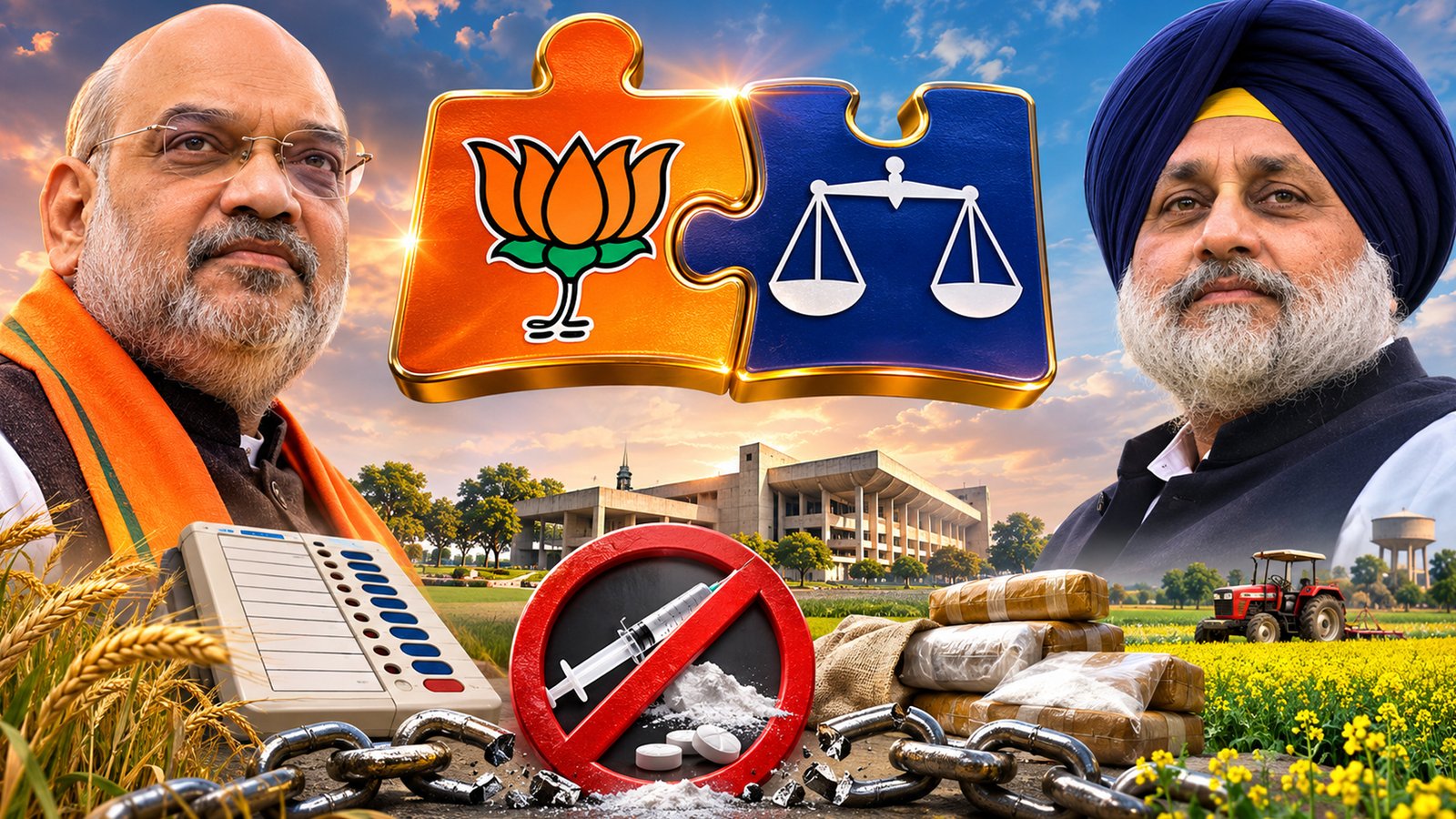
The Bharatiya Janata Party (BJP) and the Shiromani Akali Dal (SAD) have revived their alliance after six years. The announcement comes ahead of the 2027 Punjab Assembly elections. The two parties made the announcement at a joint press conference at the BJP headquarters in New Delhi on Tuesday, November 24.
Union Home Minister Amit Shah, BJP national president Nitin Nabin and SAD president Sukhbir Singh Badal attended the event. The announcement coincided with the 556th birth anniversary of Guru Nanak Dev, the founder of Sikhism.
Shah welcomed the Akali Dal’s return to the National Democratic Alliance (NDA). He described it as the NDA’s oldest ally. He also said the BJP and SAD shared deep roots in Punjab.
Shah said the renewed partnership would reflect Hindu-Sikh harmony. He added that the alliance would focus on major reforms and development in the state.
The fight against drug abuse will be a key priority. Shah said the alliance aimed to eradicate the drug menace in Punjab by December 31, 2029. He also said the parties had prepared a roadmap after three days of detailed discussions between Nitin Nabin and Sukhbir Singh Badal.
Badal described the reunion as an “emotional alliance” rather than just a political arrangement. He said the partnership would serve Punjab, the Sikh community and the country. He also recalled that his late father, former Punjab chief minister Parkash Singh Badal, had helped build the relationship between the two parties.
Badal announced that the alliance would hold a major rally in Moga on December 8. Prime Minister Narendra Modi is expected to attend the event, which will mark Parkash Singh Badal’s birth anniversary.
The alliance announcement has brought the focus back to seat-sharing. Punjab has 117 Assembly constituencies. The two parties have yet to announce how many seats each will contest in the 2027 elections.
Under their earlier arrangement, the SAD contested 94 seats, while the BJP fought from the remaining 23. The Akali Dal was the senior partner in the alliance.
However, the BJP now wants a bigger role in Punjab politics. It has been expanding its organisation and reaching out to voters across the state. The party is also keen to increase its Assembly presence.
The Times of India reported that the BJP was seeking a substantially higher number of seats than it contested under the previous arrangement. However, neither party has announced a final seat-sharing formula.
The question could test the understanding between the two partners. The BJP wants to expand its footprint, while the SAD will seek to protect its traditional political base.
Why the alliance broke up
The BJP and SAD began their partnership in November 1996. The alliance brought them electoral success and helped them form governments in Punjab in 1997, 2007 and 2012.
Their relationship ended in September 2020 over the Centre’s three farm laws. The legislation triggered widespread protests among farmers, particularly in Punjab and Haryana.
The SAD opposed the laws and withdrew from the NDA on September 27, 2020. Harsimrat Kaur Badal, who was then a Union minister, also resigned from the Union Cabinet in protest.
The farmers’ agitation continued for nearly a year. The Centre eventually repealed the three laws in November 2021. However, the political relationship between the BJP and SAD remained strained.
The decision to reunite now signals a major shift in Punjab’s political landscape. Both parties appear ready to move beyond their differences and rebuild their electoral partnership.
The two parties face considerable challenges in the state. The Aam Aadmi Party (AAP) swept the 2022 Punjab Assembly elections, winning 92 of the 117 seats. It formed the government under Chief Minister Bhagwant Mann.
The SAD won just three seats, while the BJP secured two. The results exposed the declining influence of both former allies.
The 2024 Lok Sabha elections also showed a change in the state’s political balance. The BJP secured more than 18% of the vote in Punjab, while the SAD received over 13%, according to reports. The BJP’s growing vote share has strengthened its push for a larger role in the state.
The alliance could offer benefits to both parties. The BJP has been trying to expand beyond its traditional urban support base. The SAD, meanwhile, has a long-standing network in rural constituencies and among sections of the farming community.
A partnership could help them combine their organisational strengths. It could also give them a stronger platform to challenge AAP and Congress in the next Assembly election.
However, the reunion may not be free of difficulties. The farm laws remain a sensitive issue in Punjab. The SAD will have to address concerns among farmers who opposed the legislation. The BJP, too, will need to manage differences within its state unit over the alliance.
The 2027 Punjab Assembly election is likely to see a closely watched contest among AAP, Congress and the BJP-SAD alliance, along with other political groups.