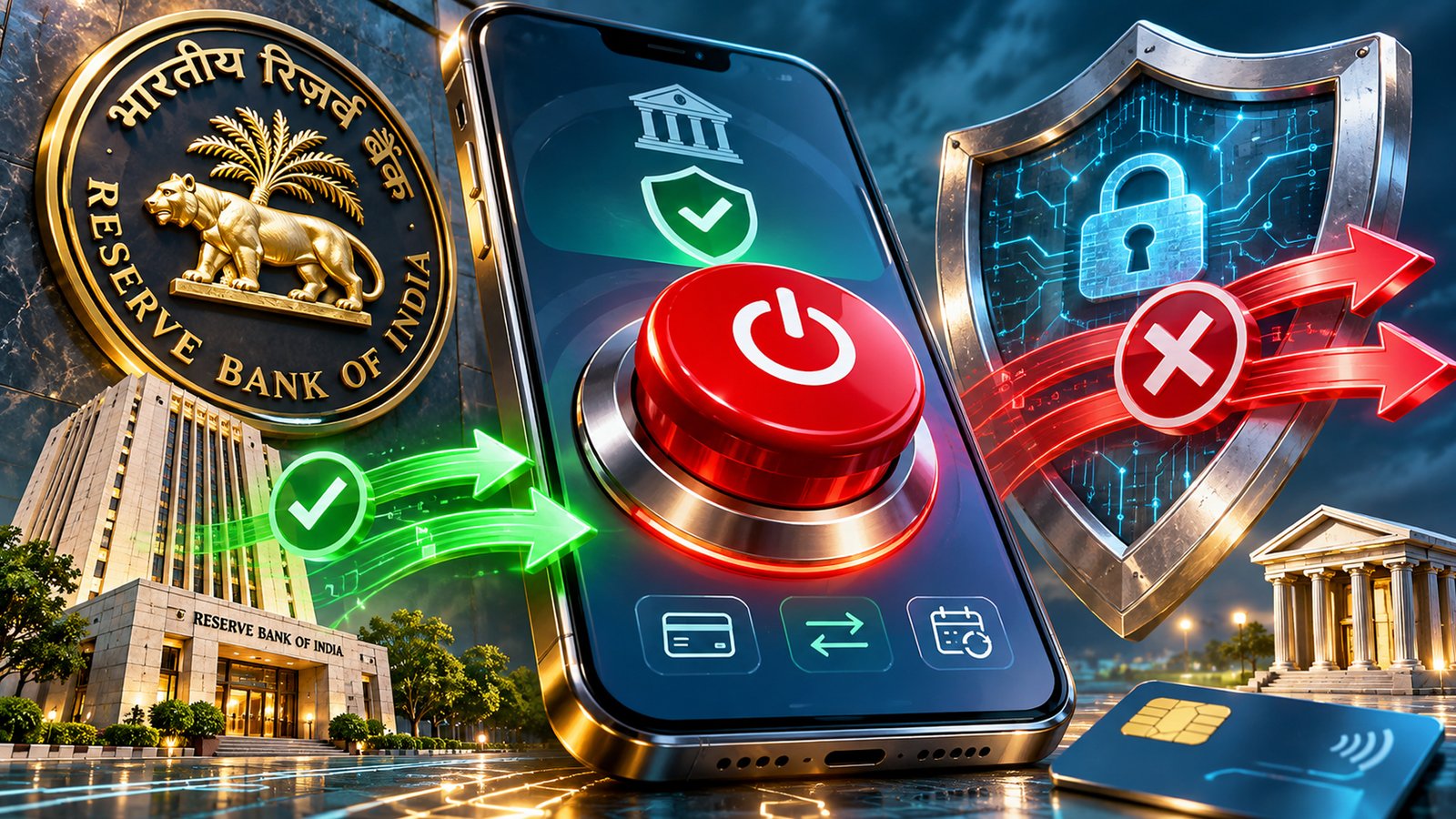
The Reserve Bank of India (RBI) has proposed a new set of safeguards to protect bank customers from digital payment fraud. The proposals aim to give account holders greater control over their money and make banks more accountable for security failures.
The draft measures include an emergency facility called the ‘Stop Switch’. It would allow customers to block outgoing payments if they suspect fraud or believe someone has gained access to their banking credentials. The RBI has also proposed customer-controlled transaction limits and an additional approval system for high-value transfers.
The proposals form part of draft amendments to the RBI’s directions on responsible business conduct. The central bank has invited comments from banks, customers and other stakeholders until December 14, 2026. The measures are not yet in force.
Stop Switch to block outgoing payments
The proposed Stop Switch will allow customers to immediately block future customer-initiated debit transactions from their bank accounts. Customers could use it if they lose their phone, suspect that their account has been compromised or notice suspicious activity.
Once activated, the facility will stop customers from initiating outgoing payments. It will also prevent them from creating new payment mandates and standing instructions. Customers will not be able to register their accounts on new third-party UPI applications during this period.
However, the facility will not freeze the entire account. Incoming payments and credits will continue. Existing recurring payment mandates and standing instructions will also remain unaffected. Bank-initiated debits, such as loan instalments and service charges, will continue as well.
Customers will be able to activate the facility through bank branches, ATMs, internet banking, mobile banking and interactive voice response systems. Banks will have to follow authentication procedures before restoring payment access. They may also introduce additional checks or a cooling-off period before reactivation.
Customers can set their own transaction limits
The RBI has also proposed giving customers more control over the amount they can transfer through digital channels.
Under the draft rules, account holders will be able to set limits for individual transactions and payments to specific beneficiaries. They can also set daily limits for individual payment channels and an overall daily limit across all digital channels.
Customers will be able to disable selected payment channels and decide when those channels can operate. This will help people restrict access to services they rarely use or do not need throughout the day.
The proposed controls will also cover debit cards, credit cards and prepaid payment instrument cards. Customers will be able to switch domestic and international transactions on or off. They can also set limits for ATM withdrawals, point-of-sale payments, online transactions and contactless payments.
The RBI wants banks to keep digital payment channels disabled by default when they open new accounts. Banks can activate these services only after customers give explicit consent and complete the required authentication.
Trusted person to approve large transfers
Another key proposal is the Trusted Person Mechanism. It will allow customers to nominate an individual to provide an additional layer of approval for high-value transfers.
The nominated person must be at least 18 years old. Customers will decide the transaction threshold that requires this additional approval. The facility will remain voluntary and will need the consent of both the account holder and the nominated person.
When a transfer exceeds the set limit, the bank will send the trusted person the transaction details. These will include the amount and beneficiary information. The person will then have one hour to approve or reject the transaction.
The bank will decline the transfer if the trusted person rejects it or fails to respond within the allotted time. The mechanism will also have a 24-hour cooling-off period before activation.
The RBI has clarified that the trusted person will not gain access to the customer’s bank account or financial details. The nominee will not be able to view account balances, deposits, investments or insurance information. The person will also not be able to initiate transactions independently or become financially liable for transfers.
The mechanism will not cover UPI payments, merchant transactions or recurring payments made through standing instructions, e-mandates and the National Automated Clearing House system.
Customers will be able to change or remove their nominated person, revise the transaction threshold or withdraw from the facility. Such changes will require authentication and may involve a 24-hour cooling period.
RBI seeks greater accountability from banks
The draft also proposes a wider definition of negligence by banks in cases of fraudulent electronic transactions.
Under the proposed framework, banks could face liability if they fail to follow prescribed authentication requirements, send mandatory transaction alerts or provide round-the-clock channels for reporting fraud. Delays in responding to customer complaints could also fall under the expanded definition.
The RBI has also included system malfunctions, security breaches and collusion involving bank employees or third parties engaged by banks. These failures could attract liability if they contribute to fraudulent transactions.
The proposals cover commercial banks, small finance banks, payments banks, regional rural banks, local area banks and cooperative banks.
The RBI has set December 14, 2026, as the deadline for public comments. If finalised, the customer safeguards are proposed to take effect from July 1, 2027, or an earlier date chosen by banks. The provisions expanding the definition of bank negligence are proposed to take effect from January 1, 2027.