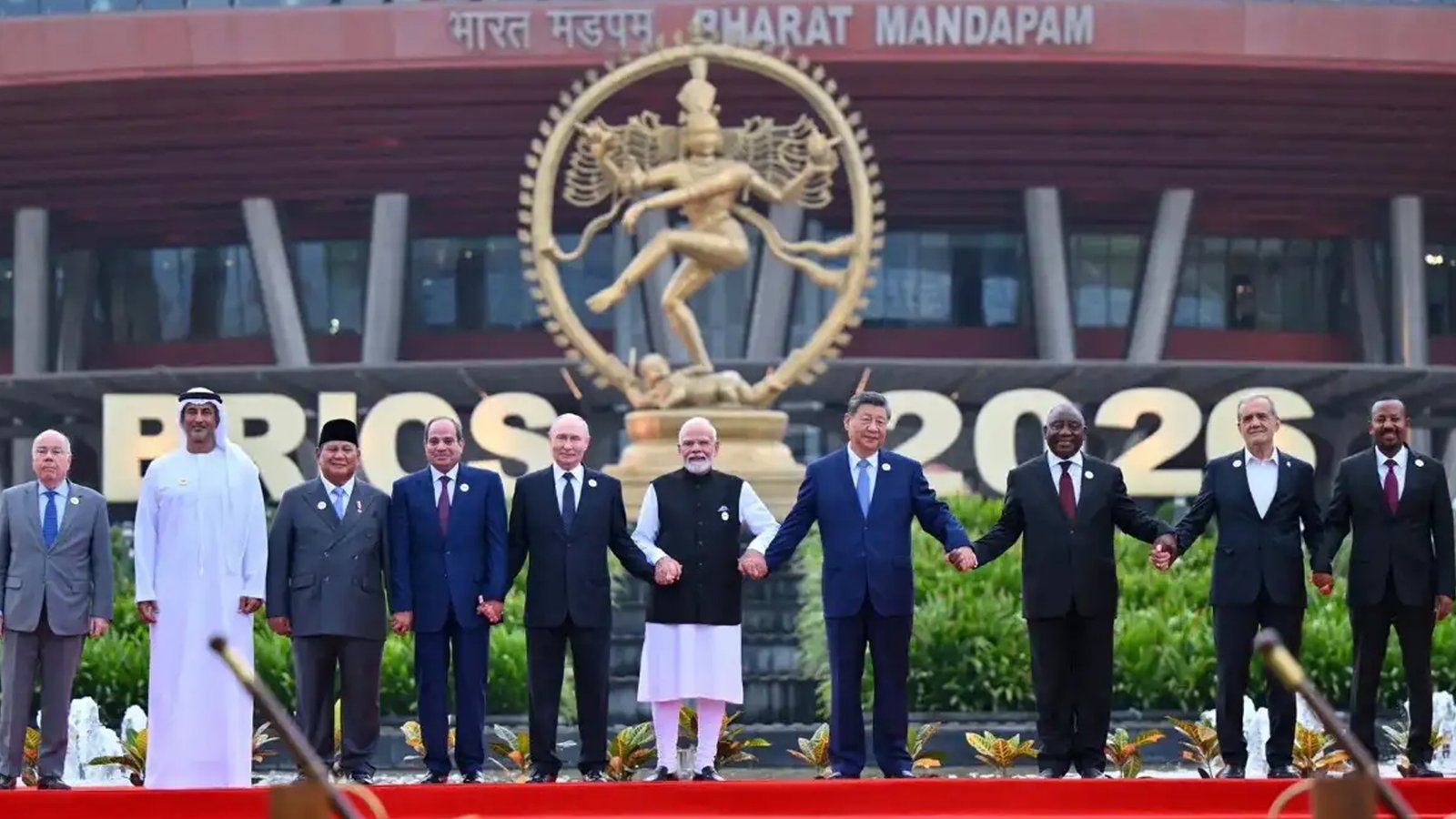
BRICS leaders have wrapped up their 18th summit in New Delhi with a broad agreement on some of the biggest issues shaping the global economy and geopolitics. The New Delhi Declaration 2026 brings terrorism, trade, artificial intelligence, conflicts in West Asia and reform of global institutions to the centre of the expanded group’s agenda.
The 45-page declaration was adopted unanimously on September 13, despite significant differences among member countries on conflicts and foreign policy. India used its year as BRICS chair to focus on areas where members could work together, while also pushing for a greater role for developing countries in global decision-making.
Terrorism emerged as one of India’s strongest priorities. BRICS leaders condemned terrorism in all its forms and called for those responsible for terrorist attacks, as well as their supporters, to be brought to justice.
The declaration specifically referred to the Pahalgam terror attack of April 22, 2025, in which 26 people were killed. It also called for action against terrorist financing, recruitment, cross-border movement and safe havens.
India has repeatedly sought a stronger international response to terrorism, particularly when attacks involve cross-border networks. The inclusion of Pahalgam in the BRICS declaration therefore carries considerable diplomatic significance for New Delhi.
The bloc also renewed its support for efforts to finalise the Comprehensive Convention on International Terrorism at the United Nations. BRICS leaders stressed that there should be no double standards in the fight against terrorism.
Trade was another major area of discussion as the global economy continues to deal with tariffs and protectionist policies.
The declaration criticised the growing use of unilateral tariffs and non-tariff barriers, warning that they can disrupt supply chains and create uncertainty for businesses and economies. BRICS reaffirmed its support for the World Trade Organization and called for reforms to make the global trading system more representative.
The wording comes at a time of heightened trade tensions, particularly because of tariff policies pursued by the United States. While Washington was not directly named, the bloc’s criticism of unilateral tariff measures sends a clear message against protectionism.
BRICS members also opposed unilateral economic sanctions that are not supported by the UN Security Council. The declaration argued that such measures can have wider consequences for developing economies and vulnerable populations.
The long-running debate over a common BRICS currency, meanwhile, did not result in a major breakthrough.
Instead, the members agreed to continue exploring ways to increase the use of national currencies in cross-border trade and investment. The BRICS Payment Task Force will continue work on improving links between members’ payment systems.
The New Development Bank will also be encouraged to expand lending in local currencies. The move is aimed at reducing transaction costs and making cross-border trade less dependent on a single international currency.
India also secured backing for its proposal to create a BRICS Risk Lab at GIFT City in Gujarat. The initiative is intended to improve cooperation and understanding of financial risks among member countries.
Artificial intelligence has emerged as another major area of cooperation.
BRICS leaders described AI as a powerful tool for economic growth, innovation and development but stressed that its benefits should reach developing countries as well. The declaration called for AI to be safe, secure, inclusive and reliable.
The group also highlighted concerns around misinformation, deepfakes, data security and the misuse of emerging technologies. Greater cooperation on AI research, skills and infrastructure was encouraged.
China proposed an AI Open Source Zone as part of wider cooperation, while India’s AI Impact Summit was recognised as an important contribution to the global discussion on responsible AI governance.
The focus on artificial intelligence reflects a larger change in the BRICS agenda. Technology is no longer being viewed only as an economic issue. It is increasingly linked to national security, industrial competitiveness, jobs and development.
The continuing crisis in West Asia was another sensitive subject at the summit.
BRICS called for dialogue and diplomatic solutions to conflicts and expressed support for a political settlement to the Palestinian issue. The declaration backed a two-state solution and stressed the need for humanitarian assistance and an end to violence.
Reaching common ground on West Asia was not easy because BRICS includes countries with different interests and relationships in the region. The final language therefore focused on broad principles such as sovereignty, dialogue, humanitarian assistance and peaceful resolution of conflicts.
The summit also renewed calls for reform of the United Nations and other multilateral institutions.
India has consistently argued that developing countries need greater representation in global decision-making bodies, particularly the UN Security Council. BRICS leaders backed the idea of making international institutions more representative of today’s economic and political realities.
India’s presidency also placed development and practical cooperation high on the agenda. Initiatives covering digital public infrastructure, healthcare, education, industrial skills and sustainable development received attention.
A BRICS digital public infrastructure repository was supported, while members also backed greater cooperation in Industry 4.0 and skills development. The bloc also welcomed a BRICS-NDB Knowledge Portal and a Task Force on Growth and Development.
The expanded BRICS now has 11 members, covering major economies and energy producers across Asia, Africa, the Middle East and Latin America. Its growing size gives the group greater influence, but it also makes consensus more complicated.
The New Delhi summit showed that BRICS can still find common ground despite political differences. Terrorism, trade, AI, financial cooperation and global governance provided areas where members could move forward together.