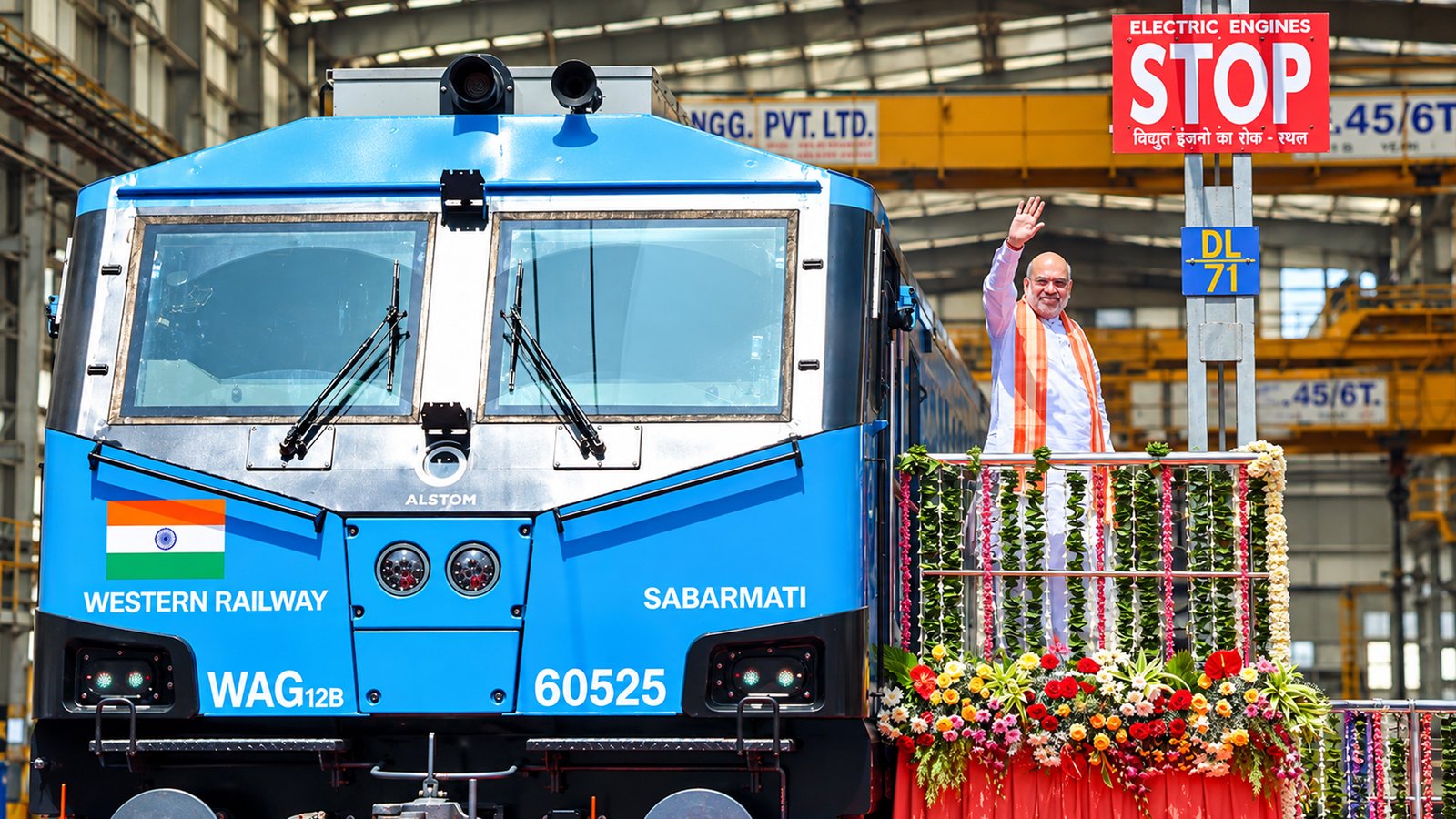
India has added another alternative-fuel technology to its railway network with the launch of the country’s first LNG-powered train in Gujarat. Union Home Minister Amit Shah flagged off the train from Sabarmati Railway Station in Ahmedabad on September 27, marking a new step in Indian Railways’ efforts to reduce diesel consumption and explore cleaner fuel options.
The train uses a diesel-LNG dual-fuel system, meaning it can operate on both conventional diesel and liquefied natural gas. Two 1,400-horsepower Driving Power Cars at the Sabarmati Integrated Coaching Depot have been converted for the technology. LNG is expected to replace nearly 40% of the diesel normally used by the system.
The inaugural service operates between Sabarmati and Mahesana Junction. The eight-coach train has non-AC chair-car seating and underwent more than 2,000 km of field trials before being introduced for passenger operations.
How the LNG train works
Unlike a conventional diesel train, the new system uses LNG alongside diesel. The engine can switch between the two fuels depending on operating conditions and fuel availability.
Each Driving Power Car has an LNG tank with a capacity of about 2,200 litres. The system has been designed to maintain the required engine performance while reducing the amount of diesel consumed.
Railway officials expect the shift to LNG to lower fuel costs and reduce emissions such as carbon dioxide, nitrogen oxides and particulate matter compared with conventional diesel operation. Trial-based estimates reported for the project indicate annual fuel savings of around ₹11.9 lakh per Driving Power Car.
The move is particularly relevant for railway sections that are not yet fully electrified. Instead of replacing the diesel system completely, the dual-fuel model allows existing infrastructure to be adapted to use LNG.
LNG comes after hydrogen train
The LNG train comes just over two months after Indian Railways introduced its first hydrogen-powered train.
India’s hydrogen train was launched on July 17 and uses a fundamentally different technology. It generates electricity through hydrogen fuel cells, where hydrogen reacts with oxygen to produce electrical energy. Water vapour is the direct by-product of that process.
The LNG train, meanwhile, continues to use an internal-combustion engine, with LNG replacing part of the diesel requirement. This makes LNG a dual-fuel transition technology, while hydrogen represents a fuel-cell-based propulsion system.
Both technologies are being explored as Indian Railways looks at ways to reduce dependence on conventional diesel, particularly on routes where complete electrification is not immediately available.
₹1,542 crore railway projects
The LNG train was launched alongside a wider package of railway projects in Gujarat. The projects announced at Sabarmati were initially described as worth more than ₹1,542 crore, while subsequent reports from the event put the value of works inaugurated and foundation stones laid at about ₹1,472 crore.
The package includes railway safety, signalling, freight infrastructure and track expansion.
A major component is the indigenous Kavach automatic train protection system. Work has begun to extend Kavach across 404 km of railway network in the Ahmedabad division, covering sections of the Ahmedabad-Palanpur and Ahmedabad-Samakhiyali routes. The system is designed to help prevent train collisions, control overspeeding and reduce risks linked to human error.
An automatic block signalling system has also been introduced across 122.57 km of railway sections. The system allows trains to maintain safe distances while helping increase the capacity of busy routes.
Focus on freight and connectivity
Another major project is the ₹700-crore WAG-12 locomotive maintenance shed at Sabarmati. The facility will support maintenance of up to 300 high-horsepower electric locomotives.
WAG-12 locomotives have around 12,000 horsepower and are designed to haul heavy freight trains. Strengthening maintenance infrastructure is expected to support the growing demand for freight movement on India’s rail network.
The 21-km Sabarmati-Sarkhej railway line doubling project, estimated at ₹313.27 crore, is targeted for completion by March 2028. The project covers stations including Sabarmati, Gandhigram, Vastrapur and Sarkhej and includes associated bridge and road-underpass works.
The launch of India’s first LNG train therefore comes as part of a broader railway modernisation effort. While electrification remains central to Indian Railways’ long-term strategy, LNG and hydrogen are being tested as alternative solutions for specific operational needs.
The immediate significance is the introduction of a new fuel technology on a working railway service for commuters. For Indian Railways, the project provides an opportunity to assess whether dual-fuel LNG technology can deliver sustained fuel savings and lower emissions on suitable routes.