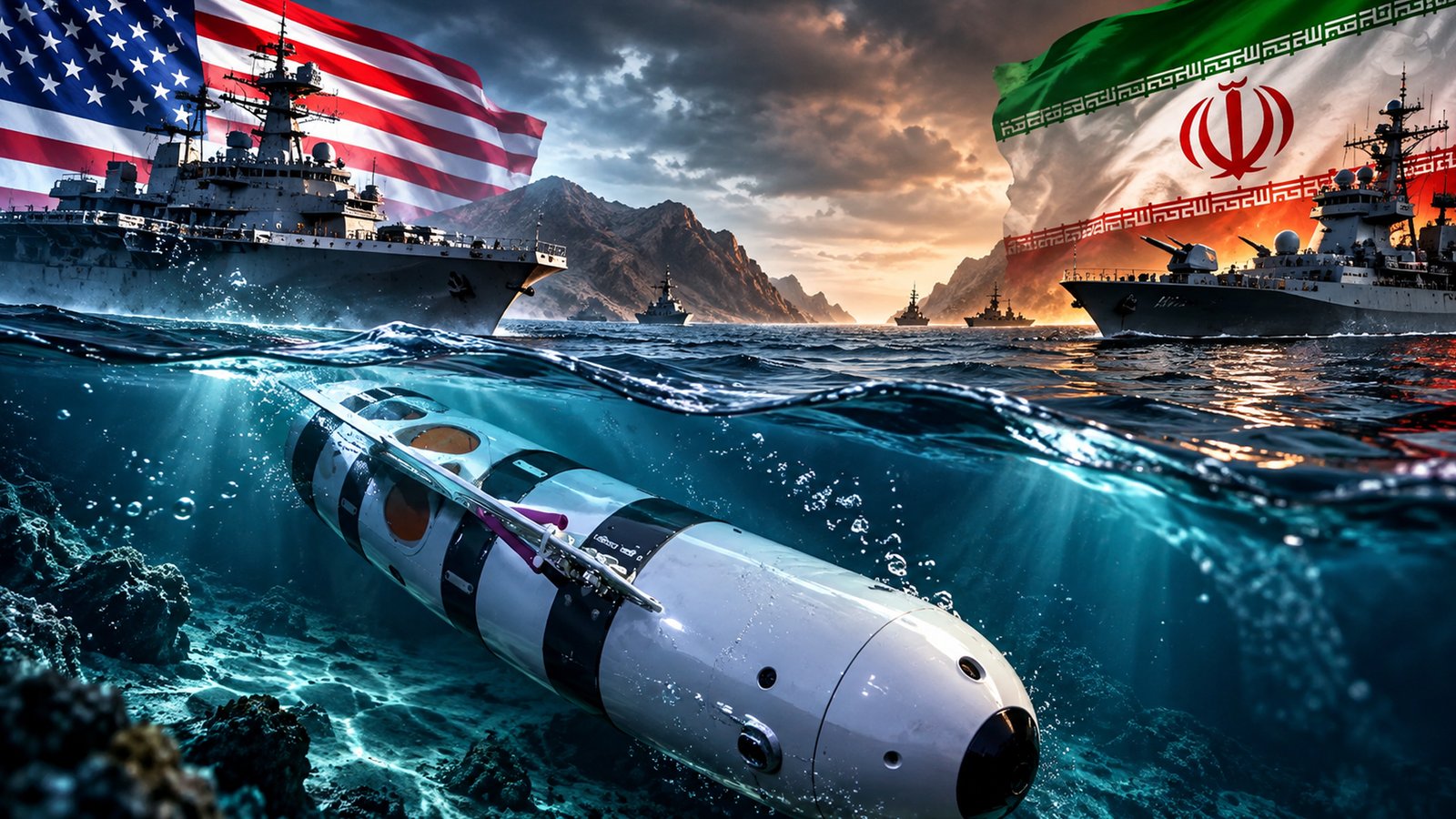
A new dispute between the United States and Iran has emerged over an alleged seizure of a US underwater drone in the strategically important Strait of Hormuz.
Iran’s Islamic Revolutionary Guard Corps (IRGC) Navy said it had captured a second American unmanned underwater vehicle during an operation in the waterway. Washington rejected the claim, saying its operational drone assets remain accounted for.
The latest dispute comes as tensions remain high around the Strait of Hormuz, a vital route for global oil and gas shipments. The narrow waterway has become a key flashpoint in the wider US-Iran confrontation.
The IRGC said its naval forces intercepted the underwater vehicle during what it described as an operation involving military intelligence and electronic warfare.
Iran initially identified the vehicle as a REMUS 600, an autonomous underwater system used for tasks such as surveillance, seabed mapping and mine detection.
Iranian officials said the vehicle had been transferred to specialists who would examine it and attempt to retrieve information from its systems.
The IRGC later identified the vehicle as a Mk 18 Mod 2 Kingfish, another autonomous underwater system used by the US military. IRGC spokesperson Hossein Mohebbi described it as the second US underwater vehicle allegedly captured in the Strait of Hormuz.
Iran has claimed that the vehicle was carrying out a surveillance mission in the strategic waterway. However, there has been no independent confirmation of the alleged capture or the purpose of the mission.
Washington has strongly rejected Tehran’s account.
US Central Command spokesperson Captain Tim Hawkins said the US military maintains “positive control” of all its operational drone assets. He described Iran’s claim as “clearly desperate”.
The statement means the US does not acknowledge that an operational American underwater drone has been seized by Iranian forces.
The conflicting accounts also highlight the difficulty of independently verifying military claims during periods of heightened tensions. While Iran has released material linked to the alleged seizure, reports have not independently established when or where the vehicle was supposedly captured.
The latest claim follows another disputed underwater drone incident earlier this month.
On September 8, Iranian authorities said they had intercepted and captured another US unmanned underwater vehicle near the entrance to the Strait of Hormuz. Iran identified the system as a Dive-LD, an autonomous underwater vehicle developed by US defence technology company Anduril.
The United States offered a different explanation. American officials said the vehicle had malfunctioned more than a day earlier while supporting operations in the region.
A Pentagon spokesperson described it as an older system and said it did not contain sensitive data or classified sonar or radar equipment.
The two conflicting accounts have added to tensions surrounding the use of unmanned systems in the region.
The Strait of Hormuz is one of the world’s most important maritime energy routes. Large volumes of oil and gas pass through the waterway, making any disruption a concern for global energy markets and international trade.
Iran’s Revolutionary Guards have continued to warn against what they describe as dangerous or unauthorised maritime activity in the area.
The latest incident also highlights the growing role of unmanned underwater vehicles in military operations. Such systems can be used for surveillance, seabed mapping, mine detection and monitoring underwater infrastructure without putting military personnel directly at risk.
The alleged drone seizure comes against the backdrop of broader military tensions between Washington and Tehran.
Iran says its forces successfully intercepted an American underwater vehicle and are examining the equipment. The United States, meanwhile, maintains that its operational drones remain under its control.
With the two sides presenting sharply different versions of events, independent verification remains important.
The dispute has also placed renewed attention on the Strait of Hormuz, where developments involving military vessels, drones and commercial shipping can have consequences far beyond the region.