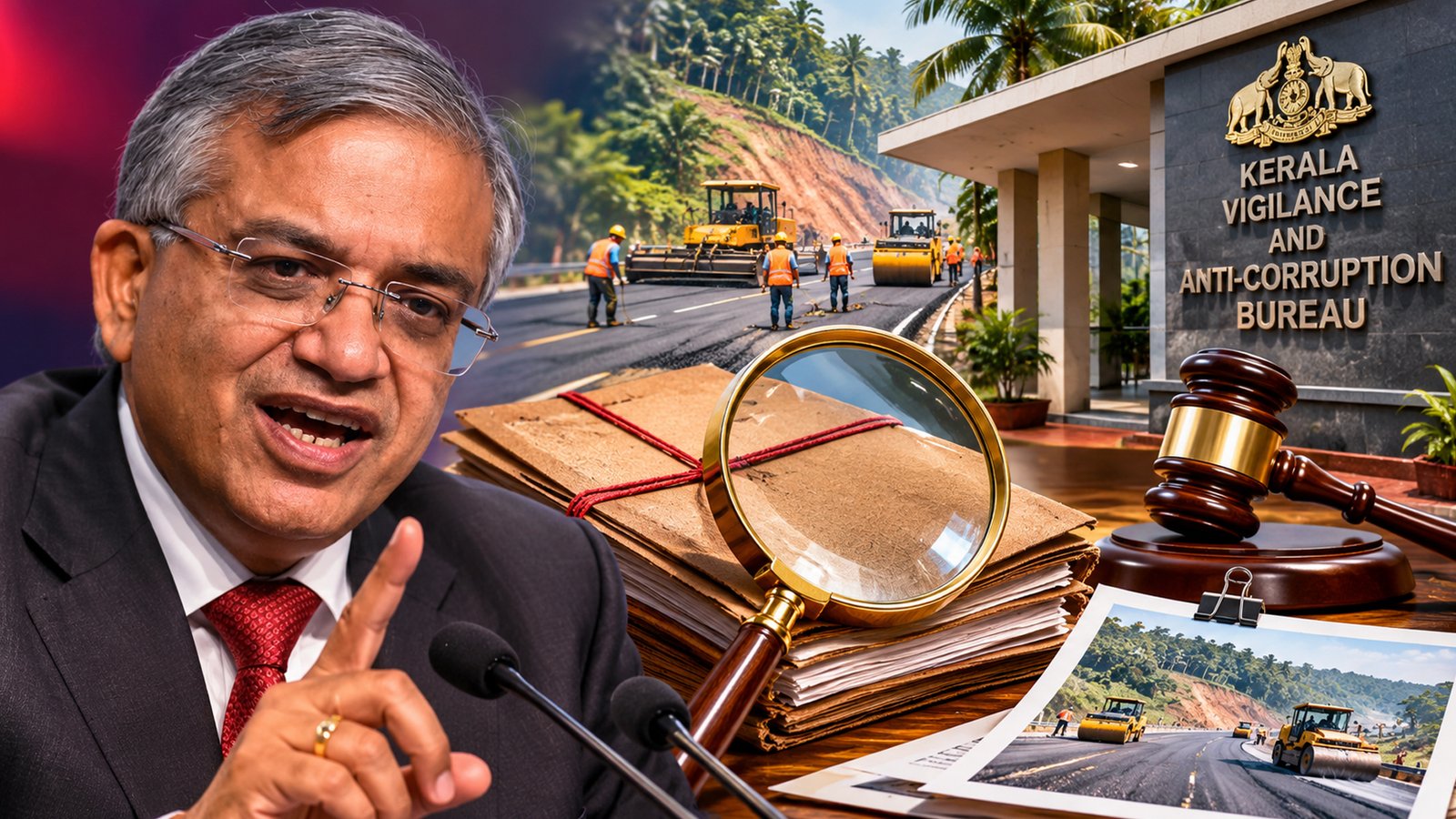
The Kerala government has ordered a fresh Vigilance and Anti-Corruption Bureau (VACB) inquiry into allegations that Chief Election Commissioner (CEC) Gyanesh Kumar demanded a bribe of ₹2 crore to clear pending payments for a road construction project nearly two decades ago, when he was serving as the state’s Public Works Department (PWD) secretary.
The latest action follows a complaint filed by former contractor V.O. Sajan, who has alleged that Kumar sought money from Malaysian engineer Lee See Been, who was associated with the India-Malaysia joint venture PATI-BEL. The company was involved in upgrading the MC Road under the Kerala State Transport Project (KSTP), a World Bank-assisted infrastructure project.
Kerala Home Minister Ramesh Chennithala has directed the Vigilance department to examine the allegations and conduct a preliminary inquiry. The decision comes after the department sought the government’s approval following a legal examination of the complaint. The Vigilance director will determine the further course of action, including whether a formal case should be registered.
According to Sajan’s complaint, Kumar allegedly withheld payments for completed construction work and demanded a ₹2-crore bribe to release the outstanding bills. The contractor claimed that the pending payments had created serious financial difficulties for PATI-BEL, its subcontractors and workers.
Sajan, who hails from Kollam district, said he had worked as a subcontractor for PATI-BEL and supplied construction materials for the project. His association with the company allowed him to interact regularly with Lee and other project officials.
He alleged that payments were initially made on time, allowing the construction work to progress smoothly. However, the situation changed when several bills remained pending despite receiving the necessary approvals from engineers.
According to Sajan, Lee informed him that four cheques worth around ₹14 crore were awaiting clearance with the then PWD secretary. The contractor has also referred to outstanding project payments of approximately ₹17 crore in connection with the dispute.
Sajan claimed that Lee later told him that Kumar had allegedly demanded ₹2 crore to release the payments. He further alleged that the Malaysian company was unwilling to pay a bribe to secure the clearance of legitimate bills.
The delay reportedly affected the company’s ability to pay contractors, suppliers and workers. Sajan claimed that Lee eventually used funds from another PATI-BEL project in Bengaluru to settle some of the outstanding liabilities.
The complaint also links the alleged bribery demand to the death of Lee, who died by suicide in Malaysia in 2006. Sajan has claimed that the engineer was under considerable mental and financial pressure because of the payment dispute.
He further alleged that Lee had referred to Kumar in a suicide note and that members of the engineer’s family had informed company employees about its contents. However, the alleged suicide note has not been made publicly available, and the claims have not been independently established.
Sajan has questioned the earlier Vigilance investigation into the matter, arguing that investigators did not record statements from him or other contractors who could provide information about the alleged bribery demand.
He has offered to provide additional evidence, including details of Lee’s family members, former company employees and other people associated with the road project. The contractor has maintained that a comprehensive investigation is necessary to establish what happened and whether the earlier inquiry adequately examined the allegations.
The latest complaint is not the first attempt to reopen scrutiny of the allegations against Kumar. The Kerala government had already initiated another Vigilance inquiry following a complaint submitted by Congress leader Malayinkeezhu Venugopal on October 4.
That complaint raised questions about alleged corruption in the Kerala State Transport Project and the handling of the earlier investigation. It also sought an examination of claims that Kumar’s name figured in the Malaysian engineer’s suicide note.
The previous Vigilance investigation, which began after the allegations surfaced in 2006, was subsequently closed after investigators reported that the charges could not be substantiated. The government had stated that the available evidence did not justify further action.
Kerala Home Minister Chennithala had also informed the Assembly that the earlier investigation examined allegations relating to several public works contracts awarded between 2003 and 2006. The Vigilance department reportedly discontinued proceedings after failing to establish the alleged irregularities.
The fresh complaint has now brought renewed attention to the circumstances surrounding the original investigation and whether all relevant witnesses were questioned.
The development comes at a politically sensitive time for the Chief Election Commissioner. Kumar has been facing criticism from Congress and other Opposition parties over the Election Commission’s Special Intensive Revision (SIR) of electoral rolls in different parts of the country.
Opposition leaders have questioned the Election Commission’s approach to voter list revisions and raised concerns about the treatment of voters during the exercise. The renewed allegations against Kumar have consequently added another political dimension to the ongoing confrontation.
However, the bribery allegations relate to his earlier tenure as Kerala’s PWD secretary and are separate from his present responsibilities as Chief Election Commissioner.
Kumar has not issued a public response to the latest allegations, according to the reports available. The claims remain allegations and will have to be examined by the Vigilance authorities before any conclusions can be drawn.
The fresh inquiry is expected to examine the contractor’s claims, the pending project payments, the circumstances surrounding Lee’s death and the handling of the earlier investigation. Its findings could determine whether further legal action is warranted in a case dating back nearly 20 years.