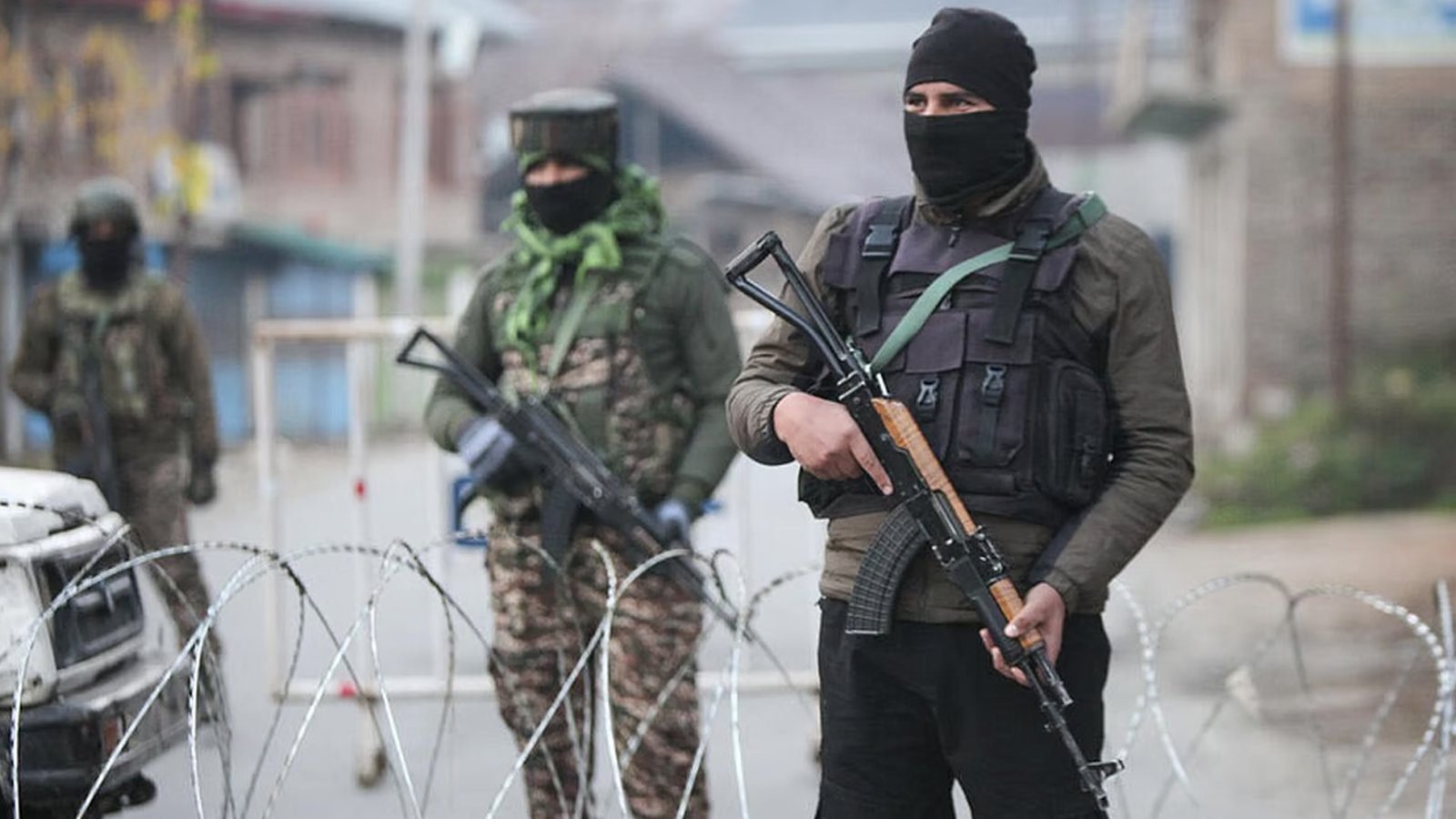
Security forces on Wednesday, November 18, killed top Lashkar-e-Taiba (LeT) commander Mohammed Lateef Bhat in an encounter in Jammu and Kashmir’s Kulgam district, bringing an end to an extensive search operation that had continued across parts of south Kashmir for several days. Bhat, one of the most wanted local militants in the Valley, was allegedly involved in the November 11 attack on Central Reserve Police Force (CRPF) personnel in which three paramilitary personnel were injured.
The encounter took place at Zangalpora village in the Devsar area after security forces received specific intelligence inputs about Bhat’s presence. A joint team of the Jammu and Kashmir Police and security personnel launched a cordon-and-search operation and managed to establish contact with him early Wednesday.
According to officials, Bhat had taken shelter inside a mosque after being cornered by security forces. The forces repeatedly appealed to him to surrender, including through a video call. Kulgam Senior Superintendent of Police Anayat Ali Chowdhary said he personally spoke to Bhat for an extended period and urged him to give up his weapons, reminding him that he was young and had his entire life ahead of him.
However, Bhat refused to surrender and continued to remain inside the religious structure. Officials said he opened fire on security personnel, triggering an exchange of gunfire that eventually led to his death.
Security forces exercised restraint during the operation to avoid damaging the mosque. The police said they were making every effort to minimise damage to the religious structure while following established operational procedures. The authorities maintained that the operation was handled carefully despite the challenges posed by the militant’s location.
The killing marks a significant development in the investigation into the November 11 attack on a CRPF checkpoint in the Akhran area of Kulgam. Bhat and his associate Umar Nisar Dar were suspected of carrying out the attack, which left three CRPF personnel injured.
Dar was killed in an encounter near the Laru bypass area on Monday, November 16. Bhat, however, managed to escape during that operation, prompting security forces to intensify searches across the surrounding villages and orchards.
Investigators suspect that Dar had provided shelter and logistical support to Bhat for nearly six months before the attack. CCTV footage reportedly captured the two conducting reconnaissance at several locations in Kulgam on November 10 and 11, a day before the attack. The footage is believed to have helped investigators reconstruct their movements before and after the incident.
Dar, who worked as a baker, had reportedly been missing, and his family had lodged a missing-person complaint. Security agencies suspect that he became associated with the militant network shortly before the attack. Investigations also indicated that he had joined The Resistance Front (TRF), an organisation described by security agencies as an offshoot of LeT.
While the security operation was aimed at tracking down those responsible for the CRPF attack, the prolonged searches had a significant impact on everyday life in several parts of Kulgam.
According to reports, restrictions on movement, house-to-house searches and frequent frisking of residents continued for seven consecutive days, leaving many families struggling to carry on with their daily activities. Security personnel were deployed across several villages, while residents faced repeated identity checks and restrictions on movement.
Reports of people being made to stand outside their homes during freezing night hours also triggered concern among political leaders and civil society representatives. The extended security measures brought renewed attention to the difficulties faced by ordinary residents during counter-terror operations.
Kulgam MLA and Communist Party of India (Marxist) leader Mohammad Yousuf Tarigami criticised the prolonged restrictions, arguing that civilians should not be made to suffer for an attack they had no role in. He said security forces should take action against those responsible but warned that harassment of innocent residents could deepen alienation and resentment.
Former Jammu and Kashmir chief minister and Peoples Democratic Party (PDP) president Mehbooba Mufti also expressed concern, describing the situation in Akhran as deeply distressing. She questioned the justification for imposing restrictions on an entire population over the actions of a few individuals and warned against what she described as collective punishment.
National Conference leader Aga Syed Ruhullah Mehdi and PDP leader Iltija Mufti also raised concerns about the treatment of civilians, particularly the frequent frisking and questioning of residents. Kashmir’s chief cleric Mirwaiz Umar Farooq described reports of elderly people, women and children facing prolonged hardship in the cold as disturbing and urged authorities to exercise restraint.
The criticism placed the civilian impact of the prolonged cordon-and-search operations at the centre of the political debate, even as security agencies continued their efforts to identify and track those involved in the attack.
Bhat’s killing is being viewed by security officials as a major success in the ongoing counter-terror operations in south Kashmir. Police officials said he had become a prominent figure in the local militant network and was among the most wanted militants operating in the Valley.
Officials also said Bhat had joined LeT on November 18, 2025, exactly a year before he was killed. His death follows the killing of his alleged associate Dar and is expected to provide investigators with further leads into the network behind the attack on CRPF personnel.
The developments come amid heightened security across Kulgam and adjoining areas. Authorities are continuing efforts to investigate the November 11 attack, establish the involvement of other suspected associates and prevent further militant activity in the region.