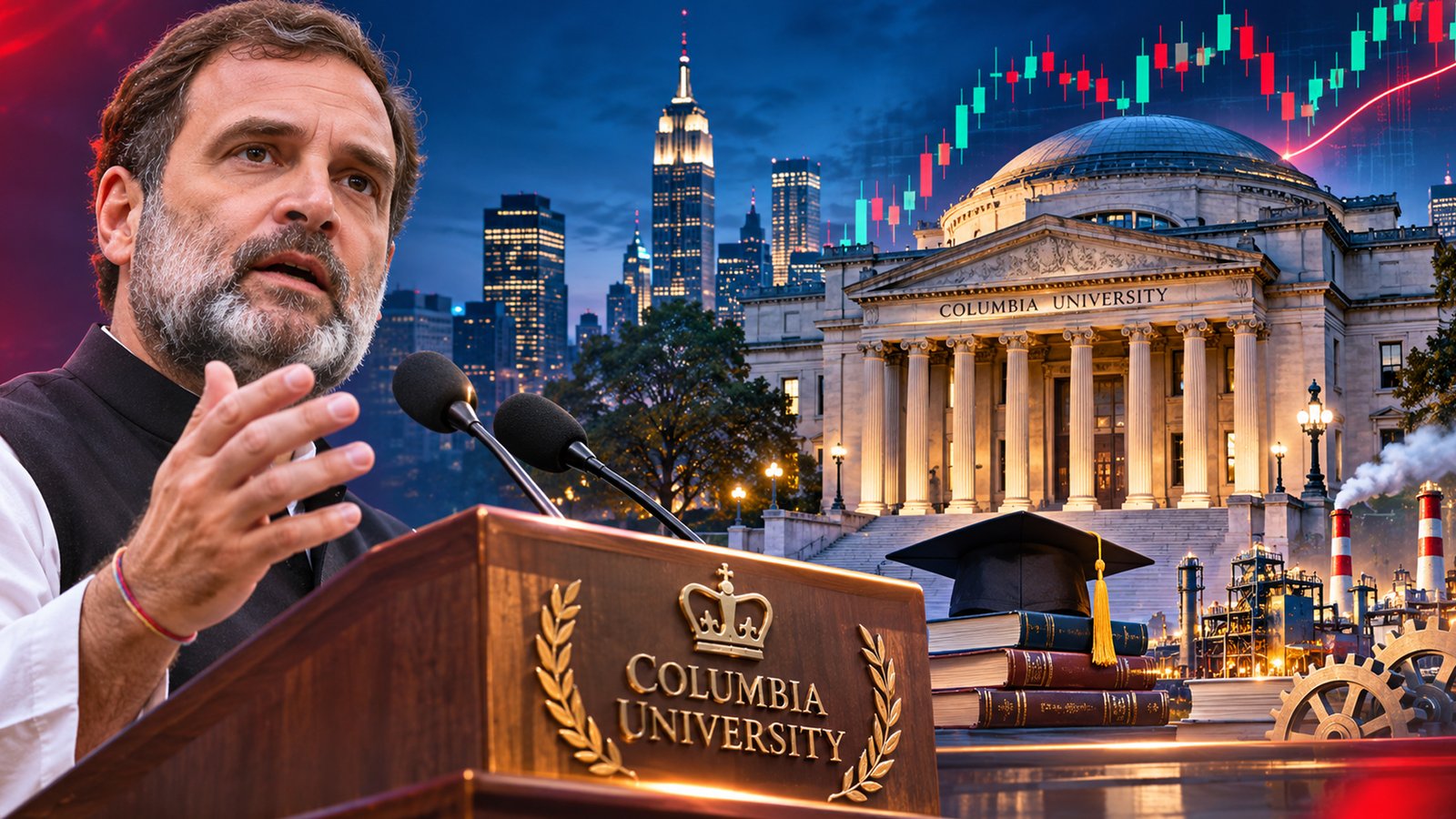
Congress leader and Leader of Opposition in the Lok Sabha Rahul Gandhi has warned that India is heading towards a serious economic crisis, pointing to widespread unemployment, weaknesses in the education system and a struggling manufacturing sector. Speaking at Columbia University in New York during his ongoing visit to the United States, he argued that the country’s economic model was no longer delivering the results needed to create jobs and provide opportunities for its growing young population.
“The blunt thing is that India is sitting on an economic disaster. That’s the reality,” Gandhi said during an interaction with students and faculty members on Tuesday, November 17. He added that unemployment and problems in the education system were major challenges that could not simply be brushed aside.
The Congress leader was responding to a question from journalist Lydia Polgreen about India’s youth and the growing frustration among sections of the younger generation. He said many young Indians, including those from middle-class families with formal education, were increasingly uncertain about their future.
According to Gandhi, the central issue was not simply a lack of employment but the feeling among young people that the opportunities they had expected were no longer available. He said this frustration was also creating a disconnect between younger people and their parents, whose career experiences and advice were becoming less relevant to the changing employment landscape.
He described a situation in which young people were questioning whether following the same educational and professional paths as their parents would lead to financial stability or meaningful careers.
Gandhi said the younger generation was effectively telling its parents that the conventional routes to success were no longer working because even educated people were struggling to find jobs.
Manufacturing sector at the centre of criticism
A significant part of Gandhi’s address focused on what he described as the weakening of India’s manufacturing base. He argued that the country’s economic structure had become overly dependent on the services sector, which, in his assessment, could not generate employment on the scale required by India’s large workforce.
He questioned the government’s approach to manufacturing and criticised flagship initiatives such as Make in India and Start-up India, claiming they had not delivered the expected transformation in job creation.
Gandhi argued that India needed a stronger manufacturing ecosystem to provide employment to millions of people entering the workforce. While the services sector could generate high-value jobs and contribute to economic growth, he said it could not independently absorb the country’s vast labour force.
He maintained that small and medium enterprises (SMEs) and agriculture remained fundamental to India’s economy because of their role in supporting livelihoods and generating employment. However, he claimed that the foundations of these sectors had weakened.
“The spine of the economy is small and medium businesses, which are the job creation engine, and agriculture,” he said, arguing that rebuilding these sectors was essential for sustainable economic growth.
The Congress leader also raised questions about private investment and the concentration of economic opportunities among a relatively small number of large business groups. Referring to industrialists Gautam Adani and Mukesh Ambani, he questioned why these businesses appeared to be among the major beneficiaries of the current economic environment. He also made remarks about the position of the Tata Group.
Gandhi further argued that the economic framework developed over several decades needed to be strengthened and rebuilt. In his view, India could not achieve balanced development without creating a stronger manufacturing base, supporting smaller businesses and ensuring that economic growth translated into employment.
BJP hits back at Rahul Gandhi
Gandhi’s remarks quickly triggered a political exchange back home, with the Bharatiya Janata Party (BJP) accusing him of damaging India’s image during an overseas visit.
BJP spokesperson Pradeep Bhandari described Gandhi as a “leader of anti-India propaganda” and accused him of repeatedly criticising the country and its democratic institutions while travelling abroad. He also questioned Gandhi’s comments on India’s economy, arguing that they ignored the country’s growth performance and international standing.
Bhandari pointed to India’s economic growth and assessments by global agencies, arguing that the country continued to be recognised as one of the world’s fastest-growing major economies. He also criticised Gandhi for raising questions about Indian democracy and the government’s economic record at an international university.
Other BJP leaders joined the criticism. West Bengal BJP leader Dilip Ghosh accused Gandhi of making negative statements about the country because he was dissatisfied with the political situation. He defended the government’s economic record, referring to India’s gross domestic product (GDP) growth and foreign exchange reserves.
The BJP also contrasted Gandhi’s remarks with Prime Minister Narendra Modi’s approach to representing India during international engagements. The party maintained that criticism of the government’s policies should not be presented in a manner that undermines the country’s reputation.
The Congress leader’s comments have therefore opened another political debate over India’s economic performance, unemployment and the role of the Opposition in raising domestic concerns on international platforms.
US visit focuses on academic engagements
Gandhi’s remarks came during a two-day academic visit to the United States, which includes engagements at two prominent universities. He interacted with students and faculty members at Columbia University’s School of International and Public Affairs in New York on November 17.
The visit also includes a scheduled engagement at the University of Chicago on November 18. According to the Congress, the trip is centred on academic discussions and exchanges on global politics, international affairs and challenges facing India. It is not planned as a series of public diaspora events.
The discussions are taking place against a backdrop of wider geopolitical and economic uncertainty, including the ongoing Iran conflict and its potential implications for India. Gandhi’s visit has also attracted political attention because of the sensitivity surrounding his previous overseas remarks.
During the Columbia interaction, Gandhi also reiterated his allegations of electoral irregularities, commonly described by the Congress as ‘vote chori’, and questioned the functioning of the Election Commission. He referred to the removal of voters from electoral rolls and renewed his criticism of India’s electoral processes.
These remarks added another dimension to the political exchanges surrounding his visit, taking the discussion beyond economic policy to questions about democracy and institutional accountability.
For Gandhi, however, the central message of his Columbia address was the need to confront the challenges facing India’s young population. His argument was that economic growth alone would not be enough if it failed to create sufficient employment, strengthen small businesses and give educated young people confidence about their future.
The debate also highlights a larger question confronting India’s political and economic landscape: whether the country’s growth is translating into enough quality jobs and meaningful opportunities for its expanding workforce.
While the BJP has defended the government’s economic record and pointed to India’s growth prospects, the Congress leader has called for a closer examination of unemployment, manufacturing and the education system.
The contrasting positions are likely to keep economic policy and youth employment at the centre of the political debate.