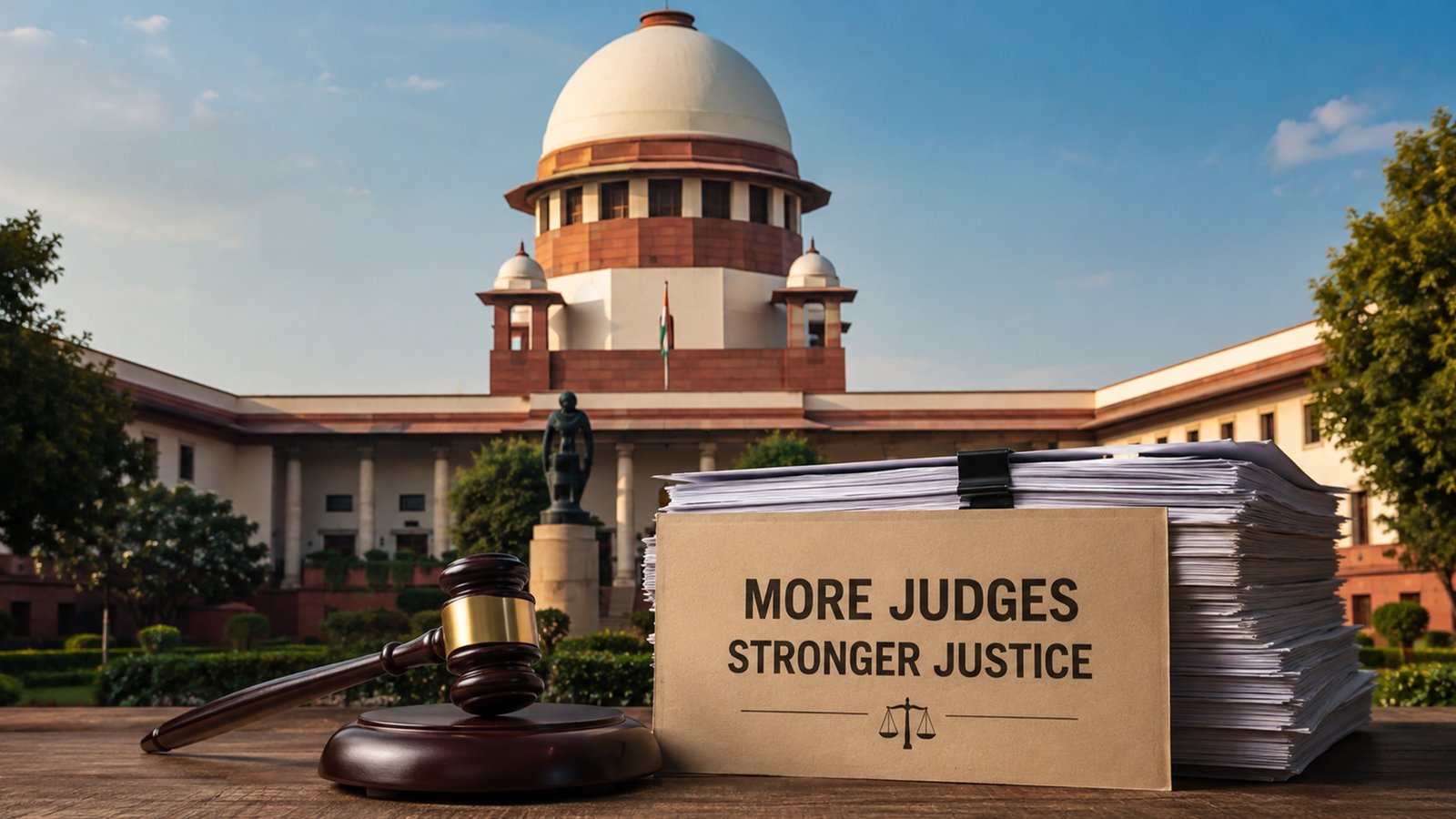
The Lok Sabha has passed a Bill to increase the sanctioned strength of the Supreme Court from 34 to 38 judges, including the Chief Justice of India, in a move aimed at tackling the court’s growing workload and case backlog.
The Supreme Court (Number of Judges) Amendment Bill, 2026, was passed on August 3 without a debate. Union Law and Justice Minister Arjun Ram Meghwal moved the legislation during the post-lunch session, saying the increase was necessary in view of the large number of pending cases before the country’s highest court and the need to improve its efficiency.
The legislation is essentially intended to replace an ordinance issued by President Droupadi Murmu in May. That ordinance had already raised the sanctioned strength from 34 to 38, comprising 37 judges apart from the CJI. The Bill seeks to give the change a permanent legislative backing through an amendment to the Supreme Court (Number of Judges) Act, 1956.
The move comes at a time when the Supreme Court is dealing with an unusually heavy caseload. More than 93,000 cases were pending before the apex court in March 2026, according to data cited from the National Judicial Data Grid. The figure stood at 93,143 cases at the end of March, making it the highest level of pendency recorded by the court in three decades.
For ordinary litigants, the significance of the increase is straightforward: more judges could mean more benches hearing cases at the same time. The government has argued that the additional judicial strength can help the Supreme Court function more efficiently and contribute to faster disposal of cases.
However, the expansion also highlights a larger challenge facing India’s judicial system. Increasing the number of judges can create additional capacity, but it does not automatically guarantee a sharp fall in pendency. The Supreme Court’s caseload has continued to rise despite earlier increases in its sanctioned strength.
The last major increase came in 2019, when Parliament raised the number of Supreme Court judges from 30 to 33, excluding the CJI. Before that, the court’s strength had been increased several times as India’s population, economy and volume of litigation expanded.
The latest expansion was also driven by the need to provide greater flexibility for Constitution Bench hearings. The Supreme Court has several Constitution Bench matters pending, including cases requiring five-, seven- and nine-judge benches. A larger sanctioned strength can make it easier for the court to constitute such benches while allowing other judges to continue hearing regular matters.
That gap matters because simply creating posts does not immediately put more judges on the bench. Judicial appointments, vacancies and retirements all influence the number of judges actually available to hear cases. The Supreme Court had also seen several appointments earlier this year after the government expanded its sanctioned strength.
The government’s decision to increase the strength therefore needs to be viewed as one part of a broader effort to improve judicial efficiency. Faster appointments, better case management, greater use of technology and effective scheduling of Constitution Bench matters will also be important if the additional judicial capacity is to translate into quicker justice.
The Bill itself does not require a constitutional amendment. Article 124 of the Constitution provides for the Supreme Court and allows Parliament to prescribe the number of judges through law. The amendment to the 1956 Act can therefore be passed through a simple majority.
The passage in the Lok Sabha, however, took place amid disruptions in Parliament, with the legislation cleared without a detailed discussion. The House was later adjourned for the day.
For the Supreme Court, the expansion represents a significant increase in capacity at a time when the institution is facing mounting pressure. For litigants waiting for their cases to be heard, the real test will be whether the additional judicial strength eventually translates into shorter waiting periods and faster judgments.
The increase from 34 to 38 judges may appear modest, but it comes against the backdrop of a rapidly expanding judicial docket. With more than 93,000 cases pending, the challenge is no longer simply about the number of judges. It is about ensuring that the entire justice delivery system, from filing and listing to hearings and final judgments, moves efficiently.
The Lok Sabha’s approval is therefore an important step, but not the final answer to India’s judicial pendency problem. The effectiveness of the move will ultimately be measured not by the number of sanctioned posts, but by how quickly cases move through the Supreme Court and how soon litigants receive justice.