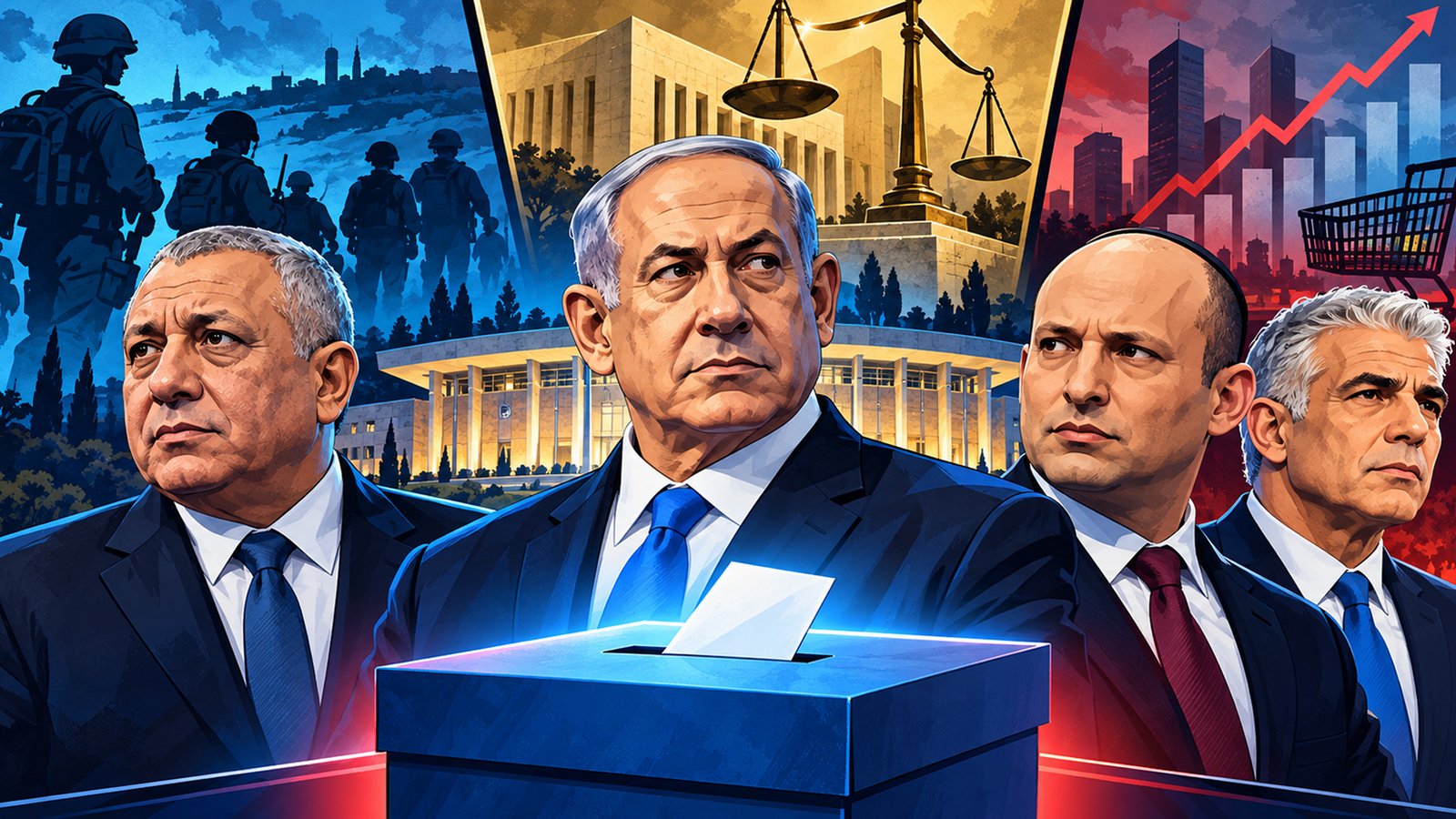
Israel’s parliamentary election on October 27 has placed Prime Minister Benjamin Netanyahu’s leadership under intense scrutiny, with voters weighing security failures, the wars that followed the October 7, 2023, attacks, and deep divisions over the country’s political future. The contest pits Netanyahu’s right-wing and religious coalition against a fragmented opposition led by former military chief Gadi Eisenkot and other political figures seeking changes in governance and accountability.
The election is the first since the Hamas-led attacks of October 7, 2023, and the subsequent wars that reshaped Israeli politics and regional relations. Netanyahu’s government has faced criticism over the security and intelligence failures preceding the attacks, as well as questions about its conduct during the conflict. The prime minister has defended his record, while opposition leaders argue that the country needs a formal investigation into how the attacks occurred and why the authorities failed to prevent them.
Eisenkot, leader of the Yashar party, has made accountability a central campaign issue. He has promised to establish a state commission of inquiry into the October 7 failures, arguing that political leaders should face the same scrutiny as security officials. Netanyahu has said he supports an inquiry with broad public backing, but disagreements over its structure and timing have become a source of political tension.
The election is also being treated as a test of Netanyahu’s ability to maintain the coalition that has supported his government. His Likud party is allied with far-right and ultra-Orthodox parties, including Religious Zionism, Otzma Yehudit, Shas and United Torah Judaism. These partners have differing priorities, and disagreements over military service, judicial reform and wartime policy could complicate coalition negotiations.
The opposition is made up of several parties rather than a single unified bloc. Alongside Eisenkot’s Yashar party are the Together alliance led by former prime minister Naftali Bennett and opposition leader Yair Lapid, Yair Golan’s Democrats and Avigdor Lieberman’s Yisrael Beiteinu. Although these parties oppose Netanyahu’s continuation in office, they differ on policy and the kind of government they would form.
Under Israel’s proportional representation system, voters choose party lists for the 120-seat Knesset. A party must receive at least 3.25% of the vote to enter parliament, while a government needs the backing of at least 61 lawmakers. Pre-election polls suggested that neither the Netanyahu bloc nor the opposition was assured of reaching that threshold. Smaller parties and Arab-led political lists could therefore become important in determining who forms the next government.
One of the campaign’s most contentious issues is compulsory military service. Ultra-Orthodox Jewish men have historically benefited from exemptions while studying in religious seminaries. As prolonged military operations have increased pressure on soldiers and reservists, opponents of the exemptions have argued that military obligations should be shared more equally.
Netanyahu’s coalition depends on ultra-Orthodox parties that want protections for religious students to continue. Eisenkot and other opposition figures have called for a change in the system, making conscription a central dividing line between the competing political camps. The issue also has implications for coalition stability because religious parties have made their support conditional on legislation addressing the status of seminary students.
Judicial reform remains another major point of disagreement. Netanyahu’s government has pursued changes to the relationship between the judiciary and elected officials. Supporters say the measures would rebalance institutional power, while critics argue that they weaken judicial independence and checks on the executive. Bennett has promised to repeal the government’s judicial overhaul laws if his alliance takes office.
Policy towards Palestinians is also part of the election debate, although the leading candidates have offered limited support for a clear route to a two-state solution. Netanyahu has opposed the creation of a Palestinian state, while Eisenkot has also rejected the two-state principle in its conventional form. The differences between the major political camps therefore centre more on domestic governance, accountability and the composition of the next coalition than on a clear divide over Palestinian statehood.
The election is unfolding amid economic pressures, international criticism over the Gaza war and concerns about rising violence by settlers in the occupied West Bank. Voters are weighing security and economic stability alongside the future of democratic institutions and Israel’s relations with international partners.
Reports of possible voting irregularities, including complaints about missing ballots, have added to election-day scrutiny. Such reports require investigation and do not, on their own, establish widespread fraud or show that the result has been affected. Election authorities are responsible for addressing complaints and safeguarding the voting process.
Polling stations are scheduled to close at 10pm local time, after which exit polls may provide an early indication of the balance between the political blocs. Official results and coalition negotiations will determine the next government, and the process could take weeks if no clear majority emerges. The outcome will shape Netanyahu’s political future and determine how Israel addresses security, military service, judicial reform and the consequences of the October 2023 attacks.