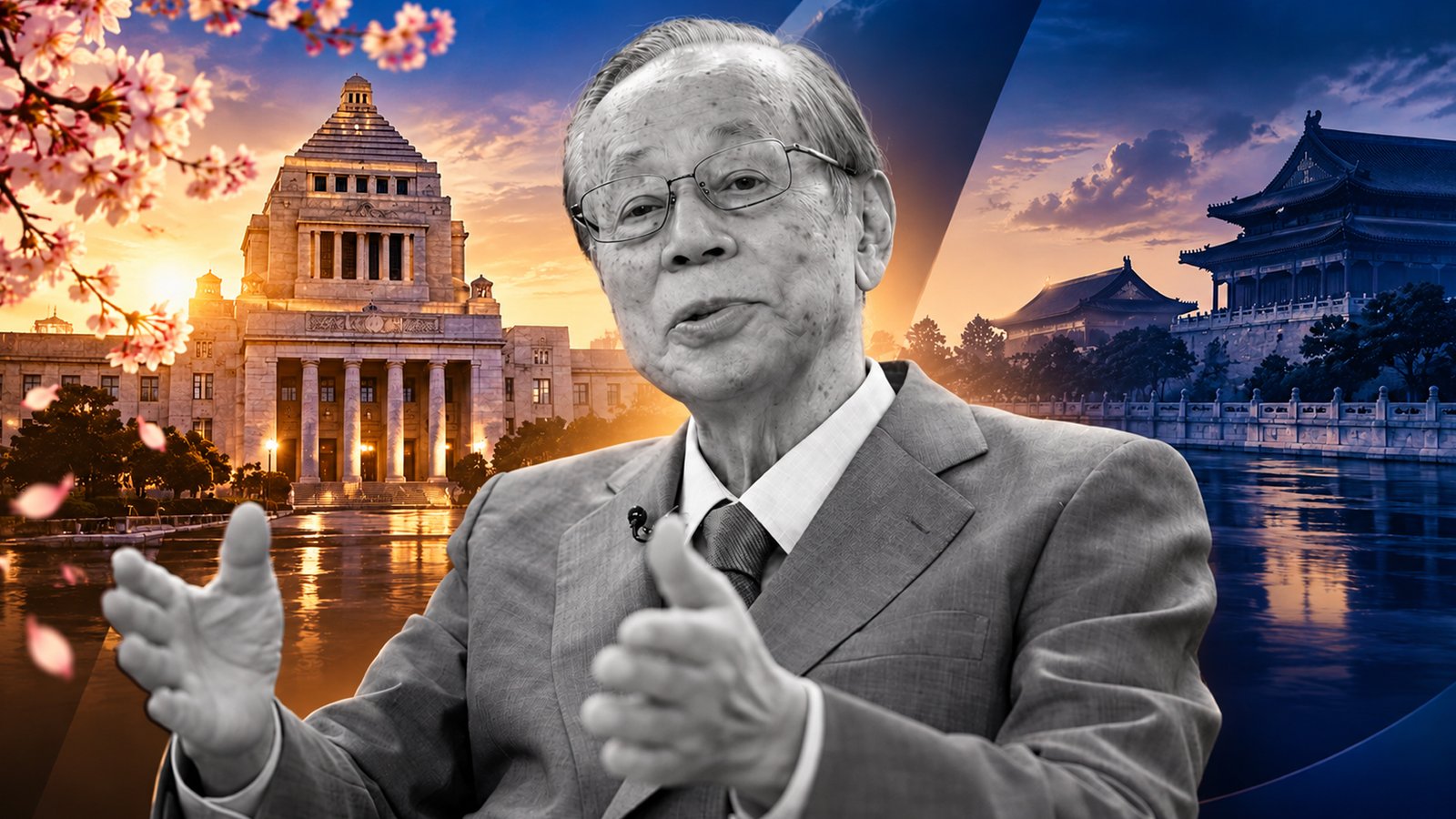
Former Japanese Prime Minister Yasuo Fukuda, remembered for his efforts to strengthen relations with China and other Asian neighbours, has died at the age of 90. Japan’s ruling Liberal Democratic Party (LDP) announced his death on Monday, October 26. Fukuda died on October 22, according to Japanese media reports. The Nikkei business daily reported that the former leader died of heart failure at a hospital in Tokyo.
Fukuda served as Japan’s prime minister from September 2007 to September 2008. Although his time in office lasted less than a year, he made regional diplomacy a priority and sought to maintain stable relations with neighbouring countries. His political career also marked a milestone in Japan’s history, as he became the country’s first prime minister whose father had previously held the same office.
Born on July 16, 1936, in Takasaki, Gunma Prefecture, Fukuda grew up in a politically influential family. His father, Takeo Fukuda, served as prime minister from 1976 to 1978 and supported efforts to improve Japan’s relations with China. Yasuo Fukuda initially followed a different professional path, spending more than 17 years working for a Japanese oil company before entering politics.
After graduating from Waseda University in Tokyo with a degree in economics, he worked in the private sector, including a posting in the United States. In 1976, he left his corporate career to become a political secretary to his father, who was preparing to take office as prime minister. The experience gave him an early understanding of government operations and political decision-making.
Fukuda entered parliament in 1990, winning a seat in the House of Representatives. He gradually established himself as a senior figure within the LDP and developed expertise in government coordination and foreign affairs. His national profile grew significantly in 2000, when he became chief cabinet secretary under Prime Minister Yoshiro Mori, a senior position that involves coordinating government policy and communicating official decisions.
He remained in the role until 2004, serving under successive administrations. During those years, Fukuda became known for his direct communication style and his ability to explain government positions. The experience helped prepare him for the challenges of leading the country, although his later premiership would be constrained by political divisions.
Fukuda became prime minister in September 2007 after Shinzo Abe resigned unexpectedly. His government faced a difficult parliamentary situation: the LDP held a majority in the more powerful lower house but lacked control of the upper house. Opposition parties could therefore delay legislation and complicate the government’s agenda.
Despite these challenges, Fukuda pursued a foreign policy focused on dialogue and regional cooperation. He sought to strengthen relations with Chinese President Hu Jintao and encouraged closer engagement between Tokyo and Beijing. In 2008, the two countries agreed to develop a strategic relationship based on mutual benefit, signalling an effort to manage differences while expanding cooperation.
His administration also maintained engagement with South Korea. During a 2008 summit with then-President Lee Myung-bak, Fukuda emphasised the need to build a forward-looking relationship between the two neighbours, whose ties have often been affected by historical disputes.
Another major event during his premiership was the Group of Eight summit held in Toyako, Hokkaido, in July 2008. As host, Fukuda helped lead discussions among major industrialised economies on climate change, development and rising food prices. His government promoted measures to address global warming, making environmental policy an important part of Japan’s international agenda.
However, domestic political difficulties continued to weaken his administration. Disagreements between the two houses of parliament slowed policymaking, while public frustration over the legislative deadlock increased. Fukuda resigned in September 2008, less than a year after taking office. His departure reflected the challenges facing Japanese governments during a period of frequent leadership changes.
Fukuda retired from parliament in 2012 but continued to work towards improving Japan-China relations. Tensions between the countries had increased over territorial disputes in the East China Sea. In 2014, Fukuda met Chinese President Xi Jinping, seeking to ease relations and encourage renewed high-level dialogue. The meeting helped create conditions for further engagement between the two countries.
He continued to advocate communication between Asian nations in later years. In a 2022 interview marking the 50th anniversary of Japan-China diplomatic normalisation, Fukuda warned that insufficient dialogue could increase the risk of misunderstandings. His message reflected his longstanding belief that sustained communication was essential to preventing disagreements from escalating.
Fukuda was also known for his dry humour and sometimes blunt public manner. When he announced his resignation in 2008, a reporter suggested that he sounded as though he were talking about someone else. Fukuda replied that he could assess himself objectively and added, “I’m not like you.” The remark became one of the memorable political soundbites of the year.
His legacy also includes controversy. In 2003, he faced criticism over remarks about women and sexual violence, a reminder that his public career was not without serious criticism.
Fukuda is survived by his son, Tatsuo Fukuda, who is also a lawmaker. His death marks the passing of a former leader whose brief premiership was overshadowed by domestic political gridlock but whose commitment to regional diplomacy continued long after leaving office.