India’s Unified Payments Interface (UPI) is set for a major change from October 15, with merchants facing a new Merchant Discount Rate (MDR) on certain high-value payments. The move ends the long-standing zero-MDR model for larger person-to-merchant transactions, while keeping UPI free for consumers in most everyday situations.
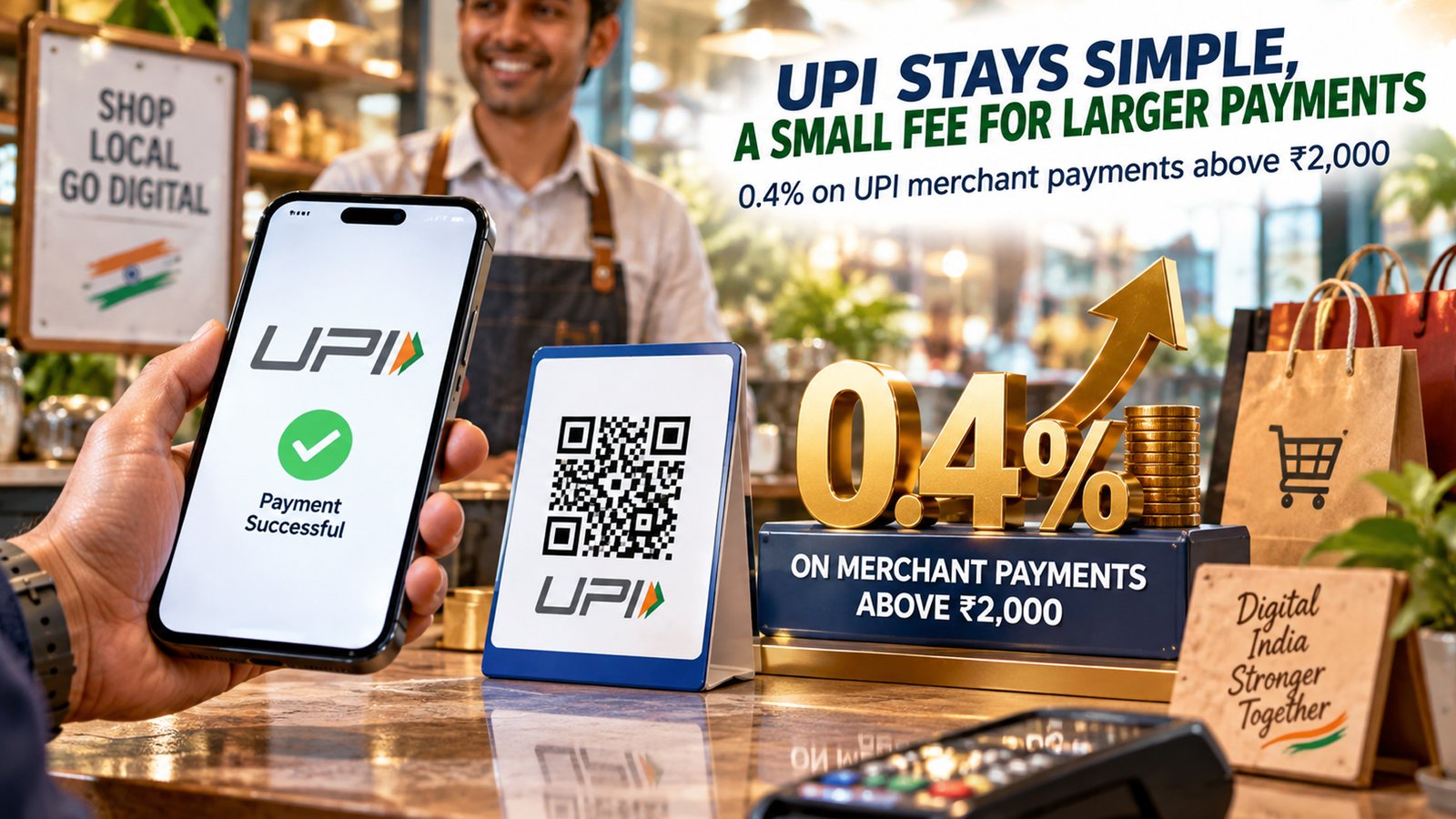
Under the new framework announced by the National Payments Corporation of India (NPCI), a 0.4% MDR will apply to person-to-merchant (P2M) UPI transactions above ₹2,000. The charge will be capped at ₹300 per transaction, meaning payments of ₹75,000 or more will attract a maximum MDR of ₹300.
The new rule does not mean that people will have to pay a UPI transaction fee every time they scan a QR code or send money. The MDR is a charge within the merchant payment ecosystem and is meant to be paid by merchants. Banks have also been advised to ensure that the cost is not passed on to customers. UPI apps will not be allowed to add platform fees or hidden charges to these payments.
Person-to-person (P2P) UPI payments will remain completely free, regardless of the amount transferred. This covers payments made to family members, friends and other individuals. Payments of up to ₹2,000 made to merchants will also remain free under the new framework.
Small merchants have also been protected from the new UPI charges. Businesses receiving up to ₹1 lakh a month through UPI QR payments under the small-merchant category will continue to enjoy zero MDR. An individual payment above ₹2,000 does not automatically remove this exemption. The framework is designed to keep neighbourhood shops, street vendors and other small businesses outside the new fee structure.
The government estimates that around 96% of person-to-merchant UPI transactions will remain unaffected. Only about 4% of merchant transactions are expected to attract MDR. Although these represent a small share of transactions by volume, high-value payments account for a much larger portion of the overall value processed through UPI.
The new UPI charges also come with special rates for several sectors. Payments above ₹2,000 involving railways, telecommunications, insurance, fuel and agricultural inputs will attract a flat ₹5 MDR instead of the standard 0.4% rate. Public utility payments, including certain electricity, municipal water and piped natural gas transactions, also receive concessional treatment under the framework. The aim is to limit the impact on essential services and businesses that operate on relatively thin margins.
Capital market transactions will have another separate rate. UPI payments linked to mutual funds, securities, stockbrokers and dealers will attract an MDR of 0.02%, capped at ₹300 per transaction. The lower rate is intended to avoid making digital payments a significant additional cost for retail participation in financial markets.
Recurring UPI payments made through mandates or AutoPay are also outside the prescribed MDR framework. This means users paying recurring bills or subscriptions through eligible UPI mandates will not suddenly face the new 0.4% charge simply because the payment exceeds ₹2,000. Credit-linked UPI transactions are governed separately.
The introduction of MDR marks a significant shift for UPI, which has operated largely without merchant charges since its rapid expansion. The payment system has grown into one of the world’s largest digital payment networks, processing 2,451 crore transactions worth about ₹29.9 lakh crore in August 2026 alone.
The move is aimed partly at creating a more sustainable financial model for the UPI ecosystem. NPCI has said the additional revenue can support investment in infrastructure, cybersecurity, fraud prevention, innovation and customer service. The MDR will be distributed among different participants in the payment ecosystem, including banks and payment application providers, rather than being treated as a government tax.
NPCI’s new structure also creates a revenue-sharing mechanism for the companies and banks that support UPI transactions. Under the reported framework, the issuing bank receives 40% of the MDR, the merchant-acquiring side gets 30%, UPI apps receive 20%, and their partner banks receive the remaining 10%. On a ₹10,000 transaction attracting ₹40 MDR, that would translate into ₹16 for the issuing bank, ₹12 for the acquiring bank, ₹8 for the UPI app and ₹4 for its bank partner.
The change comes after years of rapid UPI adoption, during which the government and payment ecosystem absorbed much of the cost of maintaining the network. The new model is therefore focused mainly on larger merchant transactions rather than ordinary digital payments between individuals.
For consumers, sending money to another person remains free, payments up to ₹2,000 at merchants remain free, and eligible small merchants remain outside MDR. The biggest change will be felt within the merchant ecosystem, particularly by businesses that regularly receive larger UPI payments.
The new UPI MDR framework is expected to reshape how banks, fintech companies, payment apps and merchants share the cost of India’s rapidly expanding digital payments infrastructure. At the same time, the government and NPCI are seeking to ensure that the move does not undermine the convenience that made UPI a routine part of everyday payments.