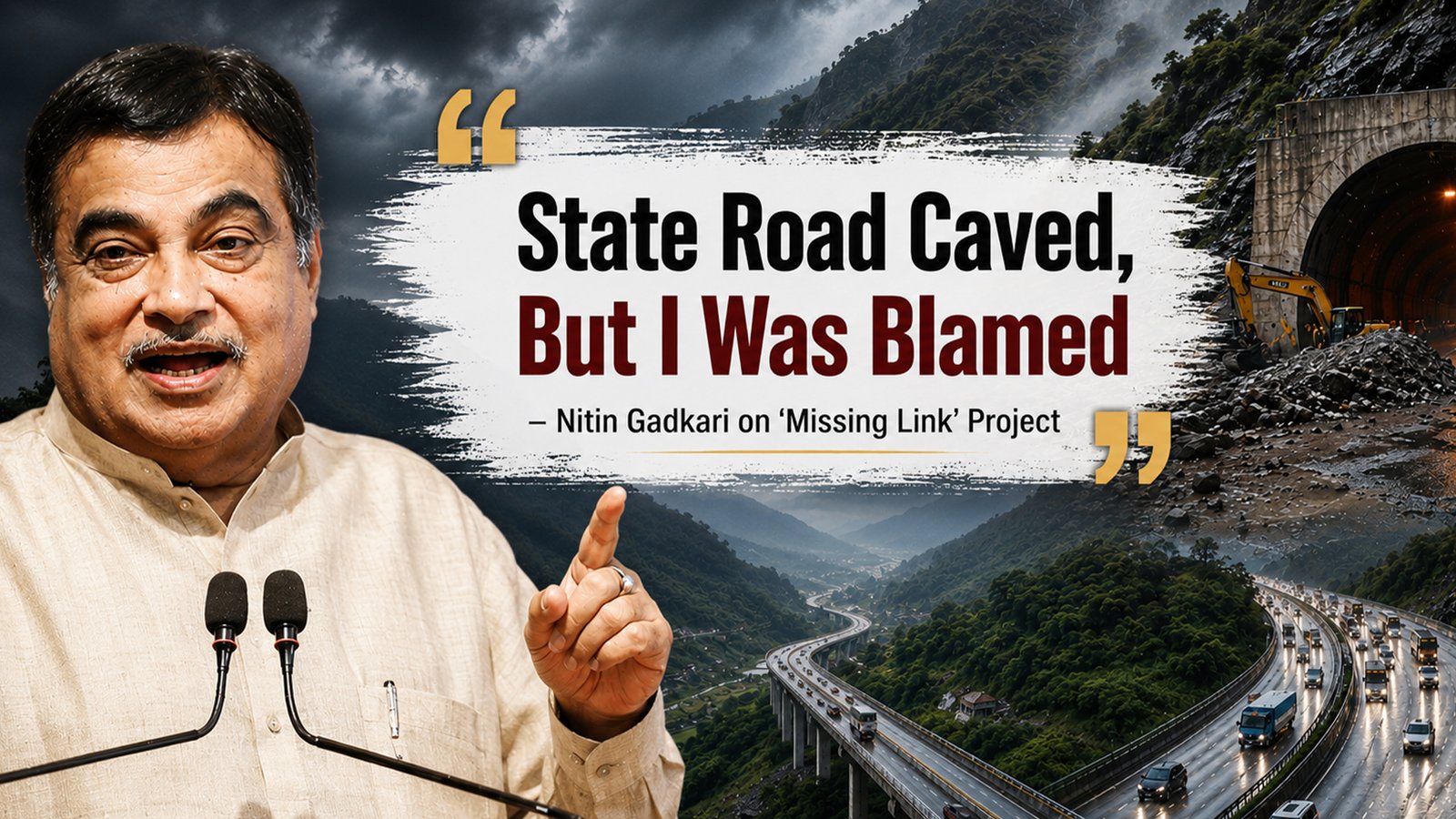
Union Road Transport and Highways Minister Nitin Gadkari has defended the performance of the Mumbai–Pune Expressway, saying the road has remained pothole-free for 27 years since its construction, even as criticism continues over damage to a newer section linked to the “Missing Link” project.
Speaking in Pune, Gadkari said the expressway stands as proof that long-term planning and strong engineering can deliver durable infrastructure. He stressed that road projects should be designed with a lifespan of 25 to 50 years, rather than focusing only on short-term needs.
The minister also responded to online criticism after parts of the Missing Link stretch suffered damage and a collapse following heavy rainfall. The incident sparked debate on social media over the quality of newly built infrastructure.
Gadkari said the criticism directed at him was unfair, pointing out that the Missing Link project was executed by the Maharashtra government and not the Union ministry. He added that the project could not be taken up earlier during his tenure due to pending forest clearances, after which the state government proceeded with it.
Using the controversy to make a wider point, Gadkari highlighted the original Mumbai–Pune Expressway as an example of how well-built roads can last for decades. He said its long-term success often gets overshadowed by isolated incidents of road damage elsewhere.
The expressway, one of Maharashtra’s key transport corridors, connects Mumbai and Pune and remains one of India’s earliest access-controlled highways. Gadkari said its durability shows the importance of quality construction and planning.
He also acknowledged the growing role of social media in infrastructure monitoring, saying that citizens posting images and videos of damaged roads can help authorities identify problem areas more quickly.
Looking ahead, Gadkari called for greater use of technology in road maintenance. He said future infrastructure should rely on modern monitoring systems, including artificial intelligence, to detect cracks, structural weaknesses and other defects before they become serious hazards.
His remarks come amid rising public concern over road conditions across the country, especially during the monsoon season when potholes and surface damage become more visible. The issue forms part of the wider national developments around infrastructure and road safety in India. The minister said the challenge for road agencies is not just building highways, but ensuring they remain safe and functional over time. This requires regular maintenance, better monitoring and faster response systems.
The minister said the challenge for road agencies is not just building highways, but ensuring they remain safe and functional over time. This requires regular maintenance, better monitoring and faster response systems.
Gadkari also linked infrastructure development to economic growth, saying better roads reduce travel time, improve logistics, support businesses and create jobs. He added that India’s expanding highway network must be supported by innovation and research.
The Mumbai–Pune Expressway, he said, remains a strong example of early success in India’s expressway development, having significantly improved connectivity between the two major cities.
However, the recent damage to the Missing Link section has also highlighted the difficulties of building infrastructure in hilly and environmentally sensitive regions, where heavy rainfall and terrain challenges increase risks.
Gadkari said infrastructure should be seen as a long-term investment and not judged only by isolated failures. He argued that one incident should not overshadow decades of successful performance.
At the same time, he reiterated the need for AI-based monitoring systems to strengthen highway safety and prevent small defects from turning into major problems.
The minister’s comments also come as Pune faces increasing traffic pressure due to rapid urban growth and rising vehicle numbers. The government is planning several new road projects to ease congestion and improve connectivity in the region.