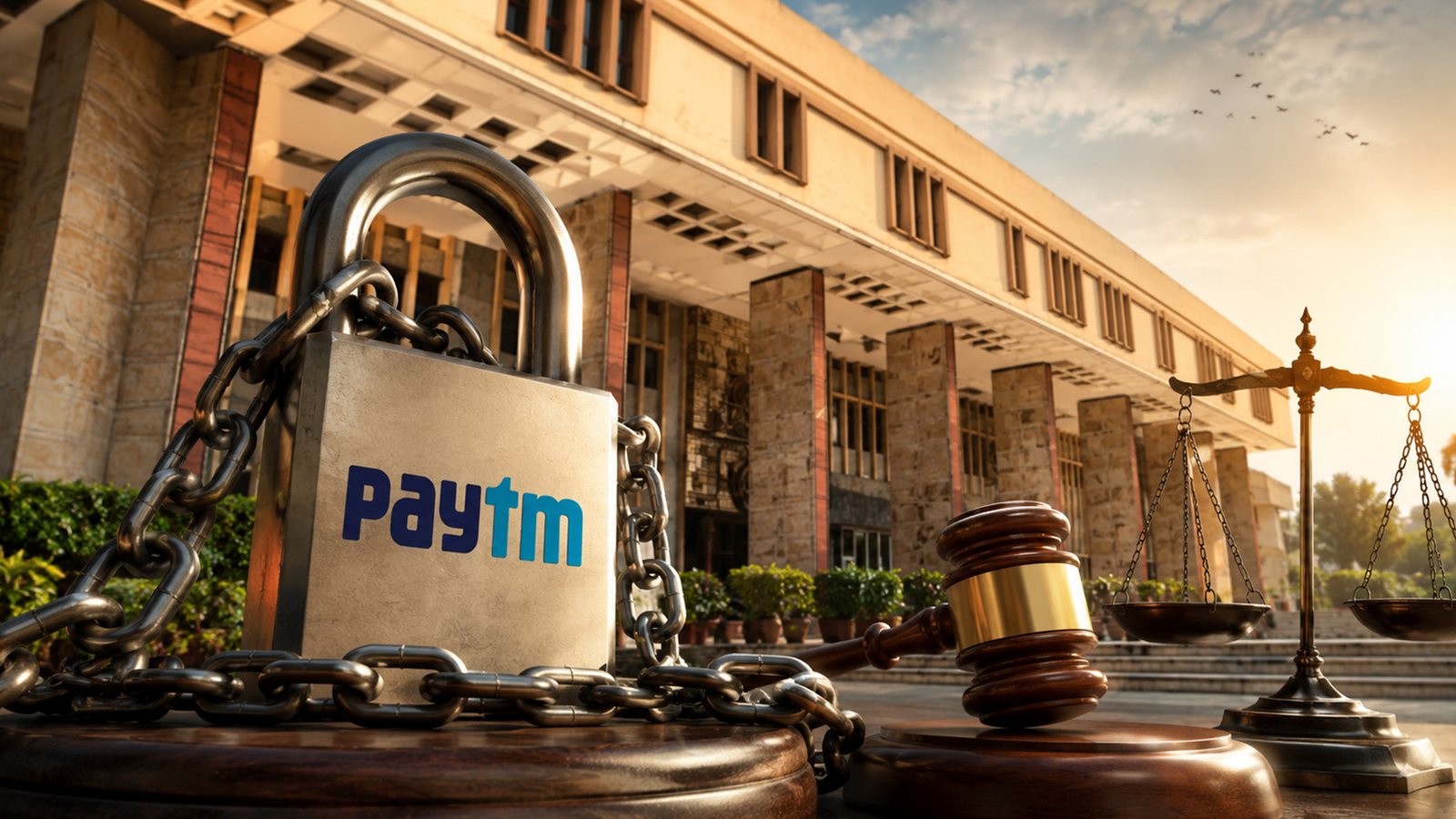
The Delhi High Court has ordered the winding up of Paytm Payments Bank Limited (PPBL), bringing the payments bank closer to a formal closure after a prolonged regulatory battle with the Reserve Bank of India (RBI).
The court passed orders on July 8 and July 22 directing the winding up of PPBL under the Banking Regulation Act, 1949, read with the Companies Act, 2013. The RBI said the court has appointed Girikumar M Nair, a former Chief General Manager of State Bank of India, as the official liquidator to oversee the process.
The order follows the RBI’s decision in April to cancel PPBL’s banking licence. The central bank had said the action was taken after the payments bank failed to comply with regulatory requirements and its affairs were being conducted in a manner that was detrimental to the interests of the bank and its depositors.
The RBI had subsequently approached the Delhi High Court seeking the winding up of the bank. The latest court orders complete that regulatory step and begin the formal liquidation process.
For Paytm users, however, the closure of Paytm Payments Bank does not mean the Paytm app or its digital payments business is shutting down.
Paytm’s UPI services continue to operate through its partner banks. The company’s broader payments business is separate from Paytm Payments Bank, allowing customers to continue using Paytm UPI for sending and receiving money, while merchants can continue accepting payments through Paytm QR codes and other payment solutions.
The distinction is important because Paytm Payments Bank and One97 Communications, the company behind the Paytm platform, are separate entities.
Paytm had already begun reducing its dependence on PPBL after the RBI imposed restrictions on the bank in 2024. The central bank had directed PPBL to stop accepting fresh deposits, credit transactions and top-ups in customer accounts, prepaid instruments, wallets, FASTags and National Common Mobility Cards.
Those restrictions significantly changed Paytm’s business structure. The company shifted its UPI operations to other banking partners, enabling the payments platform to continue functioning even as PPBL’s banking activities were progressively curtailed.
The latest development therefore affects the banking subsidiary rather than Paytm’s entire digital payments operation.
The liquidation process will now focus on PPBL’s remaining assets, liabilities and customer claims. The official liquidator will take charge of the bank’s affairs and oversee the settlement process in accordance with applicable law.
The RBI had earlier said PPBL had sufficient liquidity to meet its entire deposit liabilities during the winding-up process. This provides an important assurance for customers who may still have money or unresolved claims specifically linked to Paytm Payments Bank.
Customers should, however, distinguish between balances held with PPBL and funds held in an account with another bank that is linked to Paytm UPI.
A Paytm user who uses the app to make a UPI payment from an account held with another bank is not necessarily using Paytm Payments Bank for that transaction. The closure of PPBL does not prevent such UPI transactions from continuing.
The RBI’s action against PPBL is the culmination of several years of regulatory scrutiny. In March 2022, the central bank had directed PPBL to stop onboarding new customers following material supervisory concerns.
In January 2024, the RBI imposed further restrictions after identifying additional compliance issues. The restrictions were later extended, with PPBL being barred from accepting fresh deposits, credits and top-ups from March 15, 2024.
The RBI eventually cancelled PPBL’s banking licence on April 24, 2026, under Section 22(4) of the Banking Regulation Act. It also said the bank’s registration with the Deposit Insurance and Credit Guarantee Corporation had been cancelled following the licence cancellation.
The winding-up order marks a significant development for India’s fintech industry, where companies have rapidly expanded digital payments, wallets and financial services.
Paytm Payments Bank was an important part of Paytm’s early strategy to build a wider financial-services ecosystem around its digital wallet and payments platform. Its eventual closure highlights the importance of regulatory compliance, governance, customer protection and risk controls alongside rapid growth in financial technology.
For Paytm, the focus now shifts further towards its core payments and merchant businesses, rather than banking operations. Its UPI platform, merchant payments, QR services, Soundbox and other digital financial services can continue independently of PPBL.
The development also removes uncertainty surrounding the future of Paytm Payments Bank itself. With the banking licence cancelled and the High Court ordering its winding up, the entity has entered the final phase of its existence.