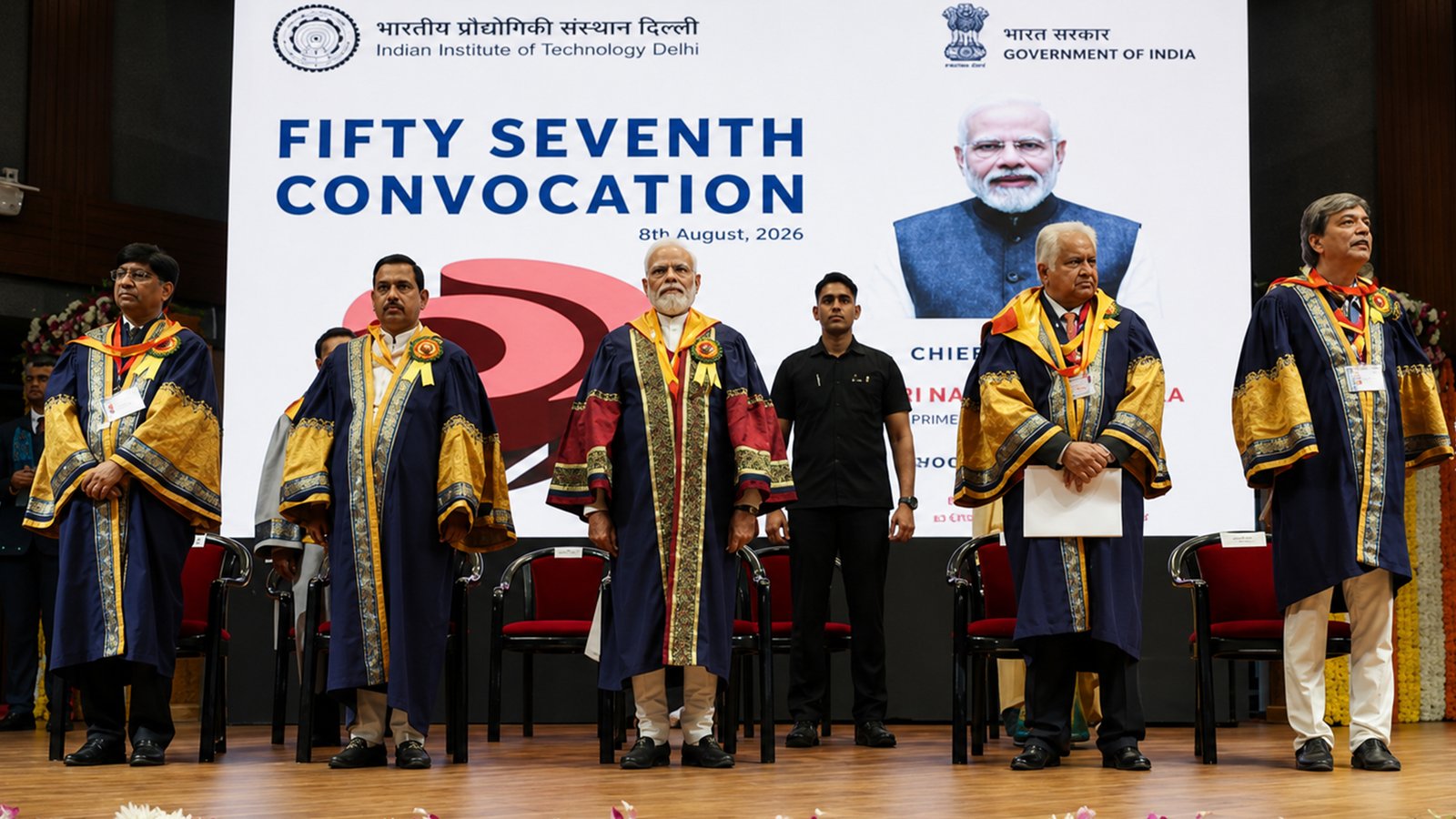
Prime Minister Narendra Modi on Saturday addressed the 57th convocation of the Indian Institute of Technology (IIT) Delhi, urging graduating students to remain curious, question established ideas and develop solutions to some of the country’s biggest challenges.
The convocation, held at the IIT Delhi campus, brought together more than 3,000 graduating students, including 587 PhD scholars. Modi also presented the institute’s top academic honours to meritorious students and inaugurated Param Pragya, an artificial intelligence-powered high-performance computing and project cluster facility at IIT Delhi’s Sonipat campus.
Addressing the graduating students, Modi said India was entering new areas of technology and development and would increasingly depend on young people to drive this transformation. He highlighted artificial intelligence, data centres, critical minerals, deep-sea exploration and quantum computing as emerging areas offering significant opportunities for India’s youth.
The Prime Minister encouraged students not to limit themselves to existing solutions. He said those willing to find new answers to difficult problems could turn challenges into opportunities.
His message focused on innovation and the importance of keeping the habit of learning alive even after completing formal education. He also encouraged students to question ideas that are accepted without sufficient examination, while stressing that questioning should be accompanied by the courage to find solutions.
The address came as India’s technology ecosystem is undergoing rapid change. Artificial intelligence and advanced computing are becoming increasingly important across sectors, from healthcare and manufacturing to financial services, defence and scientific research.
The launch of Param Pragya added a technological dimension to the convocation. The AI-powered high-performance computing facility is expected to strengthen IIT Delhi’s capabilities in artificial intelligence, data science, advanced computing and interdisciplinary research.
The facility is part of IIT Delhi’s efforts to expand its research infrastructure and support computationally intensive work. High-performance computing systems are increasingly important for AI development, scientific simulations, data analysis and other research areas that require significant computing power.
The institute’s focus on AI and advanced computing also reflects the wider demand for specialised infrastructure as India seeks to build capabilities in emerging technologies.
During the ceremony, Modi presented the President’s Gold Medal, Director’s Gold Medal, Shankar Dayal Sharma Gold Medal and Perfect Ten Medals to outstanding students. The awards recognised academic performance and achievement among the graduating batches.
For students receiving their degrees, the ceremony marked the transition from academic life to professional careers, research and entrepreneurship. Modi emphasised that their degrees should not be viewed only as personal achievements but also as an opportunity to contribute to the country’s development.
Union Education Minister Pralhad Joshi, who also addressed the convocation, described India’s education system as increasingly learner-centric, research-driven and future-ready. He said Indian youth were moving beyond simply competing internationally and were increasingly contributing to global innovation.
The IIT Delhi convocation also highlighted the institute’s expanding academic and research collaborations. The institute has entered into memorandums of understanding with 18 National Institutes of Technology, creating opportunities for academic exchanges, joint research, shared research infrastructure and faculty development.
IIT Delhi also has 88 active international MoUs involving institutions across 30 countries. These partnerships are intended to support international research cooperation, academic exchange and collaboration in emerging fields.
The institute’s growing emphasis on research comes at a time when India is seeking to strengthen its position in advanced technology. Areas such as semiconductor manufacturing, artificial intelligence, quantum computing, clean energy and deep-tech research are receiving increasing attention.
For IIT Delhi graduates, these developments could open opportunities across academia, technology companies, startups, research institutions and public-sector projects.
Modi also spoke about India’s broader goal of becoming self-reliant in technology, industry and the economy. He described technological and industrial self-reliance as important foundations for the country’s long-term development and the vision of Viksit Bharat 2047.
The Prime Minister’s message was therefore not limited to career success. He asked students to think about how their education and skills could be applied to national challenges and emerging opportunities.
The emphasis on artificial intelligence was particularly significant. AI is rapidly changing the nature of work and research, while creating demand for skilled professionals who understand computing, data science, engineering and interdisciplinary applications.
The Param Pragya facility is expected to give researchers access to advanced computing capabilities that can support such work. By combining high-performance computing with AI research, IIT Delhi aims to expand its ability to undertake complex projects requiring substantial computational resources.
The 57th convocation thus combined the traditional celebration of academic achievement with a strong focus on the future of technology and research.
As thousands of students leave IIT Delhi with degrees in engineering, science and other disciplines, the message from the ceremony was clear: academic knowledge is increasingly expected to translate into innovation, research and practical solutions.
For IIT Delhi, the launch of new AI infrastructure alongside the graduation ceremony also signals its ambition to remain at the forefront of India’s technology and research ecosystem. For the graduating students, the ceremony marked not just the end of an academic journey, but the beginning of a new phase in which their skills will be tested against rapidly changing technological and social challenges.