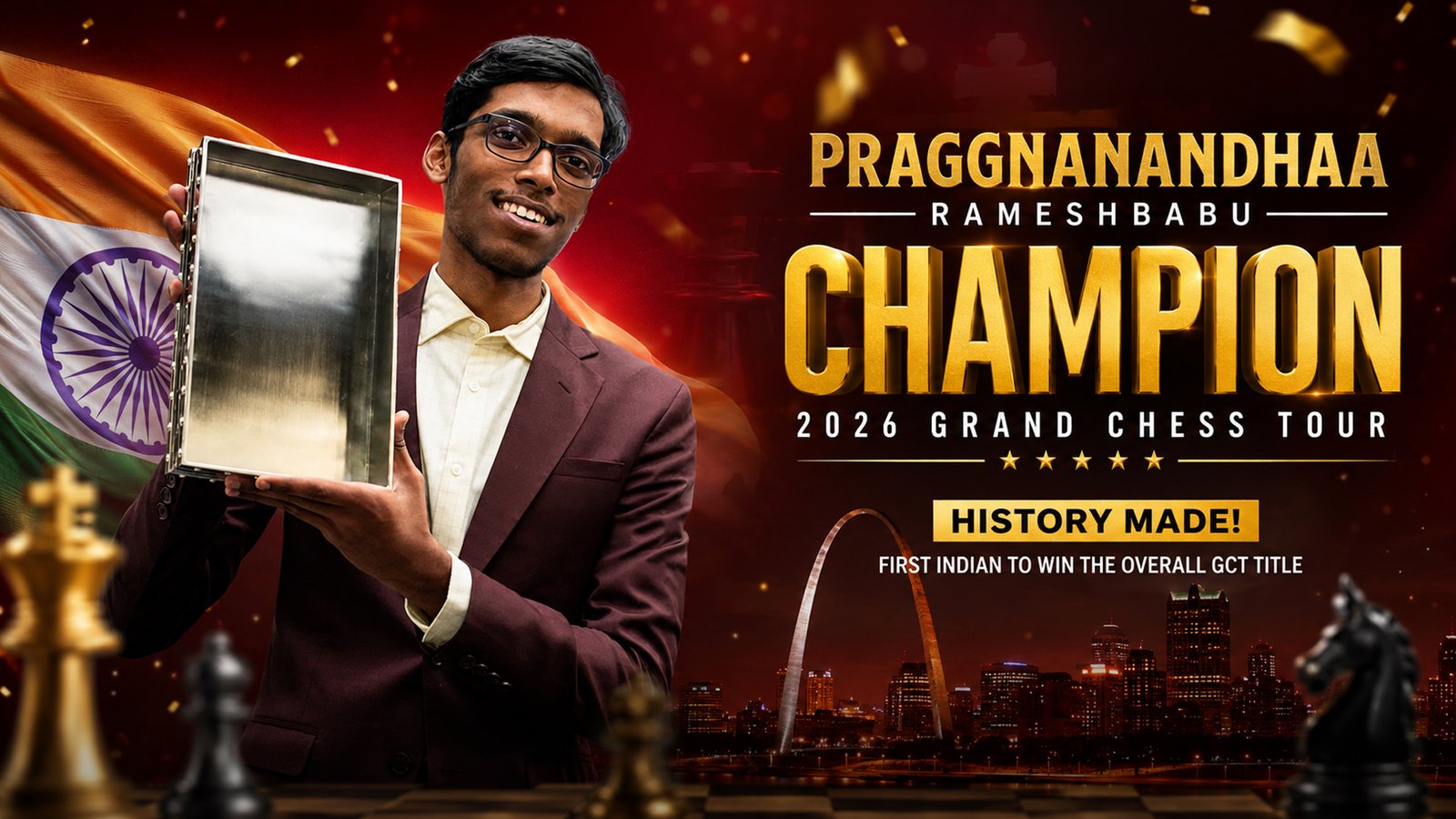
R Praggnanandhaa produced a stunning comeback against Fabiano Caruana to become the first Indian to win the overall Grand Chess Tour (GCT) title, adding another landmark achievement to India’s growing influence in world chess.
The 21-year-old grandmaster defeated Caruana 15-13 in the 2026 GCT Finals in St Louis, overcoming a six-point deficit to lift the prestigious trophy. The victory capped a remarkable run for Praggnanandhaa, who has enjoyed a highly successful season across several major international tournaments.
The final was played across classical, rapid and blitz formats, demanding both patience and speed from the two grandmasters. Caruana, the defending GCT champion, began the contest in a strong position and appeared to have the upper hand after winning the opening classical game.
That result left Praggnanandhaa facing a significant challenge. Rather than allowing the deficit to affect his approach, the Indian returned strongly in the rapid games and changed the direction of the match.
Praggnanandhaa won both rapid encounters, cutting deeply into Caruana’s lead and putting himself back in contention. The comeback meant the final would be decided in the faster blitz games, where there was little room for error.
The Indian handled the pressure effectively. He maintained his advantage during the blitz section and eventually completed the 15-13 victory. His ability to remain composed while playing at speed proved crucial as Caruana attempted to regain control.
The result is particularly important because the Grand Chess Tour is one of the most prestigious events on the international chess calendar. It brings together elite players across different formats, with the overall championship rewarding consistency and adaptability throughout the season.
Praggnanandhaa’s achievement also marks a first for Indian chess. While India has produced a world champion in Viswanathan Anand and currently boasts several players among the world’s elite, no Indian had previously won the overall Grand Chess Tour.
His victory comes during a golden period for Indian chess. D Gukesh became the youngest world champion in history in 2024, while players such as Arjun Erigaisi, Vidit Gujrathi and Praggnanandhaa have established themselves as regular contenders at the highest level.
Praggnanandhaa’s own rise has been closely followed since he became a grandmaster at the age of 12. He has since defeated several of the world’s strongest players and has become one of the most recognisable young faces in international chess.
The 2026 season has been especially productive. Before reaching the GCT Finals, Praggnanandhaa won the Norway Chess tournament, another elite event featuring several of the world’s top-ranked grandmasters.
He also enjoyed success at the Saint Louis Rapid & Blitz event earlier in the Grand Chess Tour season. Those results helped establish him as one of the strongest performers on the tour and gave him valuable momentum heading into the final.
The final against Caruana, however, was anything but straightforward.
Caruana had entered the championship match as the defending champion and quickly demonstrated why he was considered a formidable opponent. His victory in the classical game gave him a sizeable advantage, leaving Praggnanandhaa needing a strong response in the rapid and blitz portions.
The Indian’s performance in the rapid games became the turning point. Winning both games allowed him to recover the lost ground and put pressure back on Caruana. The change in momentum also demonstrated Praggnanandhaa’s ability to adapt his strategy when the format shifted.
Classical chess allows players considerably more time to calculate complicated positions, while rapid and blitz games require quick evaluation and decisive play. Praggnanandhaa successfully made that transition, keeping his calculations accurate even as the time available for each move decreased.
The final blitz stage brought another test of nerves. With the championship within reach, Praggnanandhaa avoided unnecessary risks and concentrated on maintaining his advantage. Caruana continued to fight, but the Indian eventually had enough of a cushion to close out the match.
The $200,000 winner’s prize adds to the significance of the victory, but the historic nature of the title is likely to remain the bigger talking point.
Caruana’s defeat ended his attempt to retain the Grand Chess Tour crown. The American remains one of the world’s strongest classical players, but Praggnanandhaa’s comeback demonstrated that the Indian can compete with and overcome established stars across multiple formats.
Wesley So secured third place in the GCT Finals after beating Vincent Keymer 18-12. So delivered a dominant performance in the blitz portion of their playoff, winning all four blitz games to seal the result.
The GCT title also strengthens India’s position as one of the world’s leading chess nations. The country’s success is no longer centred on a single champion. A younger generation is now regularly competing for major international honours, with Praggnanandhaa among its leading figures.
His comeback against Caruana could become one of the defining moments of the 2026 chess season. Six points behind and facing the defending champion, Praggnanandhaa needed both technical skill and mental resilience. He found both when it mattered most.
By the end of the final, the early advantage held by Caruana had disappeared. Praggnanandhaa had turned the match around, secured a 15-13 victory and written his name into Grand Chess Tour history.
This triumph is another milestone for Praggnanandhaa,in an extraordinary period for the sport. His victory represents another step in a rapid rise that has already taken him into the upper tier of international chess. His performances this year have combined strong tournament results with the ability to recover from difficult situations.
At 21, he now has a Grand Chess Tour championship, a Norway Chess title and a growing list of victories over elite opposition. The next challenge will be to build on this success and turn an exceptional season into sustained dominance at the top of world chess.