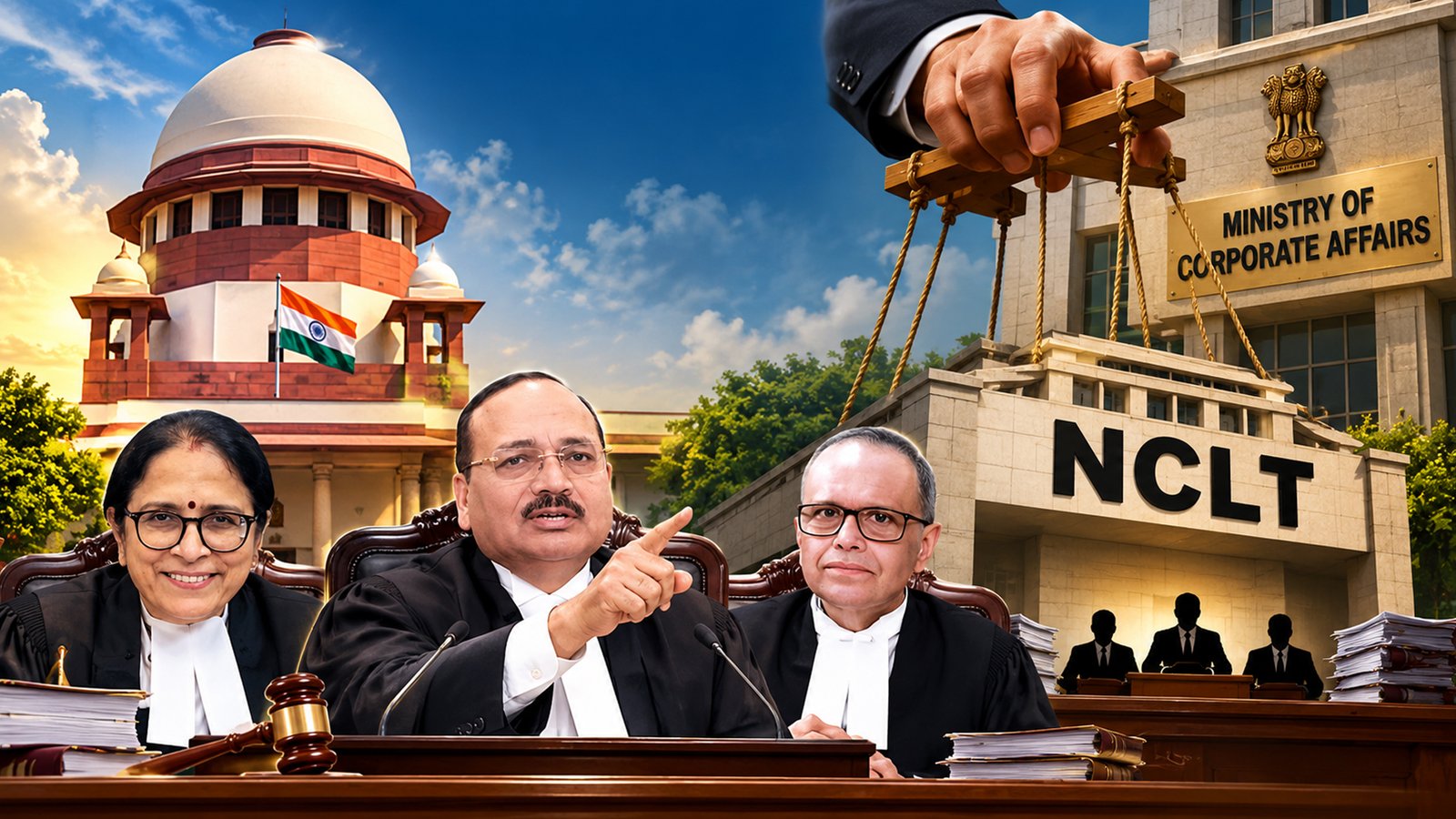
The Supreme Court has sharply criticised the Ministry of Corporate Affairs (MCA) over its control of the National Company Law Tribunal (NCLT) and the National Company Law Appellate Tribunal (NCLAT), saying the ministry’s involvement in their administration is affecting their independence. The court called for greater autonomy for the two tribunals, particularly in staff appointments, and said their leadership should have the authority to manage recruitment and day-to-day functioning.
A three-judge bench headed by Chief Justice of India Surya Kant, along with Justices Joymalya Bagchi and V Mohana, made the observations on October 29 while hearing petitions concerning staff appointments and administrative difficulties at the tribunals. The Chief Justice said the NCLT’s administration had been “completely hijacked” by the ministry and expressed concern that the government appeared keen to maintain complete control over the institution.
The bench stressed that the presidents of the NCLT and NCLAT should have full authority over staff appointments. It suggested that recruitment should be carried out through a transparent and structured process, with assistance from agencies such as the Union Public Service Commission (UPSC) or the Staff Selection Commission (SSC).
The court’s remarks came during a hearing involving contractual employees working at the tribunals. Their representatives argued that the MCA’s decision to outsource recruitment to a private company could result in the removal of existing staff members, some of whom have worked at the institutions for six to eight years.
According to the petitioners, the ministry had awarded a contract on October 6 to a foreign company operating in India to provide administrative personnel. The positions included deputy registrars, assistant registrars and stenographers. The employees feared that the new arrangement could displace the existing workforce as early as November 1 or 2.
Senior advocate Meenakshi Arora, representing the contractual employees, argued that the workers had served the tribunals for several years and should not be removed without considering their rights. She also raised concerns about the absence of benefits such as house rent allowance and dearness allowance for contractual staff.
However, the Supreme Court made it clear that long service alone would not guarantee the employees continued employment or automatic regularisation. The Chief Justice questioned whether people appointed through contractors, without a proper competitive recruitment process, could claim a right to remain in their positions. He described such appointments as backdoor entries and said the larger interest of the tribunals had to take priority over individual employment claims.
The bench declined to grant interim protection to the existing contractual employees. It also expressed concern over allegations that some contractual workers had interfered with judicial functioning and the handling of records. The court referred to an earlier incident in Mumbai in which original records were allegedly taken away, leading to police complaints.
At the same time, the judges said that recruitment arrangements should not undermine the independence of the tribunals. They suggested bringing experienced government officials on deputation as a temporary measure, while the NCLT and NCLAT develop a phased plan for regular appointments. The UPSC and SSC could assist in conducting the recruitment process.
Staff shortages have emerged as a major concern. The court was informed that only 67 of the NCLT’s 320 sanctioned regular administrative posts were filled, leaving 253 vacant. It was also told that 16 posts among judicial and technical members were vacant. Such gaps can put additional pressure on existing personnel and affect the handling of cases.
The bench also heard concerns about deteriorating infrastructure at the NCLT’s principal bench in Delhi. Senior advocate Sanjiv Sen, appearing for the NCLT Bar Association, told the court that parts of the building were in poor condition, with some floors reportedly shut because of structural problems. He said courtrooms were functioning with limited capacity, affecting the tribunal’s ability to handle its workload.
The Supreme Court asked the presidents of both the NCLT and NCLAT to submit comprehensive proposals within four weeks. These proposals must cover their requirements for staff, land, buildings, records management and other infrastructure needed to improve their functioning. The court also asked Attorney General R Venkataramani to ensure that the Centre provides basic facilities to the tribunals without further delay.
The bench further raised concerns about delays in cases under the Companies Act, observing that insolvency proceedings appeared to receive priority. The NCLT plays a central role in corporate insolvency resolution, liquidation proceedings and disputes involving companies. Its appellate body, the NCLAT, hears appeals against decisions passed by the NCLT and certain regulatory authorities.
The importance of these institutions is reflected in the scale of their work. The NCLT approved resolution plans worth around ₹55,000 crore in the 2024-25 financial year, according to information cited during the proceedings. Delays caused by staff shortages or inadequate facilities can affect companies, creditors, employees and investors waiting for disputes and insolvency cases to be resolved.
The Supreme Court’s intervention has therefore placed the spotlight on a broader question: how can specialised tribunals function independently if their recruitment, administration and infrastructure remain heavily dependent on the ministry they are expected to operate separately from? The court has not delivered a final ruling on the recruitment dispute, but its directions signal that tribunal autonomy and administrative reform will remain central to the proceedings.