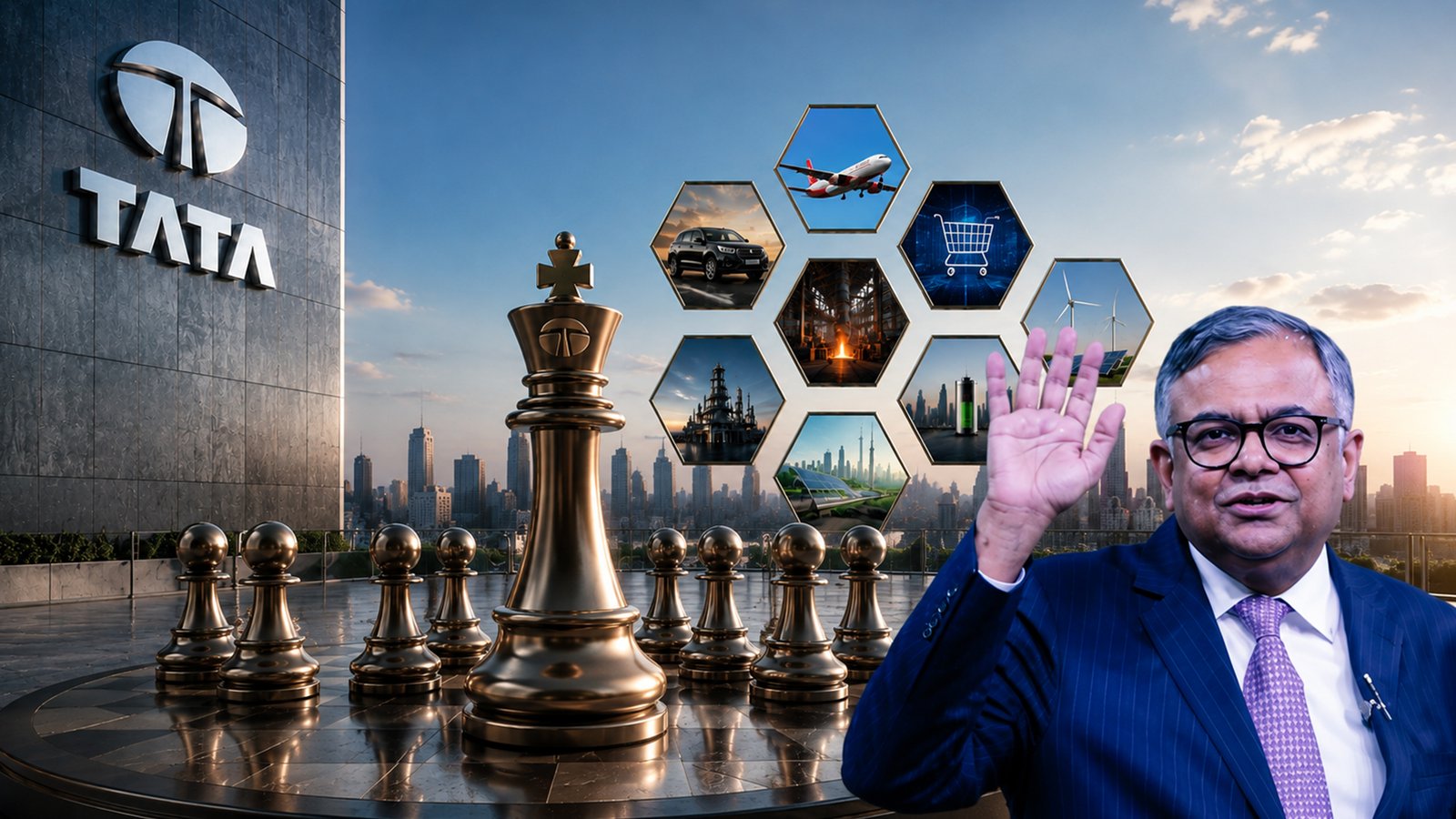
The market delivered its verdict within hours. After N Chandrasekaran announced that he would not seek another term as chairman of Tata Sons when his tenure ends on February 20, 2027, shares of Tata companies fell. Tata Consultancy Services dropped around 4%, erasing roughly ₹35,000 crore in market value.
The reaction was understandable. Chandrasekaran has been Tata’s visible centre for nearly a decade, overseeing turnarounds and expansion into potentially transformative businesses.
The natural question is: who can replace him?
It is also the wrong question.
Tata should not organise its sprawling empire around another exceptional executive. It should build a structure in which strategy, capital allocation and accountability do not depend disproportionately on one individual.
Chandrasekaran’s success makes that reform more urgent, not less. If the departure of one chairman can wipe tens of thousands of crores from listed companies that have their own boards and chief executives, the market is revealing a vulnerability as well as paying a compliment.
A remarkable record—and a dangerous conclusion
There is no need to diminish Chandrasekaran’s record to make the case for change. Tata’s latest annual report shows group revenue rising from ₹7.89 lakh crore in FY2020 to ₹16.24 lakh crore in FY2026. Profit after tax increased from ₹31,716 crore to ₹1.71 lakh crore. Over the past decade, Tata companies delivered total shareholder returns of 287%, against 253% for the Nifty 50; excluding TCS, the figure was 575%.
There were important repairs beneath those numbers. Tata Motors recovered from years of stress; Tata Steel strengthened its Indian business; Tata Capital reached the public market; and Trent became a major growth story. Tata also re-entered aviation and committed itself to electronics, semiconductors, batteries, defence and artificial-intelligence infrastructure.
These results explain why investors want continuity. But continuity is not the same as replication. Searching for “the next Chandra” risks converting a governance question into a personality contest.
Great leaders often make centralisation look efficient. They can settle disputes, move capital rapidly and hold together businesses with very different economics. The weakness appears only when they leave. A system accustomed to one trusted arbiter may discover that it has not built enough institutional muscle beneath him.
The correct lesson from Chandrasekaran’s tenure is not that Tata needs another indispensable chairman. It is that no chairman should be indispensable.
A formal process that still produced paralysis
Tata Sons does not lack succession rules. Its Articles provide for a five-member selection committee: three nominees of the two principal Tata Trusts, one Tata Sons board nominee and one independent outsider. The Trusts, which collectively own about 66% of Tata Sons, exercise decisive influence. Since 2022, the chairman of either principal Trust cannot simultaneously chair Tata Sons — a sensible separation between ownership and management.
Yet the present transition shows that formal architecture does not guarantee a functional outcome.
According to Chandrasekaran’s own statement, the Sir Dorabji Tata Trust and Sir Ratan Tata Trust unanimously recommended extending his tenure by five years. The nomination and remuneration committee and the Tata Sons board recorded and recommended the proposal. But when it was tabled in February, one board member did not support it. In the absence of unanimity, Chandrasekaran deferred the decision. Six months passed without a resolution, and he chose not to seek reappointment.
The problem is not that a director dissented. Good boards need dissent, especially when billions are being committed to risky ventures. The problem is that the system apparently could not resolve that dissent for half a year. A disagreement over one person became uncertainty for a group serving 900 million consumers and employing more than 1.1 million people.
This is not Tata’s first bruising chairmanship transition. Cyrus Mistry’s abrupt removal in 2016 produced years of litigation before the Supreme Court ruled in Tata Sons’ favour. Chandrasekaran’s departure is far more orderly, but the recurrence of high-stakes tension at the top suggests that the issue cannot be solved simply by choosing a more universally acceptable personality.
The bets are now too large for faith
The need for stronger institutional scrutiny is especially pressing because Chandrasekaran leaves behind several enormous, unfinished bets.
Tata Sons and its subsidiaries now encompass 343 subsidiaries, 38 associates and 32 joint ventures. The new-business portfolio stretches across Air India, Tata Digital, Tata Electronics, semiconductor fabrication, telecom equipment and battery maker Agratas. These are capital-intensive attempts to build national-scale capabilities in industries where returns may take years to appear.
Some are already producing strikingly different results. Tata Electronics generated revenue of ₹1.31 lakh crore in FY2026 and reached operating breakeven, although it recorded a net loss of ₹1,611 crore. Tata Digital reported revenue of ₹35,990 crore but lost ₹4,974 crore. Air India’s revenue fell to ₹71,870 crore and its net loss more than doubled to ₹22,238 crore. Agratas, still being built, lost ₹1,101 crore.
None of those figures proves that the strategies are mistaken. Airlines can take years to repair; semiconductor fabs and battery plants require patient capital; digital platforms often endure losses while seeking scale. Tata’s own history—from steel to software—is filled with investments that looked implausible before becoming institutions.
But “long term” cannot become an exemption from measurement. Patient capital still needs milestones, loss limits and exit tests. A project’s national importance does not eliminate the need to disclose what commercial success will look like and when management expects to reach it.
Tata Sons can afford patience. It ended FY2026 with no borrowings and net cash of ₹21,841 crore. That is reassuring, but it can also allow a weak investment to continue longer before the pain becomes impossible to ignore. Strong balance sheets make capital discipline more important, not optional.
Change the job before choosing the person
The succession process should therefore begin by redefining the chairman’s role.
The next chair should guard capital, governance, talent and the Tata name—not act as substitute chief executive for dozens of businesses. Operating-company boards must own their strategies. Sector leaders should have clear authority, but also measurable return-on-capital and cash-flow obligations. Tata Sons should publish intelligible milestones for major unlisted ventures, particularly when profitable companies are financing their gestation.
The group also needs a deeper, more visible leadership bench. Investors should not have to infer the future of aviation, electronics or electric mobility from the identity of the holding-company chairman. Each business should be able to explain its strategy, defend its capital requirements and survive change at Bombay House without prompting doubts about its direction. The broader debate over leadership, corporate governance and institutional accountability is explored further in our opinion and analysis coverage.
This would not require a weak chair. Tata’s complexity demands stature, independence and the ability to arbitrate between powerful interests. But there is a difference between authority and indispensability. The chair should make the system work; the system should not work only because of the chair.
The Trusts must clarify their boundary
The Tata model is unusual because philanthropic trusts ultimately control the commercial group. That structure gives Tata a long horizon and a social purpose few listed corporations can claim. It also creates two centres of legitimacy: the Trusts as controlling owners and Tata Sons as the group’s principal investment holding company.
The answer is not to weaken the Trusts. It is to make the boundary clearer. The Trusts should set the broad mandate, protect the group’s values, select capable directors and hold the Tata Sons board accountable. The board, in turn, must be able to debate strategy and resolve disagreements through a predictable process. Neither quiet deference nor unresolved veto is good governance.
The present episode offers an opportunity to make that distinction explicit. A transparent mandate for the next chair, clearer evaluation criteria and a genuine succession bench would do more for stability than a search for another leader enjoying temporary unanimity.
The legacy worth preserving
Chandrasekaran will leave Tata stronger, more profitable and more ambitious than the group he inherited. He will also leave his successor with some of the largest commitments in its history and no guarantee that all of them will succeed.
The temptation will be to appoint someone who promises reassurance: a familiar figure, a proven operator, perhaps another executive expected to command the entire system through personal credibility. That may calm the market. It would also postpone the harder reform.
Tata’s next chapter should not depend on finding a replica of N Chandrasekaran. His most durable legacy would be a group that can preserve long-term ambition, challenge its own assumptions and change leaders without appearing to lose its centre.
Tata does not need another Chandra. It needs to prove that the institution he strengthened is now strong enough not to need one.