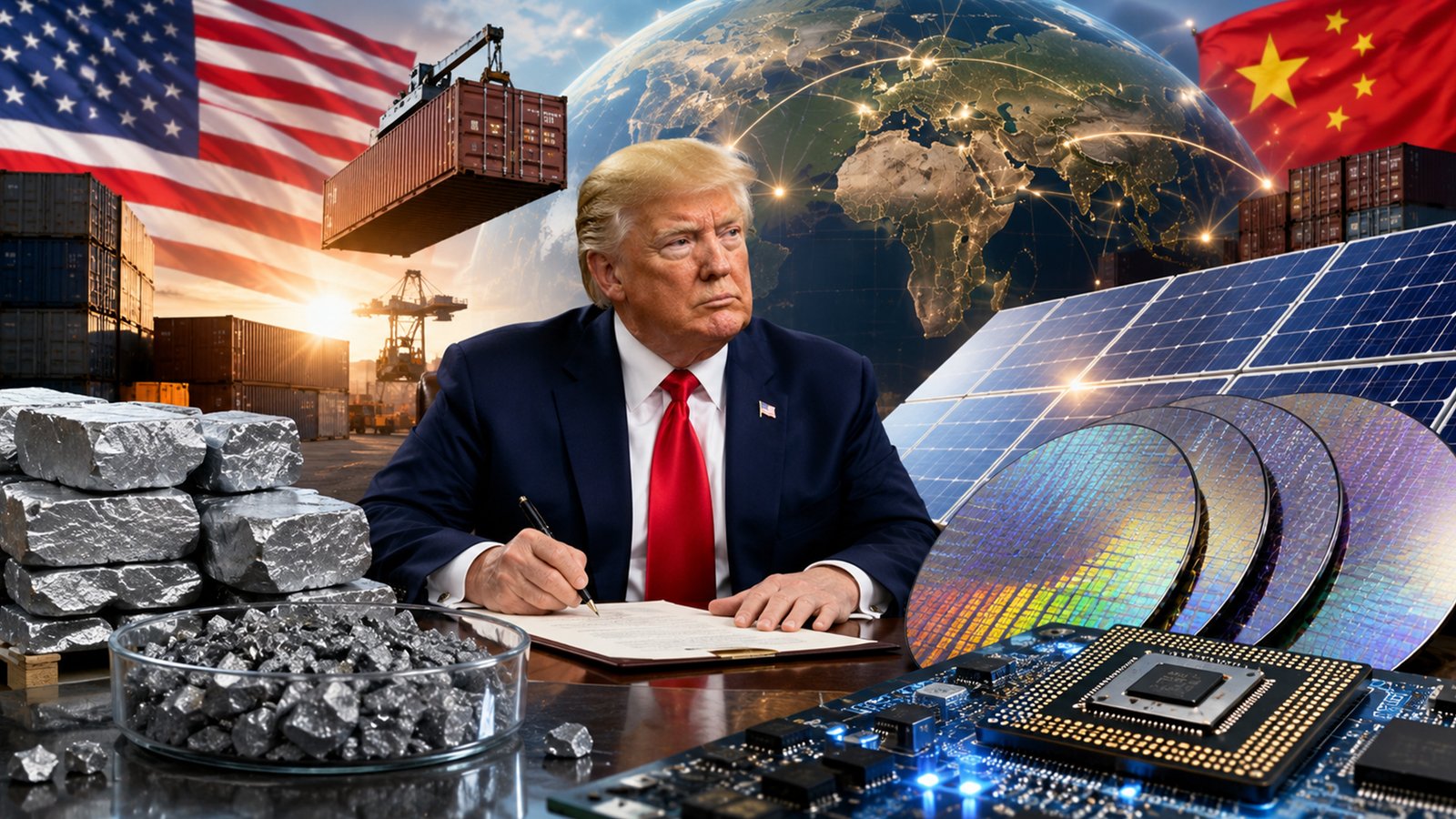
US President Donald Trump has announced a 15 per cent tariff on imported polysilicon products, along with minimum import prices, in a move aimed at rebuilding American manufacturing capacity and reducing dependence on overseas supply chains.
The new measures target polysilicon, a key material used in both solar panels and semiconductor manufacturing. The tariff and price-floor system will take effect from December 4, according to the presidential proclamation issued on Thursday.
The move is part of the Trump administration’s broader push to bring strategic manufacturing back to the United States. Washington has increasingly treated supply chains for semiconductors, solar power and other advanced technologies as matters of economic and national security.
Under the new rules, imported polysilicon and several products made from it will face minimum price requirements. The measures cover polysilicon, ingots, wafers, solar cells and solar modules.
The minimum import price has been set at $21 per kilogram for raw polysilicon and $100 per kilogram for polysilicon ingots and wafers. For solar cells, the floor is $0.22 per watt, while solar modules will have a minimum import price of $0.38 per watt.
The White House said the measures are intended to create a more level playing field for US producers and encourage companies to expand domestic manufacturing. The administration has argued that low-priced imports have weakened America’s ability to produce materials considered important for the country’s technology and energy sectors.
The announcement follows a year-long investigation by the US Commerce Department into imports of polysilicon. The investigation was launched in July 2025 under Section 232 of the Trade Expansion Act of 1962, the same national-security provision the Trump administration has used to impose tariffs on several other industrial products.
The decline of the US polysilicon industry has been a central argument behind the policy. According to the White House, the US accounted for about half of global polysilicon production capacity in 2005. By 2024, its share had fallen to less than 2 per cent.
Commerce Secretary Howard Lutnick described polysilicon as a foundational material for the semiconductor industry and said the administration wanted both production and the wider supply chain to be located in the US.
The policy is also closely linked to America’s competition with China. China has become a dominant force across the global solar supply chain, including the production of polysilicon and downstream products such as wafers and solar cells.
By establishing price floors and tariffs, Washington is seeking to prevent what it describes as unfairly low-priced imports from undermining US manufacturers.
The new tariff replaces a narrower safeguard duty on solar cells and modules that expired in February 2026. Unlike that earlier measure, the latest action extends across more stages of the polysilicon supply chain.
The administration is also offering a potential incentive to companies willing to expand US production. Under the proclamation, companies that receive approval for plans to build, refurbish or expand domestic facilities could receive tariff relief on certain imports needed to establish those operations.
This could encourage manufacturers to invest in US polysilicon plants, solar manufacturing facilities and related supply-chain infrastructure. The Commerce Department will determine the extent of duty-free imports based on the investment commitments made by companies.
There are currently only two domestic companies producing polysilicon in the US, according to Quartz: Hemlock Semiconductor, a Michigan-based joint venture involving Corning and Japan’s Shin-Etsu Handotai, and Wacker Chemie, which operates a plant in Tennessee.
For the solar industry, however, the new policy could create a mixed picture. American manufacturers may benefit from greater protection against low-cost imports, but higher import costs could also raise expenses for companies that still depend on overseas materials.
Solar developers and manufacturers will have to assess whether the higher costs can be absorbed or passed on through the supply chain. That could have implications for the price of solar equipment and the pace at which some projects are developed.
The impact could extend beyond solar power. Polysilicon is also used in semiconductor manufacturing, making the measure relevant to the US chip industry. Washington has been seeking greater domestic control over semiconductor supply chains as competition with China intensifies.
However, enforcing the new rules across complex global supply chains could prove difficult. Industry groups have previously warned that tracing the origin of polysilicon once it is incorporated into semiconductor products can be challenging.
The December 4 start date also gives importers several months to prepare for the changes. Some companies could accelerate shipments before the new tariff and price floors take effect, potentially creating a temporary increase in imports ahead of the deadline.
The policy marks another significant step in Trump’s tariff strategy. The administration has increasingly used Section 232 to justify sector-specific tariffs on products considered important to US national security.
For Washington, the objective is broader than simply raising the cost of imports. The administration wants to reshape supply chains, encourage domestic investment and reduce America’s dependence on foreign manufacturing for critical technologies.
For the solar and semiconductor industries, the challenge will be balancing those long-term goals with the immediate costs of restructuring supply chains.
The new polysilicon tariff therefore represents another front in the US effort to compete with China in clean energy and advanced technology. From December 4, companies importing covered products into the US will have to navigate both the 15 per cent tariff regime and the new minimum pricing requirements.
Whether the policy succeeds in creating a stronger American polysilicon industry will depend largely on whether it encourages sustained domestic investment without significantly slowing the expansion of solar power and semiconductor manufacturing.