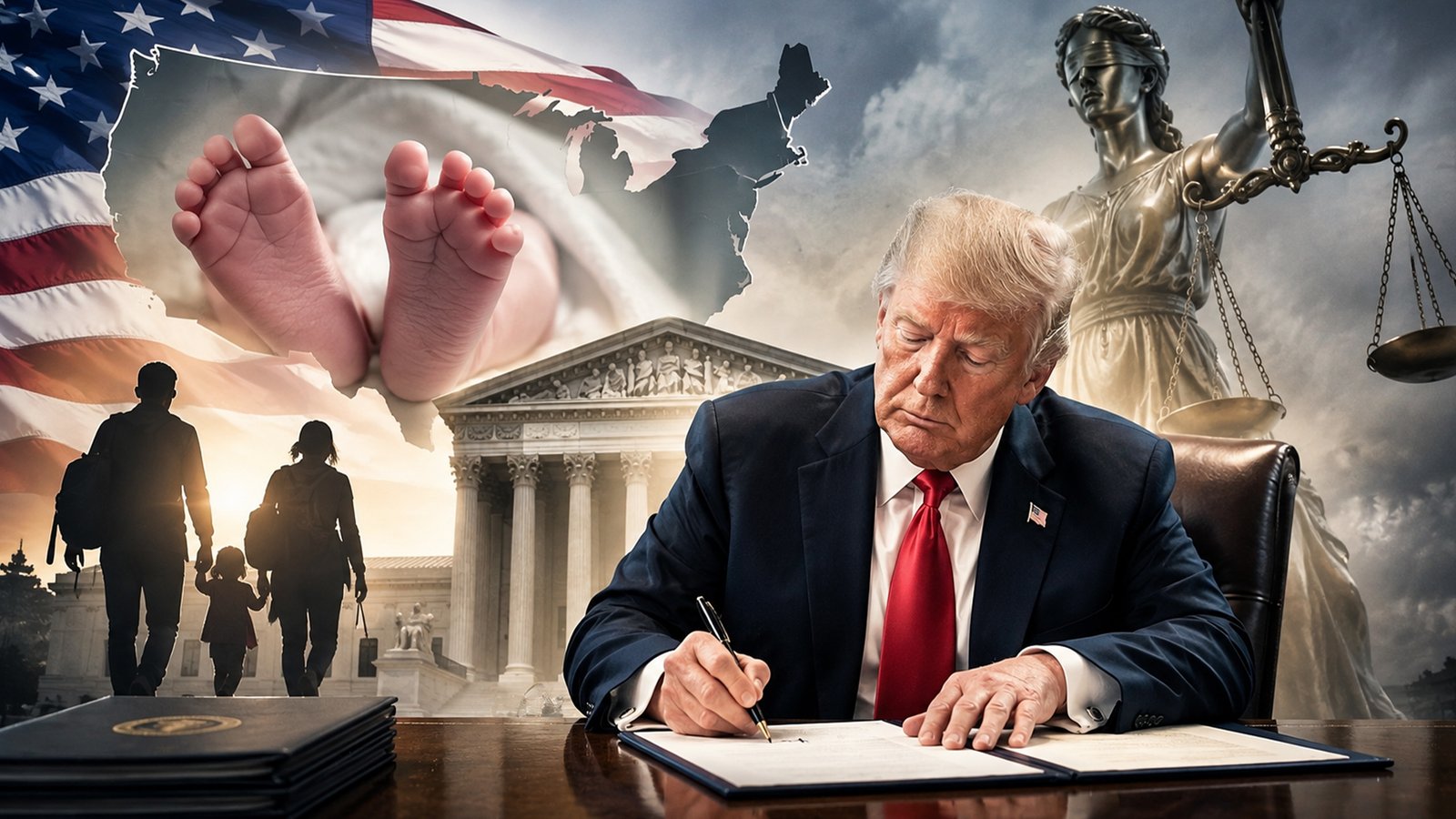
US President Donald Trump has renewed his push to restrict birthright citizenship, signing two executive orders that target children born in the United States to certain foreign parents and seek to crack down on so-called birth tourism.
The orders, signed on August 6, come just weeks after the US Supreme Court rejected Trump’s earlier attempt to broadly end birthright citizenship for children born to parents who are either in the country illegally or are present on temporary visas. The latest move has therefore reopened a major immigration debate and could have implications for Indian families living and working in the US.
The White House says the new measures are designed to protect the “meaning and value” of American citizenship. One order identifies categories of children who, according to the administration, would not qualify for birthright citizenship under historical exceptions recognised by the Supreme Court. The second directs the Secretary of State and Secretary of Homeland Security to take steps to stop birth tourism, where foreign nationals travel to the US primarily to give birth so their children can obtain American citizenship.
The US 14th Amendment generally provides citizenship to people born in the United States and subject to its jurisdiction. For generations, this has meant that children born on American soil have generally received US citizenship regardless of their parents’ nationality or immigration status.
Trump has challenged that interpretation, arguing that the constitutional guarantee should not automatically cover children whose parents are foreign nationals without permanent status.
The issue reached the US Supreme Court after Trump’s first executive order on birthright citizenship, signed in January 2025, attempted to deny citizenship to certain US-born children. On June 30, 2026, the Supreme Court ruled that children born in the US to parents who are unlawfully or temporarily present are covered by the Citizenship Clause of the 14th Amendment.
That ruling was a major setback for the Trump administration. Instead of abandoning the policy, the administration has now returned with a narrower approach, arguing that the latest orders are based on exceptions that it says are already recognised in American law and Supreme Court precedent.
The issue is particularly important for the large Indian-American community, including thousands of Indian professionals working in the US on H-1B visas.
Many Indian technology professionals and other skilled workers spend years in the US while waiting for permanent residency. Their children may be born during this period, when the parents hold temporary immigration status rather than US citizenship or a Green Card.
The Supreme Court’s June ruling provided important protection for such families by confirming that children born in the US to parents who are unlawfully or temporarily present are citizens at birth under the 14th Amendment.
The new executive orders, however, are likely to trigger another round of legal challenges. For Indian families, the uncertainty is less about children who already have US citizenship and more about how the administration’s new rules will be interpreted and enforced for future births.
The second executive order focuses specifically on birth tourism. The Trump administration argues that some foreign nationals deliberately travel to the US to give birth and secure citizenship for their children.
The White House has instructed the State Department and Department of Homeland Security to develop measures aimed at preventing such practices, including action against networks that facilitate birth tourism.
This distinction is important. Families who are long-term residents of the US, including Indian H-1B workers, are different from people who enter the country specifically for childbirth. However, the broader citizenship restrictions could still create anxiety among temporary visa holders because their immigration status may become a factor in determining their children’s citizenship if the administration’s interpretation survives legal scrutiny.
The biggest question now is whether Trump‘s latest orders can survive the US legal system.
The Supreme Court has already ruled against the administration’s earlier attempt to restrict birthright citizenship. Its June 30 decision specifically held that children born in the United States to parents who are unlawfully or temporarily present are citizens at birth under the 14th Amendment.
Legal challenges to the new orders are therefore expected. Critics argue that the president cannot change a constitutional guarantee through an executive order alone. The administration, meanwhile, maintains that it is relying on historically recognised exceptions to birthright citizenship rather than attempting to abolish the principle altogether.