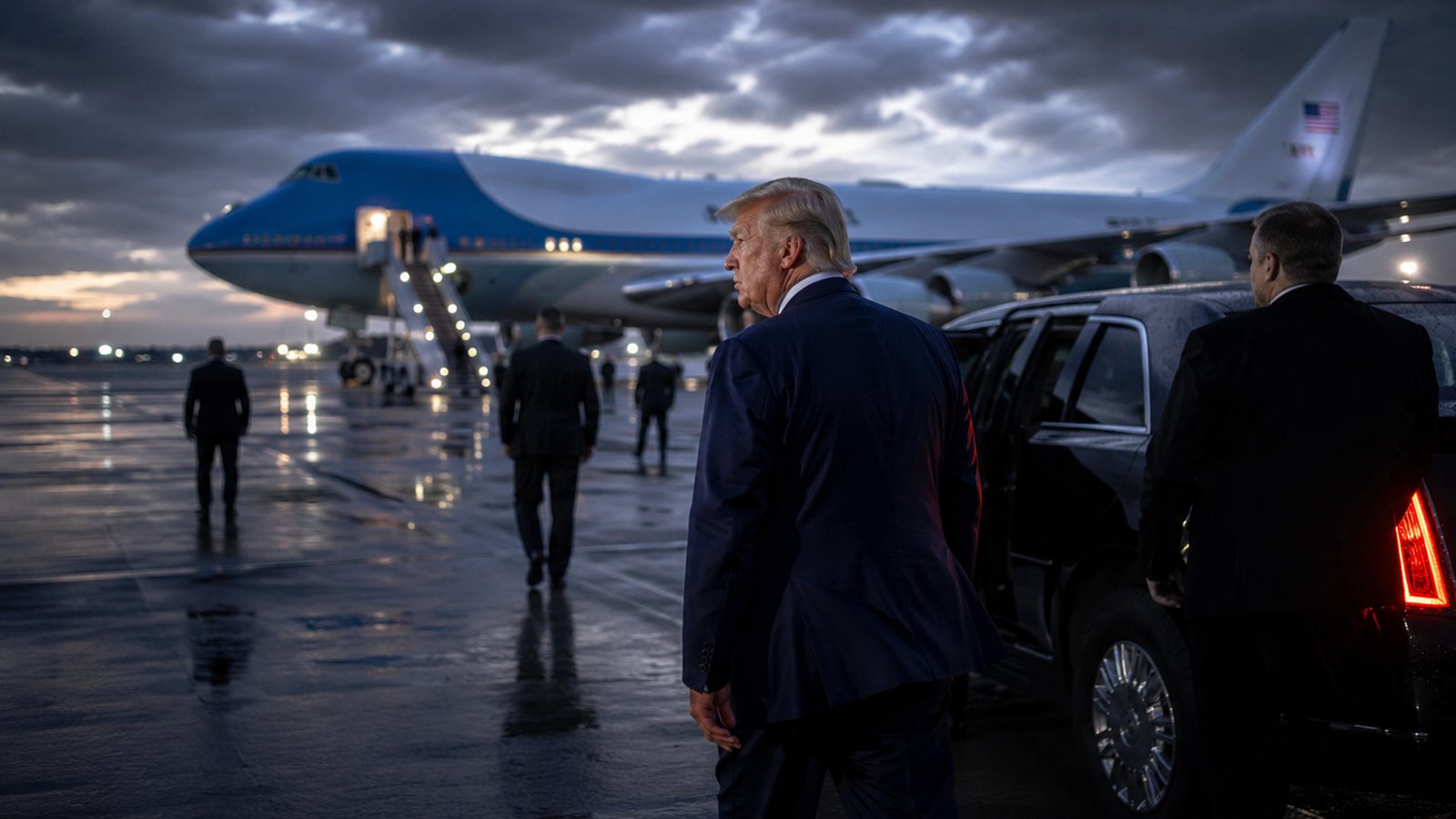
US President Donald Trump has confirmed that he was secretly moved off Air Force One after a NATO summit in Turkey because security officials feared a potential threat linked to Iran. Trump said the decision was taken by the US Secret Service and military advisers, who wanted him to leave Turkey on a different aircraft as a precaution.
The revelation has drawn fresh attention to security arrangements around the US president and the growing tensions between Washington and Tehran. The incident happened after Trump’s visit to Ankara for a NATO summit last month, but details of the operation emerged only recently.
According to reports, Trump initially boarded Air Force One at Ankara. He was then secretly taken away from the aircraft and transferred to a smaller military plane. The operation was designed to prevent anyone outside a small group of officials from knowing which aircraft was carrying the president.
Trump said on Tuesday that he “slipped away” from Air Force One after being advised by the Secret Service and military personnel to use another aircraft because of a threat. He said he did not ask for extensive details about the nature of the threat and indicated that security warnings were not unusual for him.
The Washington Post, which first reported the secret flight change, said Trump was taken from Air Force One to a C-32A military aircraft using an airport catering truck. The move was carried out without the usual public announcement and was intended to conceal the president’s actual departure aircraft.
Air Force One, meanwhile, remained part of the deception. Journalists and some White House personnel were still aboard the presidential aircraft, creating the appearance that Trump was travelling on it. The president instead departed on the less conspicuous military aircraft.
The unusual operation has raised questions about the level of the perceived threat and the decision to keep people travelling on Air Force One unaware of the security situation. The administration has not publicly provided detailed evidence about the threat or identified those believed to be behind it.
Trump has linked the security concern to Iran at a time when relations between Washington and Tehran remain extremely tense. The United States and Iran have been involved in a broader confrontation that has included military action, threats and disputes over the Strait of Hormuz.
The reported threat was serious enough for the Secret Service and military advisers to recommend changing the president’s aircraft. Trump, however, sought to play down his personal concern. He said he was following the advice of security officials and suggested that he was accustomed to receiving threats.
The aircraft used for the secret departure was a C-32A, a military version of a Boeing 757 that is considerably smaller than the Boeing 747 used as Air Force One. The aircraft can be used to transport senior US officials and is capable of operating with a lower public profile than the highly recognisable presidential aircraft.
The decision to use a different aircraft also meant that Trump’s actual location was temporarily concealed even from some people travelling with him. The Washington Post reported that more than 100 aides, officials and journalists remained aboard the original aircraft, which effectively served as a decoy.
The incident has generated political criticism in Washington. Questions have been raised about whether journalists and staff aboard Air Force One were knowingly placed in a potentially risky situation. Critics have also questioned the decision to allow the aircraft to continue appearing to carry the president while Trump had already been transferred elsewhere.
Security officials, however, face a difficult balance between protecting the president and maintaining secrecy during a possible assassination threat. Revealing the details of a security operation in real time could make it easier for potential attackers to track presidential movements.
The White House has not publicly disclosed the precise intelligence that prompted the aircraft switch. It is also unclear whether the threat was considered imminent or whether officials were responding to broader intelligence about a possible Iranian attempt to target Trump.
The disclosure comes against the backdrop of repeated threats involving Trump and Iran. The US president has adopted an increasingly hard-line position towards Tehran, while Iranian officials have repeatedly warned of consequences for American military actions. That environment has made presidential security a particularly sensitive issue.
The use of a decoy aircraft is not without precedent in US presidential security. Presidents have occasionally used alternate aircraft or concealed travel arrangements when intelligence indicated a potential danger. The difference in this case is the extent to which the operation was kept secret from people accompanying Trump and the fact that Air Force One continued to function as a visible decoy.
Trump’s comments have now confirmed that the aircraft switch was not simply a logistical change. It was a deliberate security measure carried out because advisers believed the president faced a potential threat.