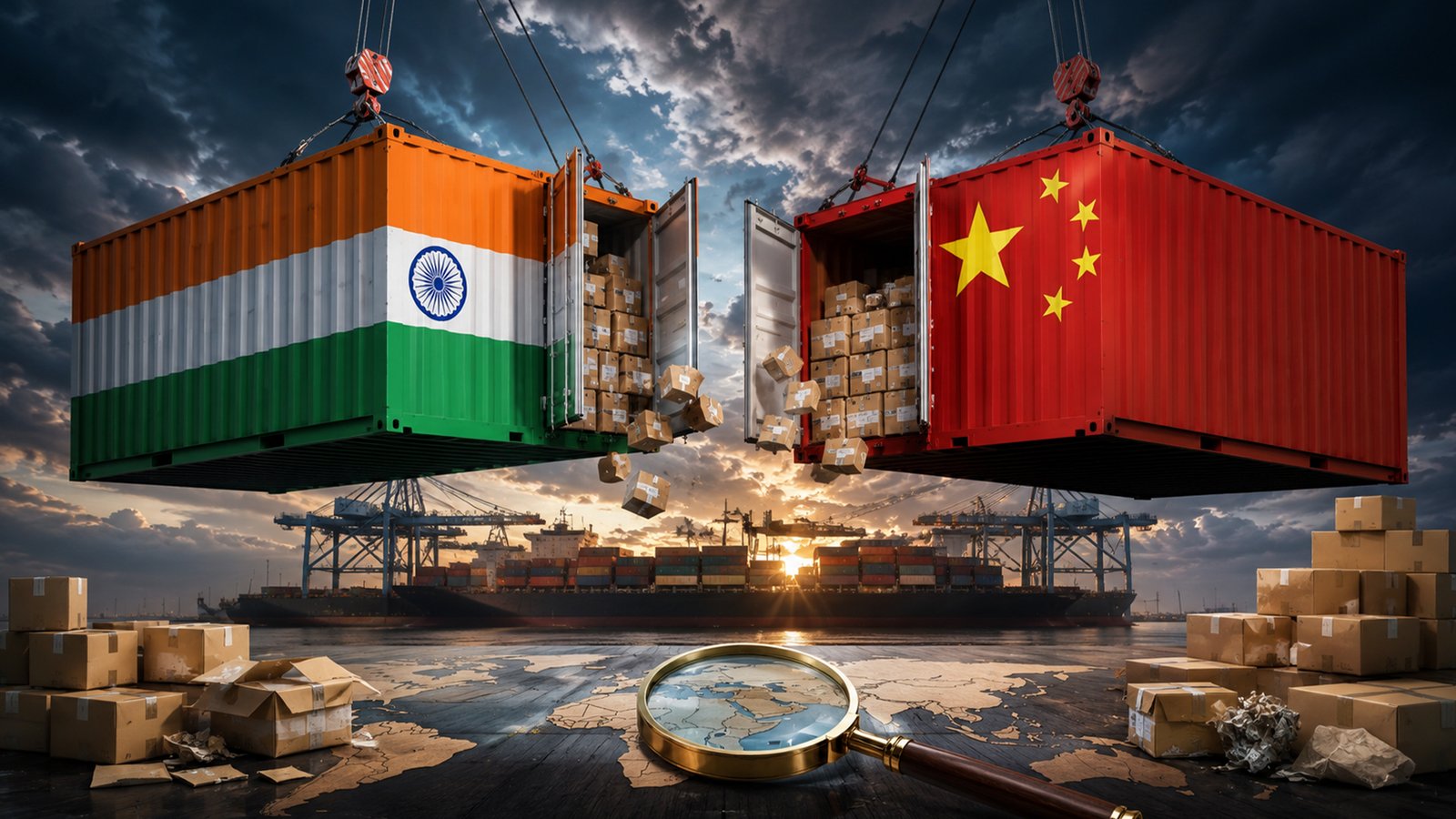
The United States has included India among more than 40 countries it says are part of a global network through which Chinese goods may be rerouted to the American market to avoid higher tariffs.
The allegation is contained in a US government report examining the growing use of third-country trade routes after Washington sharply increased duties on Chinese imports. The report argues that some exporters have responded by sending goods through other economies before they reach the US, making it harder for customs officials to determine their true origin.
India’s inclusion comes at a delicate stage in India-US trade relations, with both sides dealing with disagreements over tariffs and market access. However, the US listing should not be read as an accusation against every Indian exporter or as evidence that the Indian government is involved in tariff evasion.
The central issue is whether goods genuinely undergo sufficient manufacturing in a third country before being exported to the US. Simply changing the shipping route, packaging or paperwork does not necessarily alter a product’s legal country of origin.
This distinction matters because international manufacturing has become increasingly fragmented. A product sold in the US may contain Chinese components, use Indian or other foreign inputs, undergo assembly in another country and then be shipped across several borders before reaching its final customer.
Such arrangements are common in global commerce and are not automatically illegal.
The US concern is focused on transactions where a third country is allegedly used mainly to conceal the Chinese origin of merchandise and reduce the customs duty payable in America.
The report identifies several major trading economies alongside India, including countries in Asia, North America and Europe. Washington’s broader argument is that Chinese exporters have adapted to higher US tariffs by using established manufacturing and logistics centres elsewhere.
India’s growing importance as a global manufacturing destination makes the issue particularly significant. The country has attracted investment from companies seeking to diversify production away from China, while government incentives have encouraged expansion in sectors such as electronics, pharmaceuticals, automobiles and engineering goods.
That genuine shift in production has contributed to India’s growing exports. The challenge for US authorities is to determine whether increased shipments reflect new manufacturing capacity or merely a change in the route taken by Chinese merchandise.
The answer will depend on rules of origin, which establish when processing in a particular country is substantial enough for goods to qualify as originating there.
For Indian businesses, this could mean closer attention to production records, supplier information, invoices and documentation showing the extent of domestic value addition. Companies using Chinese components may have to provide clearer evidence of where the final product was manufactured and what transformation occurred in India.
This could raise compliance costs, particularly for smaller exporters that operate with suppliers across several countries.
The US is also moving towards greater use of technology in customs enforcement. American authorities are expected to examine trade data more closely to identify unusual shipping patterns, sudden changes in export volumes, discrepancies in product descriptions and relationships between companies involved in international transactions.
Such scrutiny is intended to identify potential cases for investigation rather than automatically treating every shipment from a third country as suspicious.
The issue has gained prominence because of the wider US-China trade conflict, which continues to shape global trade and international affairs. Washington’s tariffs have made direct exports from China more expensive, encouraging businesses to reassess their manufacturing strategies.
For some companies, the response has been a genuine relocation of production. Others have expanded operations in countries such as India, Vietnam and Mexico while retaining parts of their Chinese supply chains.
That makes the distinction between legitimate diversification and tariff circumvention increasingly important.
India has strong reasons to protect the credibility of its exports. The US is one of its most important trading partners, and Indian manufacturers are seeking to use the country’s expanding industrial capacity to win a larger share of global supply chains.
Any perception that India is being used as a route for Chinese products could complicate that strategy.
At the same time, Indian officials and trade experts are likely to seek greater clarity from Washington about the evidence behind the allegations. Identifying a country as a potential transit point is different from establishing that a particular company has committed customs fraud.
Specific investigations would require shipment-level evidence and an examination of the manufacturing process involved.
The development could also become relevant to ongoing discussions between New Delhi and Washington on tariffs, market access and supply-chain resilience. India wants to increase exports to the US, while Washington is seeking stronger safeguards against practices that could undermine its tariff policy.