India marked Kargil Vijay Diwas 2026 by remembering the bravery and sacrifice of the soldiers who fought in the 1999 Kargil War, while national leaders underlined how the conflict continues to shape the country’s modern military strategy and security doctrine. Twenty-seven years after India reclaimed its mountain posts from Pakistani intruders, the lessons of Kargil remain central to defence planning, border surveillance and military preparedness.
President Droupadi Murmu, Prime Minister Narendra Modi, Defence Minister Rajnath Singh, Home Minister Amit Shah and several other leaders paid tribute to the fallen soldiers, describing their courage and dedication as a lasting inspiration for the nation.
In a message on Kargil Vijay Diwas, Prime Minister Modi said the sacrifices made by India’s armed forces would never be forgotten and that the nation remains committed to safeguarding its sovereignty and territorial integrity. President Murmu also hailed the extraordinary courage of the soldiers whose determination ensured India’s victory under extremely challenging conditions.
The Kargil War, fought between May and July 1999, began after Pakistani soldiers and infiltrators occupied strategic mountain peaks on the Indian side of the Line of Control (LoC) in Jammu and Kashmir. Indian armed forces launched Operation Vijay to recapture the occupied positions, battling harsh weather, difficult terrain and enemy fire at high altitudes.
After nearly three months of intense fighting, Indian troops successfully regained control of the occupied peaks, forcing Pakistani forces to withdraw. More than 500 Indian soldiers laid down their lives during the conflict, making Kargil one of the most significant military victories in India’s modern history.
This year’s commemorations also highlighted how the experience of Kargil has transformed India’s defence policy. Military experts say the conflict exposed critical gaps in intelligence gathering, surveillance, logistics and inter-service coordination, leading to wide-ranging reforms across the armed forces.
Over the past two decades, India has significantly strengthened its border infrastructure, deployed advanced surveillance systems, expanded the use of drones and satellite monitoring, and improved coordination between the Army, Air Force and intelligence agencies. These changes have enhanced the country’s ability to detect and respond quickly to cross-border threats.
Government officials and defence analysts say many of these reforms have also influenced recent military operations, including Operation Sindoor, which reflected India’s emphasis on rapid response, precision strikes and integrated military planning.
According to defence experts, Operation Sindoor demonstrated how India’s security doctrine has evolved from reactive defence to proactive preparedness. The operation showcased improved intelligence sharing, modern surveillance technology and faster operational decision-making—capabilities that were strengthened after the lessons learnt during the Kargil conflict.
The government’s emphasis on self-reliance in defence manufacturing has also gained momentum since Kargil. Indigenous production of drones, missiles, artillery systems, communication equipment and surveillance platforms has become a key priority under the broader vision of strengthening India’s defence capabilities.
Military planners believe technological superiority is now just as important as battlefield courage. Artificial intelligence, cyber warfare, electronic warfare and space-based surveillance are increasingly becoming integral to India’s national security framework alongside conventional military strength.
Defence experts note that the Kargil conflict permanently changed India’s approach to border management. Continuous monitoring of vulnerable mountain regions, improved infrastructure along border areas and year-round deployment of surveillance assets have significantly reduced the possibility of similar large-scale infiltrations.
At commemorative events across the country, veterans recalled the extraordinary resilience displayed by Indian soldiers, many of whom climbed near-vertical mountain slopes under enemy fire to reclaim strategic peaks. Their stories continue to inspire younger generations entering the armed forces.
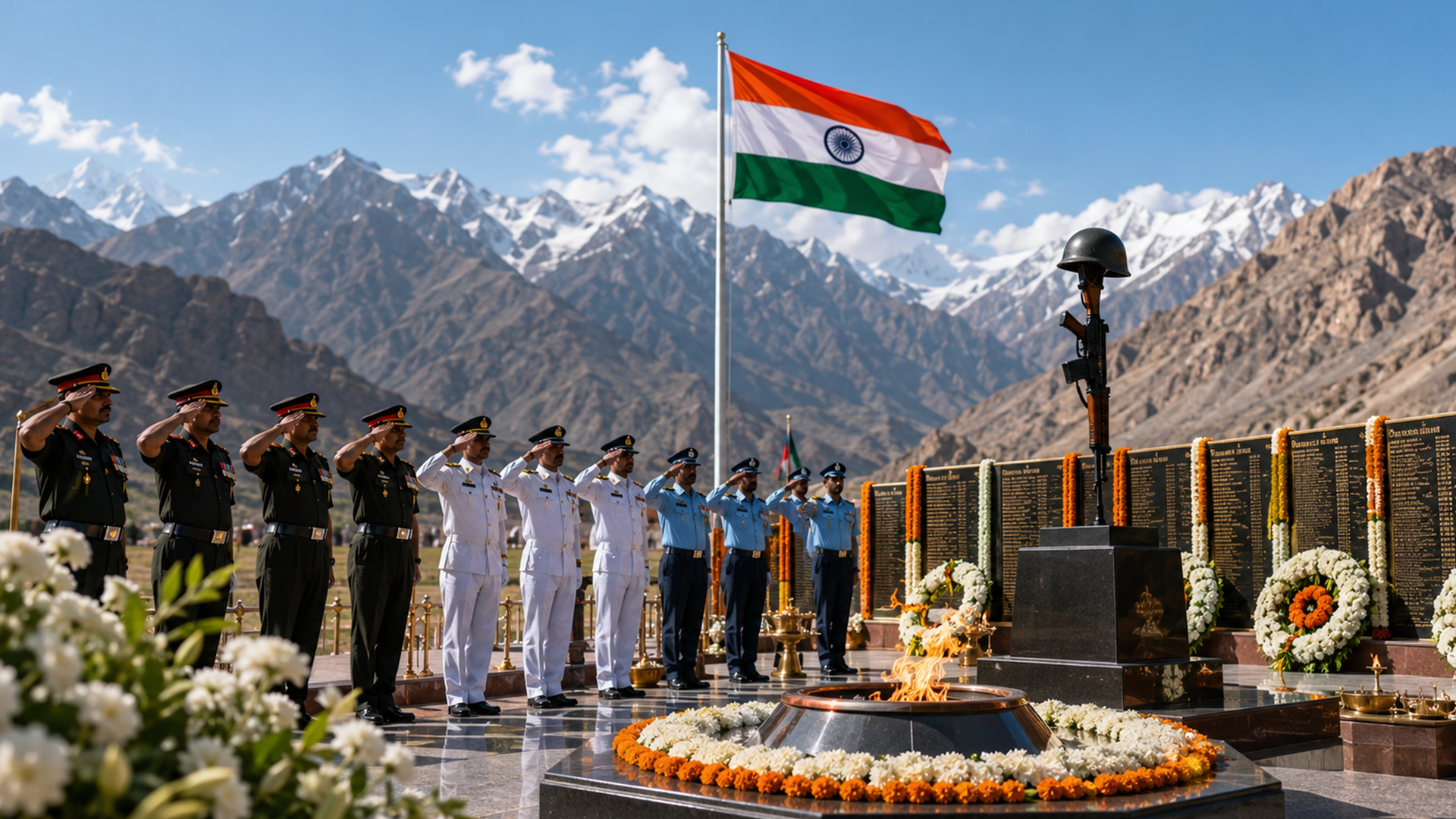
Tributes were also paid at the Kargil War Memorial in Dras, where families of fallen soldiers, military personnel and civilians gathered to honour the martyrs. Ceremonies included wreath-laying, military honours and remembrance events recognising the sacrifices made during the conflict.
Leaders across political parties echoed the sentiment that the courage displayed during Kargil continues to define India’s military ethos. They said the victory was not only a battlefield success but also a symbol of national unity, determination and unwavering commitment to protecting the country’s borders.
Security analysts believe the strategic significance of Kargil extends far beyond history. As geopolitical tensions and security challenges continue to evolve, the conflict remains a case study in military planning, intelligence coordination and high-altitude warfare.
The integration of modern technology with traditional military capabilities has become one of the defining features of India’s defence strategy. Investments in indigenous weapons systems, real-time intelligence, drone technology and integrated command structures reflect the long-term impact of the reforms initiated after 1999.
As India observed Kargil Vijay Diwas 2026, the day served not only as a tribute to the heroes who fought in the Himalayas but also as a reminder that national security requires constant vigilance, preparedness and innovation. From Operation Vijay to Operation Sindoor, the country’s defence journey reflects how the sacrifices of the Kargil martyrs continue to shape a stronger, more technologically advanced and resilient Indian military prepared to meet future challenges.