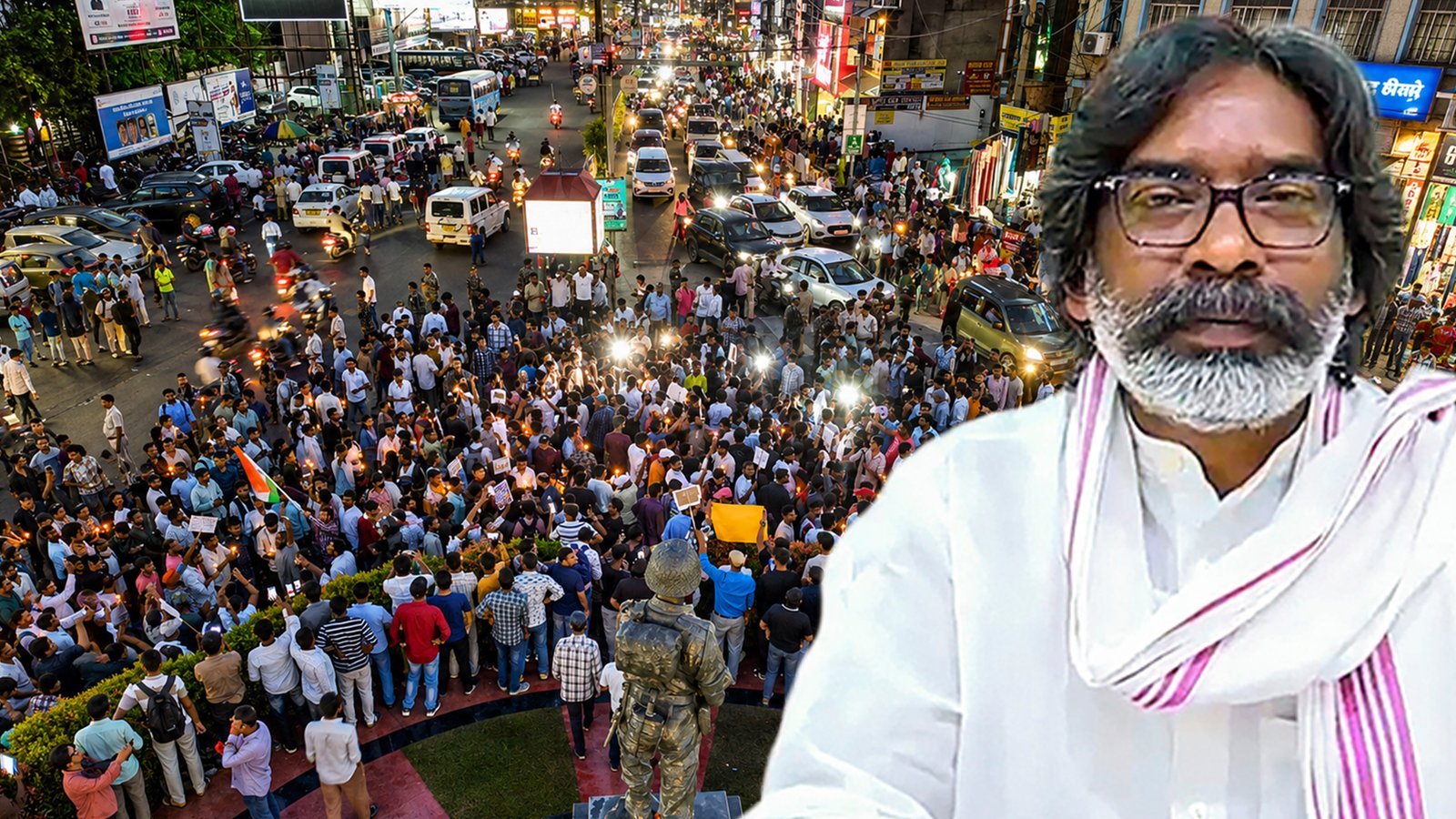
A protest by students and government-job aspirants in Jharkhand has entered a crucial phase, with demonstrators agreeing to hold talks with the Hemant Soren government while keeping their demand for an independent probe firmly on the table.
The protesting students have formed an 11-member delegation to engage with the state government over alleged irregularities in recruitment examinations conducted by the Jharkhand Public Service Commission (JPSC) and Jharkhand Staff Selection Commission (JSSC).
The delegation comprises eight students, two journalists serving as experts and an advocate. Protesters said the journalists and lawyer would provide guidance during the discussions, while the students would directly present their concerns.
The move follows Chief Minister Hemant Soren’s offer of dialogue, after nearly two weeks of demonstrations in Ranchi. The protest began on July 25 under the banner of the JPSC-JSSC Reforms Manch at Jaipal Singh Munda Stadium and has since grown into a wider youth movement centred on recruitment transparency, examination integrity and employment opportunities.
The students, however, have made it clear that talks will not mean stepping back from their core demands.
Among their principal demands is the cancellation of the 14th JPSC Civil Services Examination and an independent investigation into alleged irregularities. Protesters have sought either a Central Bureau of Investigation (CBI) probe or an inquiry by a panel of retired High Court judges from outside Jharkhand.
They are also demanding comprehensive reforms in the functioning of JPSC and JSSC.
The agitation has been fuelled by allegations ranging from manipulation of examination processes and OMR sheets to delays in conducting examinations and announcing results, as well as concerns over the non-disclosure of cut-offs. Students have also alleged broader recruitment-related irregularities. These remain allegations raised by protesters and would need to be established through an impartial investigation.
For many young people involved in the agitation, however, the issue goes beyond one examination.
It is about years of waiting for government jobs in a state where competitive examinations are often seen as one of the few stable routes to employment. Aspirants say repeated delays and controversies can consume years of preparation and leave candidates uncertain about their future.
Students have raised questions about vacancies, recruitment delays and the limited number of government posts being advertised compared with the number of graduates entering the job market each year.
That frustration has helped transform the Ranchi protest from a dispute over examination procedures into a broader conversation about youth unemployment, government recruitment and accountability.
The agitation has also acquired a political dimension.
On Thursday, as the Jharkhand Assembly began its Monsoon Session, opposition legislators raised slogans inside the Assembly premises over the recruitment controversy. Meanwhile, the student protest continued outside the political arena, with demonstrators maintaining pressure on the government.
The protest has also included a hunger strike. Six demonstrators were reported to be on hunger strike as the agitation entered its 13th day.
The state government has indicated that it is willing to engage with the protesters. Soren has described examination-paper leaks as a national problem and said the government’s doors were open for discussions. Earlier, the government had also announced a high-level committee headed by Higher and Technical Education Minister Sudivya Kumar to interact with students and submit a report.
The students’ decision to constitute a formal delegation could therefore provide an opportunity to move the confrontation from the streets to the negotiating table.
At the same time, the Jharkhand agitation is unfolding against a larger national backdrop of growing youth concern over competitive examinations, paper leaks, recruitment delays and limited employment opportunities.
The issue has also entered the political conversation beyond Jharkhand.
Congress leader and Leader of Opposition in the Lok Sabha Rahul Gandhi launched an “Ask Me Anything” session on Instagram on Thursday as part of an outreach effort aimed at Gen Z. He invited students to send questions through Instagram Stories on education, employment, governance and other issues. His initiative came shortly after he met students who had protested over examination-related issues and alleged police excesses.
Gandhi has subsequently spoken about the need for governments to listen to students and reform the education system, bringing the concerns of young job seekers and students further into the political spotlight.
For the students in Ranchi, though, the immediate question is more practical: whether their concerns about JPSC and JSSC recruitment exams will result in concrete action.
The formation of the 11-member delegation signals a willingness to talk. But with protesters continuing their agitation and demanding an independent investigation, the coming discussions could determine whether the Jharkhand government can rebuild confidence among thousands of young aspirants who believe their careers depend on a fair and transparent recruitment system.