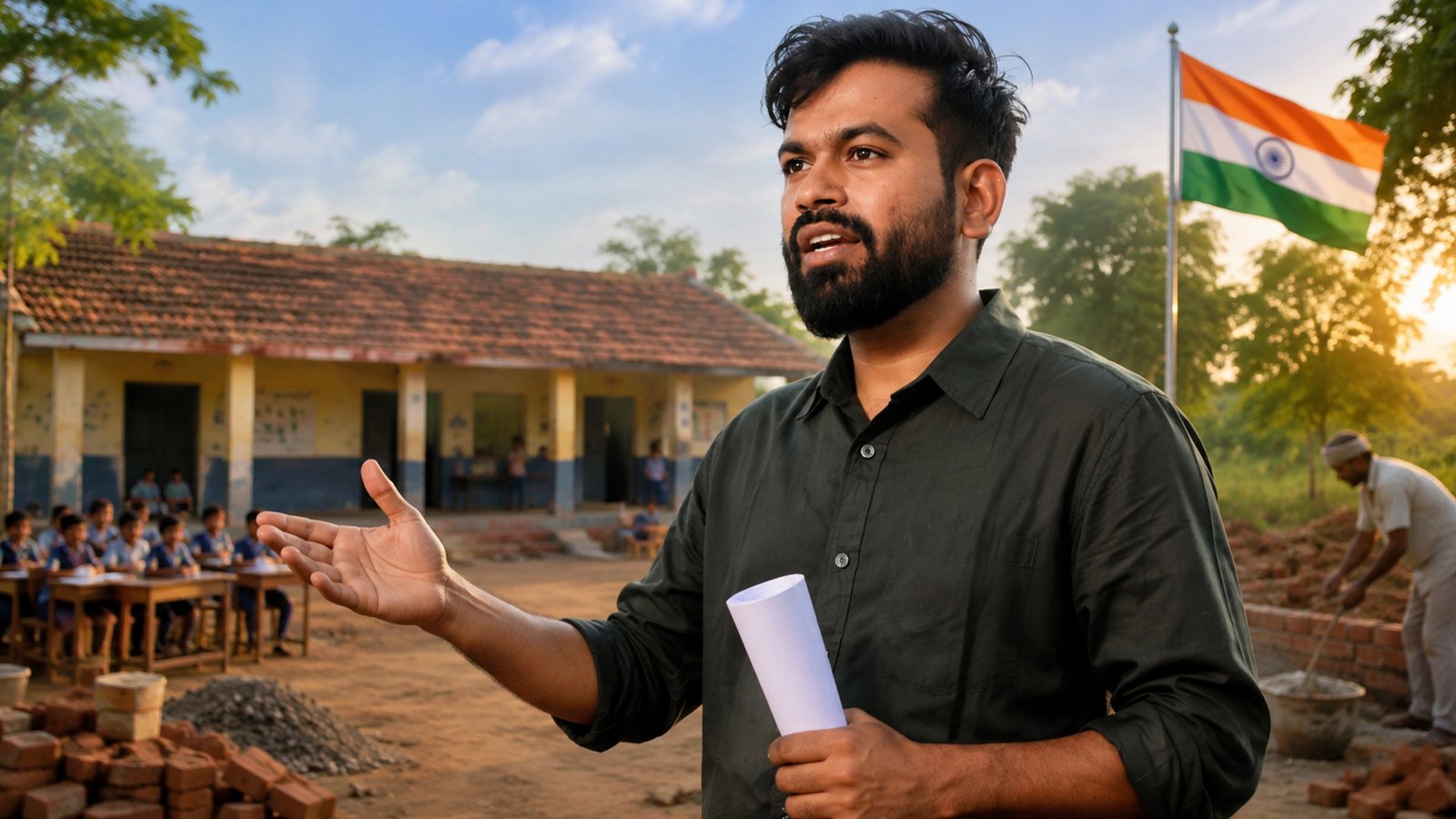
The Cockroach Janta Party (CJP) has announced a nationwide campaign to improve the condition of government schools in rural India, putting the spotlight on basic facilities that many children continue to struggle without.
CJP founder Abhijeet Dipke said the campaign will begin on August 15, India’s 80th Independence Day, and will seek the participation of parents, citizens and village leaders. The initiative will focus on making government schools more functional, accessible and suitable for children, particularly in villages where infrastructure remains inadequate.
Dipke said he will launch the campaign from his native village in Hingoli, Maharashtra, by approaching the village head and asking for improvements to the local government schools. He has also appealed to sarpanches across the country to take up similar efforts in their villages.
The campaign comes with a simple message: improving education cannot be limited to discussions about examinations, paper leaks or higher education. For millions of children in rural India, the immediate challenge is often much more basic — having a school nearby with drinking water, toilets, electricity and other essential facilities.
In a video message, Dipke questioned why large public infrastructure projects could be built while government schools in villages continue to face neglect. He also asked whether the children of farmers and labourers are being treated as an equally important part of India’s future.
“Real India lives in villages,” Dipke said while highlighting the difficulties faced by rural students. According to him, some children still have to travel long distances to attend school, only to find that basic amenities such as drinking water and toilets may not be available.
The lack of functional toilets and safe water can be especially difficult for girls, potentially affecting attendance and their ability to remain in school. For families already dealing with economic pressures, inadequate public education infrastructure can add another barrier to regular schooling.
The CJP campaign therefore plans to involve the people who see these problems firsthand. Parents whose children attend government schools will be encouraged to visit the institutions and assess their condition.
The proposed social audit of government schools will cover basic facilities such as electricity, clean drinking water, functional washrooms and mid-day meals. The organisation plans to release a printable audit form that citizens can use to record what is available and what is missing in their schools.
The completed forms, along with video evidence where necessary, can then be submitted to the CJP through the contact mechanism announced by the organisation. The campaign is intended to create a grassroots picture of the condition of rural schools rather than relying only on official claims about educational infrastructure.
Another feature of the initiative is the “Sarpanch Challenge”. Under the campaign, village heads who improve their government schools will be publicly recognised by CJP through photographs and social media posts showing the changes made.
The idea is to turn successful improvements into examples for other villages. Instead of treating school infrastructure as an issue only for governments and education departments, CJP wants local communities and elected village representatives to take greater ownership.
The campaign marks another shift in CJP’s activities. The organisation, which began largely as an online satirical platform, gained national attention after mobilising young people around concerns over examination irregularities and education governance.
CJP staged a 36-day agitation at Delhi’s Jantar Mantar over examination-related issues. The protest was called off on July 25 following the resignation of then Union Education Minister Dharmendra Pradhan.
After the protest, questions emerged about whether CJP would transform itself into a political organisation. However, following a two-day strategy meeting in Maharashtra earlier this month, the group decided to continue primarily as a youth movement rather than immediately entering electoral politics.
It has also announced the “Kya Bolti Public?” campaign as part of its broader nationwide outreach.
The focus on government schools now gives that outreach a more grassroots dimension. Rather than concentrating only on national-level education policy, the campaign is asking citizens to look closely at the school their own children attend and document what needs to change.
For rural families, such improvements can have a direct impact on everyday education. A functioning toilet, access to drinking water, electricity and a school within reasonable travelling distance may appear basic, but they can determine whether children attend regularly and whether parents feel confident about sending them to school.
The campaign also places village leaders at the centre of the conversation. By challenging sarpanches to improve schools and publicly recognising those who do, CJP hopes to create local competition around better public education infrastructure.
Dipke has argued that Independence Day should be an opportunity to think about the country’s next generation. His campaign seeks to make rural government schools part of that conversation, with the emphasis on visible improvements rather than promises alone.