India marked its 80th Independence Day on Saturday with Prime Minister Narendra Modi outlining an ambitious development roadmap for 2047, while President Droupadi Murmu used her address on the eve of the occasion to underline national security, the fight against terrorism and the need for inclusive growth.
From the Red Fort, Modi called on Indians to dream bigger and work towards building a “Viksit Bharat” by 2047, when the country completes 100 years of Independence. He said India had made significant progress over the past 12 years and now had the confidence to set bigger national goals.
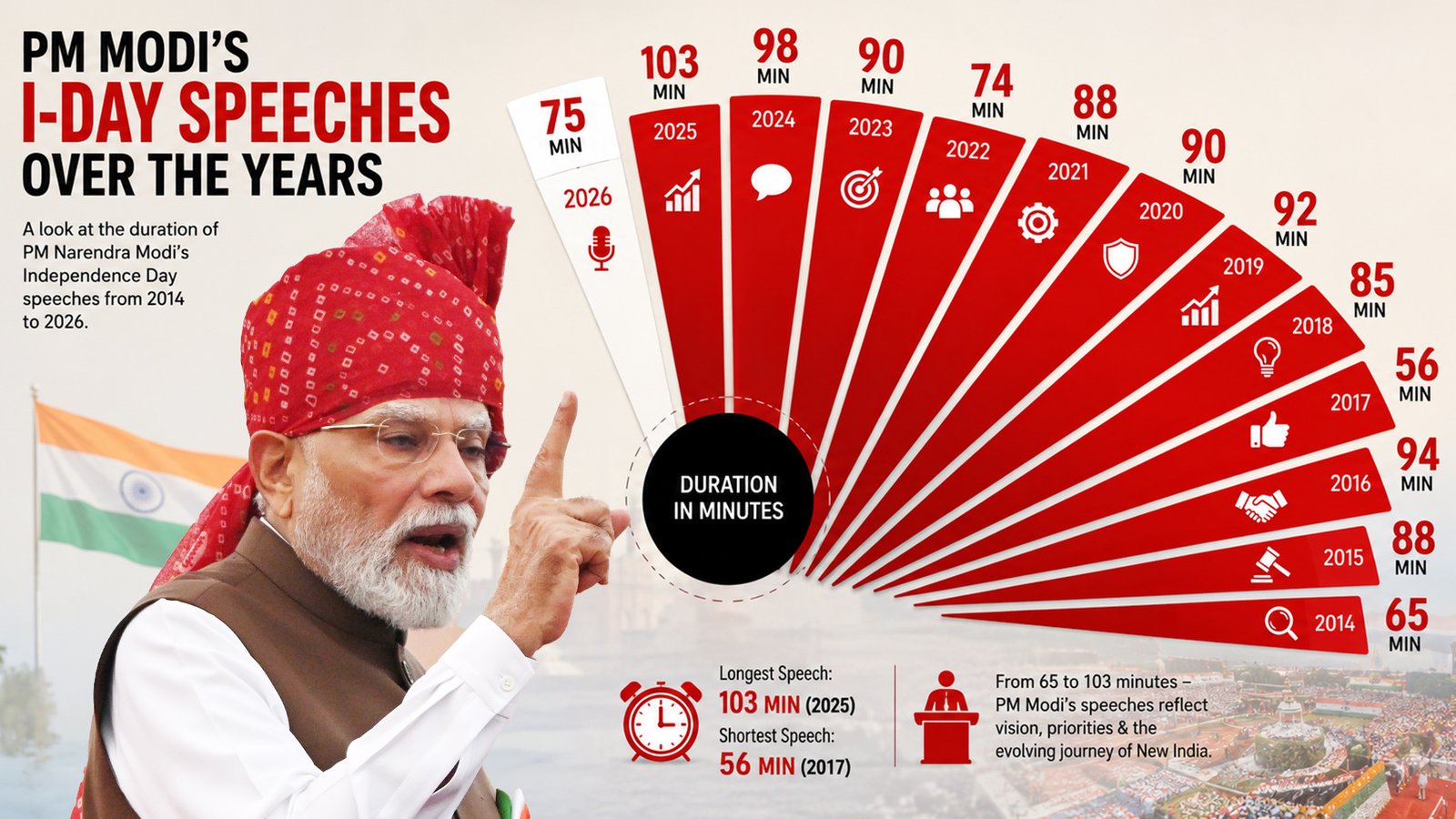
PM Modi’s address was also notable for its duration. His 2026 Independence Day speech lasted about 78 minutes, making it his shortest in four years and the second shortest of his 13 Independence Day addresses. His speech in 2025 had lasted 103 minutes, the longest of his tenure. The 2026 address was also his 13th consecutive Independence Day speech from the Red Fort, taking him past former Prime Minister Indira Gandhi’s record of 11 consecutive addresses. Jawaharlal Nehru remains ahead with 17.
The Prime Minister placed self-reliance at the centre of his economic message. He said India could not remain dependent on other countries and highlighted the growing importance of domestic manufacturing, critical minerals, semiconductor production and energy security.
He introduced a seven-part framework, described as “Sapta Dhara”, for the next phase of development. The areas include manufacturing, farming, technology, Gati Shakti, defence, the green economy and soft power. He said these sectors, combined with the energy of India’s young population, could give the country a faster and stronger development trajectory.
Technology and artificial intelligence received particular attention. Modi announced a plan to provide AI skill training to one crore young Indians over the next year. He also announced free online coaching for students preparing for competitive examinations, saying the high cost of coaching had become a burden for many poor and middle-class families.
The Prime Minister also spoke about semiconductors, critical minerals and nuclear energy. He said semiconductor production had already begun at three plants and indicated that more facilities were expected in the coming years. He also set an ambitious target of 200 GW of nuclear energy capacity and said five new nuclear reactors were being taken forward.
Youth remained a central theme of the speech. Modi described young Indians as both the biggest beneficiaries and the driving force behind the Viksit Bharat mission. He also urged young people to contribute to the upcoming Census by helping their families provide accurate information.
The celebrations themselves carried a strong cultural message. For the first time since Independence, the full version of “Vande Mataram” was performed at the Red Fort as part of the Independence Day ceremony. This year marks 150 years of the national song, making its inclusion one of the defining moments of the celebrations.
President Droupadi Murmu had set a more security-focused tone in her Independence Day eve address. She praised the Indian Armed Forces for their role in Operation Sindoor, launched following the April 2025 Pahalgam terror attack. She said the operation demonstrated the military’s ability to carry out precision strikes against terror networks and sent a clear message to terrorists and their supporters that they would face consequences.
Murmu also described India’s suspension of the Indus Waters Treaty with Pakistan as a “decisive step” in the national interest, particularly for farmers. The treaty, signed in 1960, governs the sharing of the Indus river system between India and Pakistan. India put the treaty in abeyance after the Pahalgam attack, linking the decision to Pakistan’s alleged support for cross-border terrorism.
Her address also highlighted the government’s efforts to make India Naxal-free. Murmu pointed to greater development and public participation in areas that were once affected by Left-wing extremism, citing events such as the Bastar Olympics as examples of changing conditions.
For young Indians, the President spoke about reforms in public examinations. She said the government was taking comprehensive steps to curb paper leaks and unfair practices and make examinations more transparent, secure and trustworthy. She described students as the architects of India’s future and stressed the need to protect their opportunities.
Murmu also highlighted India’s economic resilience despite global uncertainty. She said the country was continuing to grow at a pace significantly higher than the global average and pointed to progress in poverty reduction, digital infrastructure and financial inclusion. She said more than 25 crore people had been brought out of poverty over the past decade.
Together, the two addresses presented a broad picture of India’s priorities: stronger national security, economic self-reliance, technological advancement, youth empowerment and inclusive development. While Murmu’s message focused heavily on security, justice and social progress, Modi used the Red Fort platform to look ahead, setting out a vision of an India that is technologically capable, economically stronger and self-reliant by 2047. These priorities are also shaping the wider national developments across India, from government policy and security to economic growth, education and technology.
The tone of this year’s Independence Day was therefore both reflective and forward-looking. Seventy-nine years after Independence, India’s leadership placed the emphasis not only on remembering the freedom struggle but also on defining what the country should look like when it reaches its centenary in 2047.