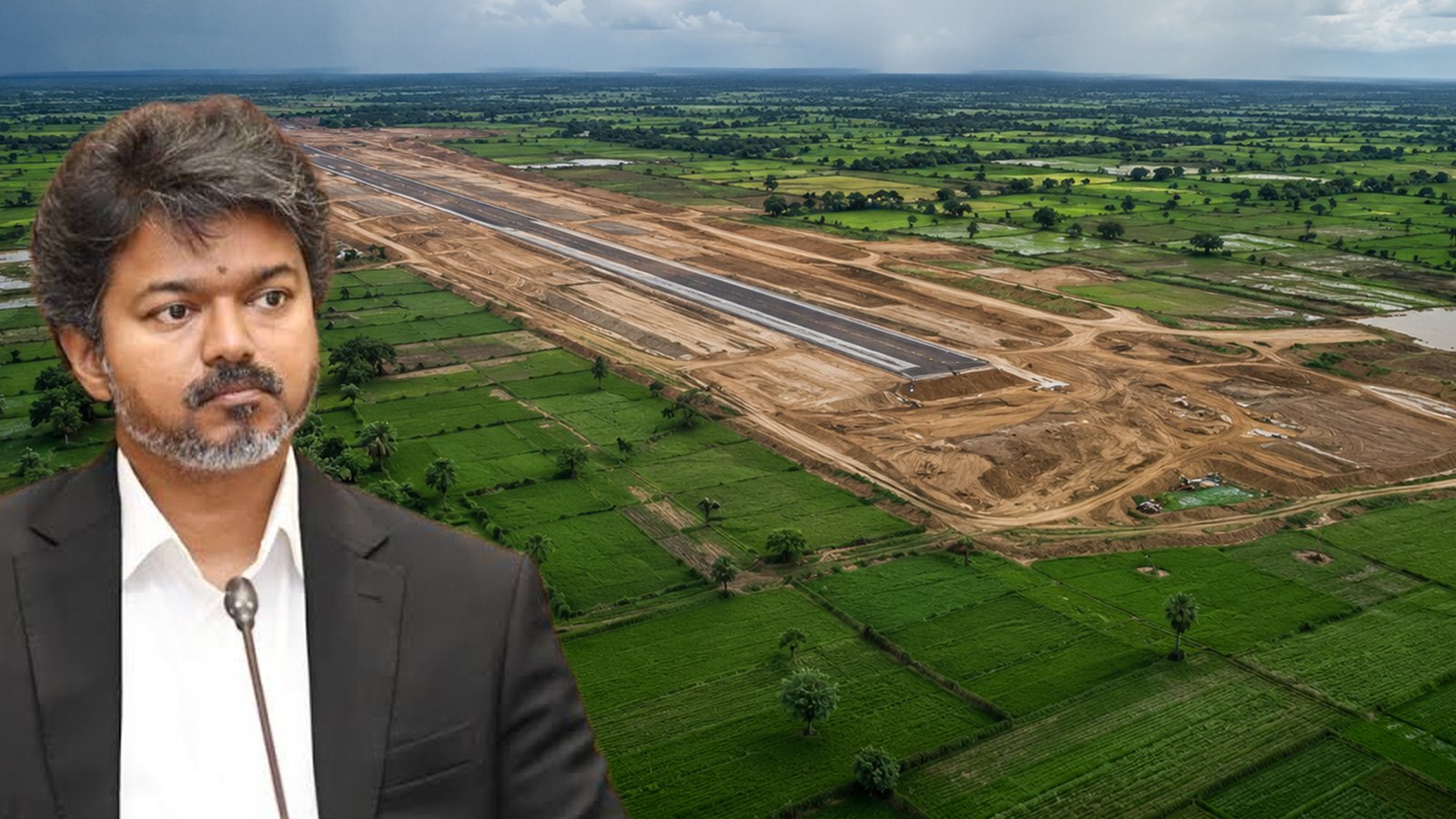
Tamil Nadu has dropped its proposed ₹27,000-crore Parandur greenfield airport project, ending a long-running dispute over farmland, water bodies and the future of Chennai’s aviation infrastructure.
Chief Minister C Joseph Vijay announced the decision in the state Assembly on August 24, saying the project would not go ahead at Parandur because it could affect agricultural land and the livelihoods of local communities. The government will instead identify another location for Chennai’s second airport while expanding the capacity of the existing Chennai airport.
The decision comes after years of opposition from farmers and residents of villages around Parandur in Kancheepuram district. The protests, particularly in Ekanapuram and neighbouring villages, had centred on the proposed acquisition of farmland and the possible impact on local lakes, canals and other water bodies. The farmers’ movement continued for around 1,000 days, turning the airport project into a major political and environmental issue.
The Parandur airport was planned as a major greenfield airport to serve the rapidly expanding Chennai metropolitan region. The existing Chennai International Airport at Meenambakkam is facing increasing passenger and cargo demand, particularly because Chennai is one of India’s biggest manufacturing and industrial centres.
The need for a second airport, therefore, has not disappeared with the cancellation of Parandur. Chennai is home to major automobile, electronics and manufacturing companies, and industry bodies have repeatedly highlighted the need for better aviation infrastructure to support investment, logistics and international connectivity. Tamil Nadu contributes a significant share of India’s manufacturing output, making airport capacity an important part of its economic plans.
The idea of a second airport for Chennai is not new. The state has examined different locations over several years, with earlier proposals including Sriperumbudur. In 2022, four locations — Parandur, Pannur, Padalam and Thiruporur — were examined as possible sites. After feasibility studies, Parandur emerged as the preferred location.
The proposed airport was to cover more than 5,000 acres across 13 villages. The project involved extensive land acquisition and was expected to be developed in phases. The estimated cost eventually rose to around ₹27,000 crore.
However, the size and character of the proposed site became the biggest challenge. Farmers argued that the airport would take away fertile agricultural land and disturb a network of water bodies that supports cultivation and local drainage. Environmental groups also raised concerns about the consequences of altering the region’s natural water-storage and drainage systems.
The Tamil Nadu government has now pointed to these concerns while defending its decision. It said only around 1,802 acres had been acquired out of the approximately 5,846 acres required for the project. It also said important environmental processes, including an environmental impact assessment and environmental clearance, had not been completed.
This has become a key point in the political battle over the airport. The Opposition DMK has criticised the government’s decision, arguing that scrapping the project could hurt Tamil Nadu’s economic prospects. Former Chief Minister M K Stalin described the cancellation as a setback to the state’s development, while the Opposition has questioned the future of the land that has already been acquired.
The DMK and its allies also staged a walkout from the Assembly over the decision, highlighting how politically sensitive the issue has become. Critics argue that replacing Parandur with a completely new site could lead to further delays because a new location would require fresh studies, land acquisition and regulatory approvals.
Supporters of the cancellation, however, see it differently. For residents who have spent years opposing the airport, the decision represents a victory for farmers and rural communities. Their argument has never been against development itself, but against locating a massive infrastructure project on land they depend on for agriculture and around water systems they say are vital to the region.
The state government has made it clear that Chennai still needs additional airport capacity. Until an alternative greenfield airport site is finalised, it plans to strengthen the existing Chennai airport. The government has indicated that expansion of the Meenambakkam facility could eventually increase its annual capacity from about 30 million passengers to around 55 million.
The Parandur episode also leaves several practical questions unanswered, including the future of land already acquired and infrastructure plans that were linked to the proposed airport. Earlier plans had envisaged improved road, rail and metro connectivity to Parandur, along with logistics and other supporting infrastructure.s.