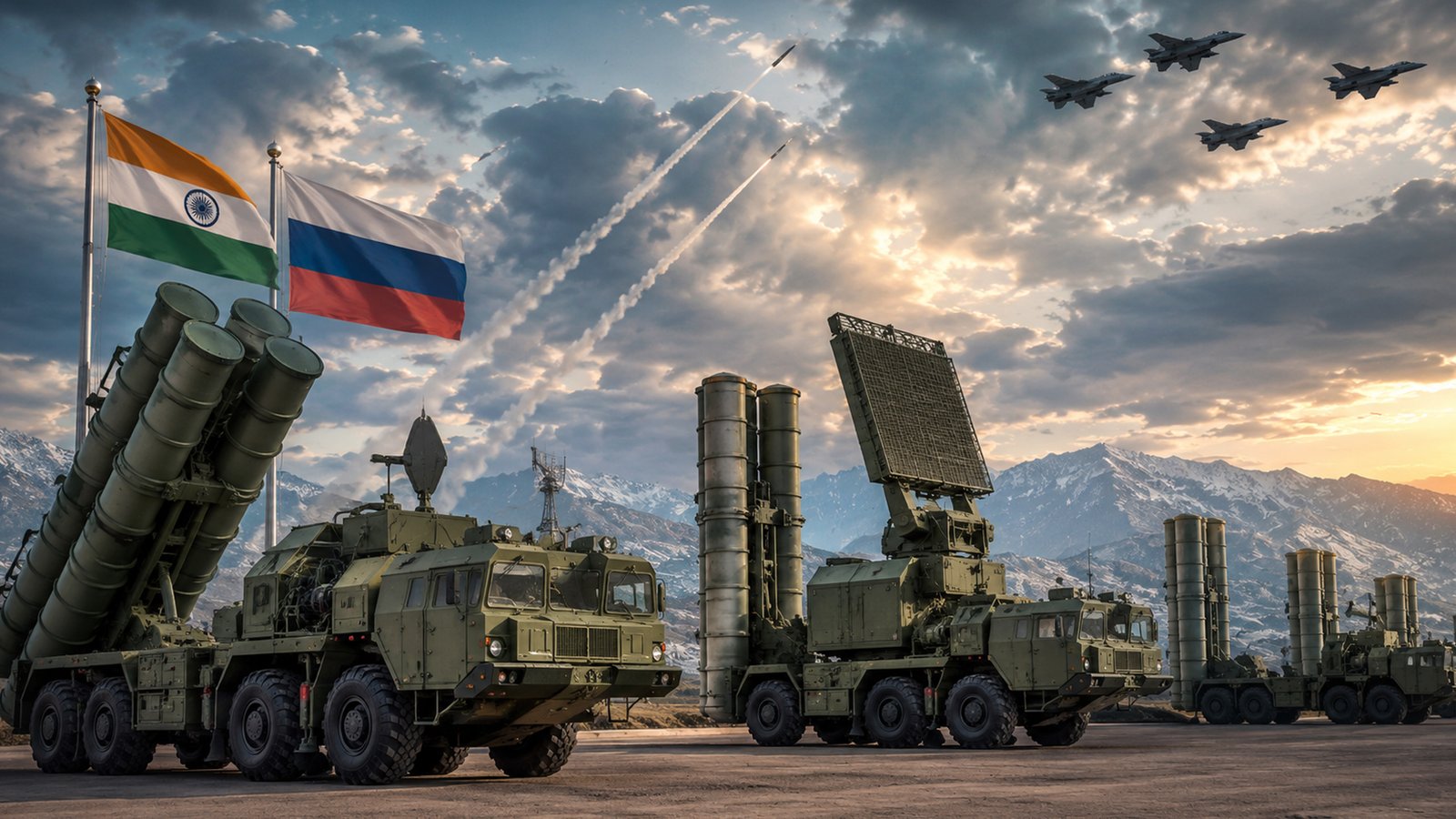
Russia has submitted a proposal to India for supplying five additional S-400 Sudarshan long-range air defence squadrons, marking a significant step towards expanding the country’s missile defence network. The proposed acquisition is estimated to be worth more than ₹50,000 crore and is currently being examined by the Defence Ministry.
The proposal follows India’s decision earlier this year to pursue five more S-400 squadrons for the Indian Air Force. The move gained importance following the experience of Operation Sindoor, during which India’s air defence systems were deployed amid military tensions with Pakistan.
The Russian proposal is not yet a final contract. It will undergo evaluation and further negotiations before the necessary approvals are obtained. If the deal is eventually concluded, India’s S-400 fleet would increase from five squadrons to 10 squadrons.
The S-400 Triumf is a mobile, long-range surface-to-air missile system designed to detect and engage various aerial threats. It can be used against aircraft, cruise missiles and other airborne targets at different ranges and altitudes. Its combination of advanced radars and interceptor missiles allows it to provide protection over a wide area.
The dditional S-400 systems would strengthen its integrated and layered air defence network for India. The systems are expected to improve protection for strategically important military installations and other critical assets, particularly along India’s eastern and western fronts.
The need for stronger air defence has become increasingly important as modern warfare evolves. Fighter aircraft are now accompanied by drones, cruise missiles, surveillance platforms and other sophisticated aerial systems. A layered air defence network allows different sensors and weapons to detect and respond to such threats at different distances.
India already operates S-400 systems acquired under an earlier agreement with Russia. The country had contracted five squadrons in 2018. Four squadrons have already been delivered, while the fifth and final unit is expected to arrive by November 2026.
The five additional squadrons would therefore represent a major expansion of India’s existing long-range air defence capability.
The S-400’s operational importance received renewed attention after Operation Sindoor. Indian defence officials have credited the country’s air defence network with helping counter aerial threats during the operation. The experience highlighted the importance of maintaining strong long-range capabilities and contributed to the decision to seek additional S-400 systems.
At the same time, India is working towards reducing its dependence on foreign air defence platforms through indigenous development. Under Project Kusha, the Defence Research and Development Organisation is developing a long-range surface-to-air missile system that is expected to become an important part of India’s future air defence architecture.
The parallel pursuit of domestic systems and established foreign platforms reflects India’s broader defence modernisation strategy. While indigenous programmes will strengthen self-reliance over the longer term, systems such as the S-400 provide India with an operational capability that is already proven and available.
The proposed acquisition also underlines the continuing importance of India-Russia defence cooperation. Russia has historically been one of India’s major defence suppliers. However, New Delhi has also been diversifying its defence procurement and increasing its focus on domestic production, technology transfer and indigenous manufacturing.
The financial scale of the proposed S-400 purchase makes it a major defence procurement programme. The estimated value of over ₹50,000 crore could change during negotiations depending on the final configuration, equipment package, delivery schedule and other contractual conditions.
Even if the agreement is finalised, the additional systems would not be available immediately. Deliveries are expected to begin approximately three years after the contract is signed, making the acquisition part of India’s longer-term effort to strengthen its air defence capabilities.
The S-400 would also operate alongside other components of India’s layered defence network, including the Akash missile system and medium-range surface-to-air missile platforms. These systems, supported by radar and surveillance networks, are designed to provide multiple levels of protection against different types of aerial threats.
The broader objective is to create a resilient national air defence network capable of responding to an increasingly complex security environment. Long-range systems such as the S-400 can provide early detection and engagement, while shorter-range systems can offer additional protection closer to vital targets.
However, as of now, Russia’s proposal remains under consideration. The Defence Ministry will have to complete the technical and commercial evaluation, negotiate the terms and secure the required government approvals before a contract can be signed.
If approved, the addition of five S-400 squadrons would significantly expand India’s long-range air defence footprint and strengthen its ability to protect key military and strategic assets.