Rashtriya Swayamsevak Sangh (RSS) chief Mohan Bhagwat has urged Indians living in the United States to remain committed to the country where they live and work while continuing to uphold the values they have inherited from India.
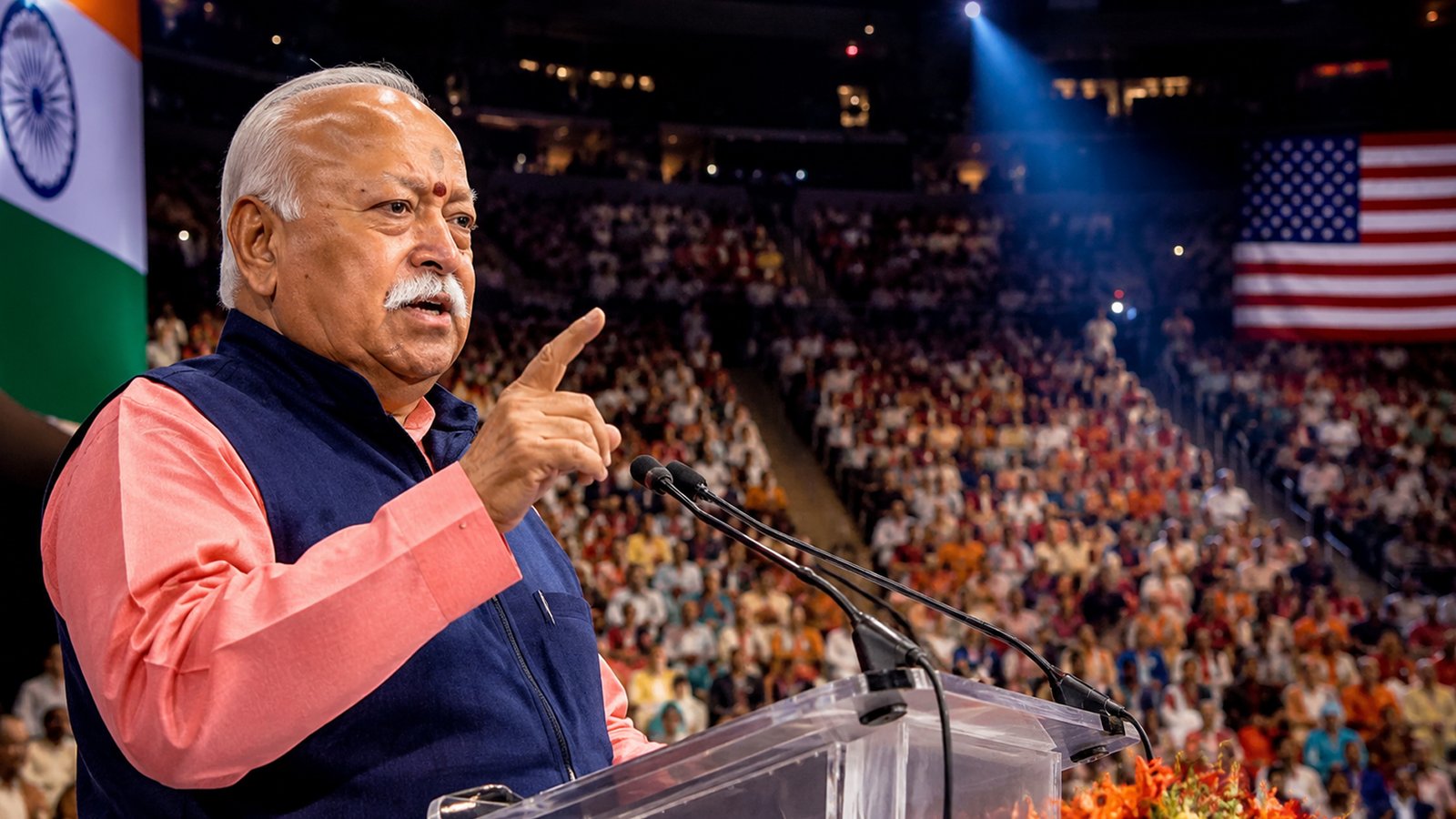
Addressing a large gathering at Madison Square Garden in New York on August 29, Bhagwat said the Indian diaspora has a responsibility towards its “karmabhoomi”, or the country where people live, work and earn. He said Indians in America should be loyal to the United States and contribute to its progress before turning their attention to their country of birth.
The remarks were made during the Universal Oneness Celebration, attended by more than 6,000 members of the Indian-American community and interfaith leaders. The event brought together people from several parts of the US and other countries and focused on unity, diversity and shared human values.
Bhagwat said the Indian diaspora could remain connected with Bharat while fully embracing its responsibilities towards American society. He described India as the “janmabhoomi”, or land of birth, and America as the “karmabhoomi” for those who live and work there.
Unity in diversity is Bharat’s message
A central theme of Bhagwat’s address was India’s idea of unity in diversity.
He said nations are not merely geographical territories but have a larger role and purpose. Referring to Swami Vivekananda’s ideas, Bhagwat said every nation has a message, a mission and a destiny.
He said Bharat’s role is to demonstrate to the world that unity and diversity can exist together. According to him, diversity should not be treated as a source of division but as something that adds richness to a shared sense of belonging.
Bhagwat said people should respect and accept differences while recognising what they have in common. He linked this approach to the broader Indian civilisational idea of seeing the world as one family.
The message was also reflected in the format of the New York event. Cultural performances by Indian-American children featured music and dance representing different parts of India as well as cultures from Africa, Latin America, China, Europe and the Middle East.
Interfaith leaders who attended the programme also spoke about cooperation, mutual respect and helping one another.
Remarks on Hinduism and Muslims
Bhagwat also spoke about religious diversity in India, making a direct reference to Muslims and the place of different faiths within the country.
He said a person who identifies as Hindu but believes that Muslims should have no place in Bharat would not be true to the idea of Hinduism he was presenting.
He argued that Hindu thought accepts different paths and that the Indian tradition has historically allowed communities with different beliefs to coexist.
The remarks came as Bhagwat sought to present Hindutva and Indian civilisation through the themes of inclusiveness, fraternity and shared humanity.
He contrasted two ways of approaching society. One, he said, is the idea of “live and let live”, while another is to allow only those who agree with or obey you to live freely.
Bhagwat argued in favour of the first approach, saying people should not be judged by whether they agree with one another. Instead, he said, the larger responsibility is to recognise that all human beings belong to one another.
His comments placed social harmony and religious coexistence at the centre of his message to the international Indian community.
A high-profile US visit
Bhagwat’s appearance in New York came as part of his wider international outreach during the RSS centenary year.
Before the Madison Square Garden programme, he met members of the Indian diaspora, business leaders and community representatives. He also visited the Bhakti Centre in New York and paid tribute to Srila A.C. Bhaktivedanta Swami Prabhupada, the founder of the International Society for Krishna Consciousness.
The New York event attracted significant attention because of Bhagwat’s position as the head of the RSS, an organisation that has played a major role in India’s social and ideological landscape.
The programme also faced opposition before it was held. New York Mayor Zohran Mamdani had criticised the event and said he could not support what he described as an exclusionary ideology. Civil rights and interfaith groups also raised concerns about the RSS and its record on minority issues.
The event nevertheless went ahead, with Bhagwat using the platform to focus on unity, diversity, social responsibility and the relationship between cultural identity and life abroad.
Bharat’s role in the world
Bhagwat also presented India’s global role in terms of service rather than power.
He said India’s contribution to the world should come from its civilisational values and its ability to show how different communities can live together.
Rather than arguing that India should simply seek greater global influence, he stressed the importance of contributing to humanity. He said people who understand their responsibilities and act in the right direction can help sustain society and the wider world.
Indian diaspora felt this meant carrying forward the values associated with Bharat through their conduct rather than merely speaking about them.